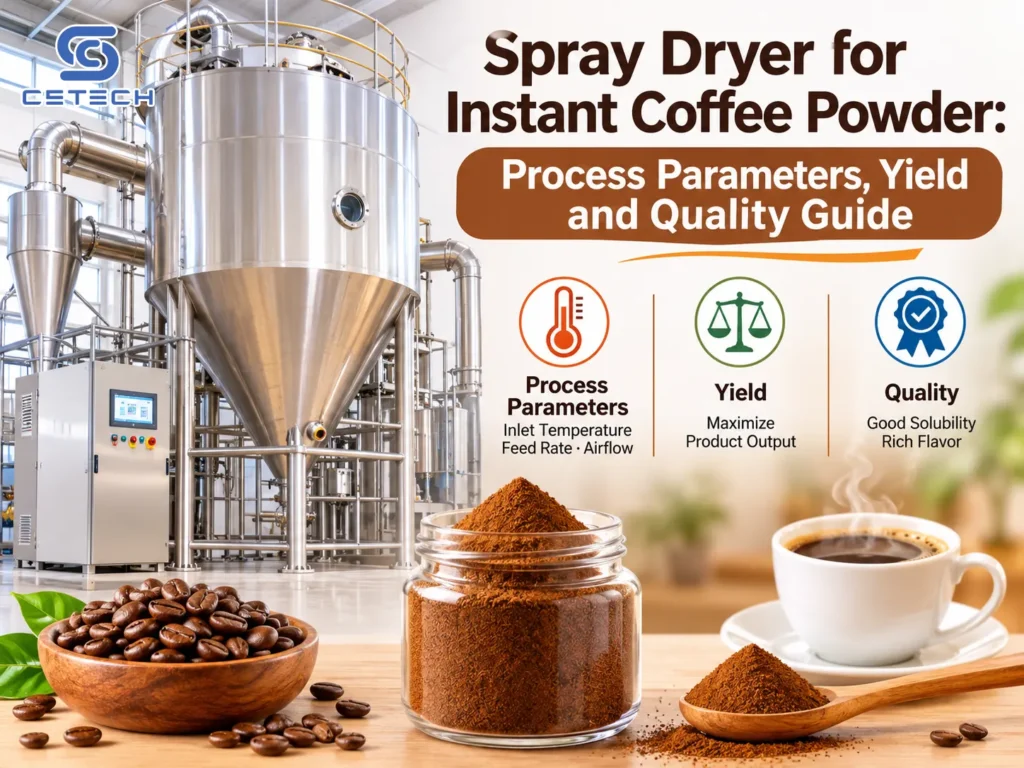
Spray Dryer for Instant Coffee Powder: Process Parameters, Yield and Quality Guide
Instant coffee is a powder engineered to dissolve in seconds while preserving the aroma, body and roast character of the original brew. Behind every cup of soluble coffee sits a spray dryer: the single most energy-intensive and quality-determining piece of equipment in a soluble coffee plant. Choosing, sizing and operating a spray dryer for instant coffee powder correctly separates a powder that rehydrates into a clean, aromatic cup from one that arrives clumped, oxidized or flat.
This guide walks through what a coffee spray dryer actually does inside the chamber, the process parameters that buyers must fix before requesting a quote, how yield and quality are affected by nozzle choice, and what to ask a supplier before committing to an industrial line.
Why Instant Coffee Is Spray-Dried, Not Freeze-Dried
Freeze-drying produces premium aroma retention but at roughly three to five times the operating cost per kilogram. Spray drying evaporates the concentrate in fractions of a second using hot air, turning a 25–45 % solids coffee extract into a free-flowing powder with moisture below 4 %. That combination of throughput and cost is why the majority of commercial instant coffee on the market is spray dried.
The trade-off is that coffee volatiles (acetic acid, furaneol, higher alcohols and coffee oils) are heat-sensitive. A well-designed dryer does not destroy them; it shortens exposure time to less than a second and recovers aroma in a separate condensate stage that can be sprayed back onto the powder.
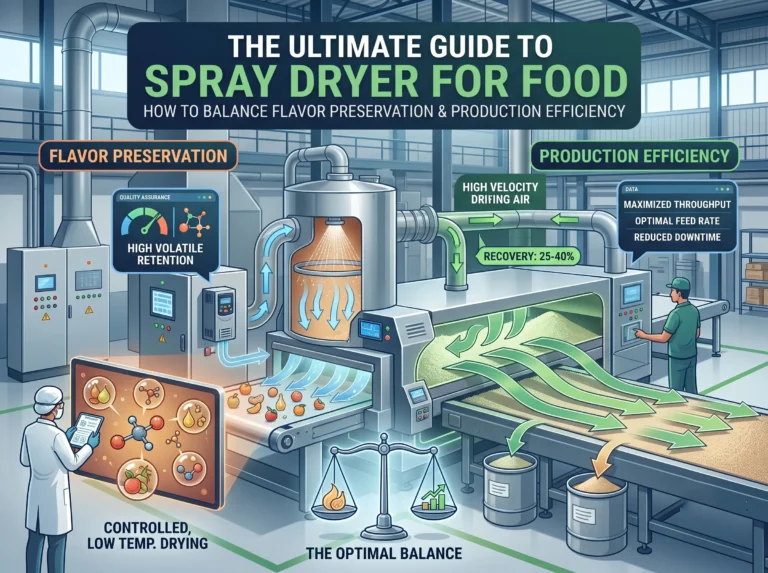
The Inside of a Coffee Spray Dryer
A soluble coffee line, from front to back, looks like this:
1. Extraction and concentration. Roast and ground coffee passes through counter-current extraction; the liquor is evaporated under vacuum to 25–45 % total solids before reaching the dryer.
2. Atomization. The concentrated extract is pumped to a pressure nozzle or a rotary wheel that breaks it into 30–80 µm droplets.
3. Drying. Heated air (180–220 °C inlet) meets the droplets in the drying chamber; surface water evaporates instantly, cooling the particle to around 80–95 °C wet-bulb even at high inlet temperatures.
4. Separation. Powder exits through the cone; fine particles go to a cyclone and bag filter for recovery.
5. Agglomeration (optional). Dry powder is re-wetted with steam or atomized aroma and re-dried on a fluid bed to create the porous, fast-dissolve granules consumers recognize.
The critical engineering fact here is residence time: a coffee particle spends roughly 0.5 to 2 seconds inside the hot air stream, and its own temperature never reaches the inlet air temperature.
Process Parameters Buyers Must Lock Before Quoting
| Parameter | Typical range for coffee | Why it matters |
| Inlet air temperature | 180–220 °C | Higher throughput but aroma loss if uncontrolled |
| Outlet air temperature | 90–110 °C | Drives residual moisture and final yield |
| Feed solids | 25–45 % | Higher solids = less evaporation = better economics |
| Atomizer type | Pressure nozzle / rotary wheel | Wheel handles higher throughputs; nozzle gives finer particles |
| Droplet size | 30–80 µm | Determines dissolution speed and bulk density |
| Residual moisture | 2.5–4.0 % | Below 4 % prevents caking during shelf life |
| Chamber drying air velocity | 0.5–1.5 m/s | Avoids wall deposition (coffee sticks) |
Coffee is prone to wall deposition: wetted powder sticks to chamber walls, scorches and creates burnt-flavor batches. Chamber cone angle, internal air patterns and polished SUS316L walls are not cosmetic details; they directly determine how often the line has to stop for cleaning.
Nozzle vs Rotary Wheel: Which Atomizer?
– Pressure nozzles produce smaller, more uniform particles and suit lines emphasizing fine powder, lower bulk density and instant dissolution. Wear is the recurring cost because coffee solids are abrasive.
– Rotary wheels handle higher throughputs and more abrasive feeds at lower pressure; they produce slightly larger, denser particles and are easier to open and clean between recipes.
For a single-product commodity line, the wheel usually wins on throughput. For a co-manufacturer switching between coffee, tea and herbal extracts, the nozzle’s flexibility is often preferred.
Yield, Bulk Density and the 4 % Moisture Target
Plant economics hinge on three numbers:
– Evaporation rate (kg H₂O/h) — what the dryer is actually rated for, not the “powder output” the sales brochure implies.
– Bulk density (g/L) — typically 200–350 g/L for spray-only coffee and 350–500 g/L after agglomeration; it determines bag size, shipping cost and perceived “fill weight.”
– Moisture — below 4 % is the industry minimum for shelf stability; above 5 % powder cakes in the hopper within weeks.
A common buyer mistake is sizing the dryer by final powder output without subtracting the moisture and soluble-loss numbers. Always ask suppliers for evaporation capacity at your measured inlet/outlet temperatures, not at the theoretical point.
Food-Grade Design Requirements Specific to Coffee
Coffee contact surfaces should meet the following before serious discussion:
– SUS304 for external ducts; SUS316L product contact areas with electropolished finish
– CIP/COP-capable chamber: spray balls accessible without confined-space entry
– Sealed motor drives and IP65+ controls for wet cleaning
– Aroma recovery condenser (optional but expected at plants producing retail SKUs)
– Explosion venting if the plant handles fine organic dust (coffee dust is combustible)
Supplier Audit Checklist for a Coffee Spray Dryer
When comparing manufacturers, score each vendor against this list:
1. Do they provide reference plants producing soluble coffee specifically (not only dairy or chemicals)?
2. Can they run a pilot test with your own extract sample and return measured yield, moisture and bulk density?
3. Is the chamber design polished, with accessible CIP spray balls and documented cleaning cycles?
4. What is the guaranteed evaporation rate at your specified inlet/outlet temperatures?
5. What materials of construction are standard, and what is the upgrade cost to SUS316L?
6. Do they supply the full line (extraction, concentration, dryer, agglomeration) or only the dryer body?
7. What is the quoted delivery time, installation support and spare-parts policy?
8. Can they provide IQ/OQ documentation support for food-grade documentation?
FAQ
Q: What size spray dryer do I need for 500 kg/h of instant coffee powder?
A: At 35 % feed solids and 3.5 % outlet moisture, producing 500 kg/h of powder requires evaporating roughly 630 kg of water per hour. Size the dryer by evaporation rate, not powder output, and specify your measured inlet/outlet temperatures.
Q: Why does my spray-dried coffee taste burnt?
A: Burnt notes usually come from wall deposition, overheated outlet air, or long residence time on a stagnant wall. Check outlet temperature, chamber air velocity and CIP frequency before changing the recipe.
Q: Is freeze-dried coffee always better than spray-dried?
A: Freeze-drying retains more volatile aroma but at significantly higher cost and slower throughput. For most retail and foodservice SKUs, a well-operated spray dryer with aroma recovery produces acceptable quality at a fraction of the cost.
Q: Can one spray dryer switch between coffee, tea and herbal extracts?
A: Yes, with a rotary wheel or quick-change nozzle, CIP cycles and shared conveyors. Plan changeover time between runs; cross-flavor carryover is the main risk.
Contact Us
For a spray dryer sized to your coffee extract solids and target throughput, send us your feed solids %, desired powder output kg/h, and target bulk density. We will return an evaporation-rated proposal with pilot-test options. Reach our engineering team through our contact page or WhatsApp for a same-week response.