Pharmaceutical Spray Dryer GMP Requirements: 9 Design Checks Before You Buy
Pharmaceutical Spray Dryer GMP Requirements: 9 Design Checks Before You Buy
If you have ever watched a validation engineer reject a dryer because the welds were unpolished or the cleaning coverage could not be documented, you know the real cost of ignoring **pharmaceutical spray dryer GMP requirements**. A pharma spray dryer is not GMP-compliant just because it is made from stainless steel. Here is what our engineers check when a pharma buyer asks us to quote.
GMP Is a System, Not a Material Grade
Many buyers assume stainless steel 316L equals GMP compliance. It does not. GMP compliance means the dryer supports cleanability, contamination control, validated operation, controlled air handling, documentation and repeatable batch quality.
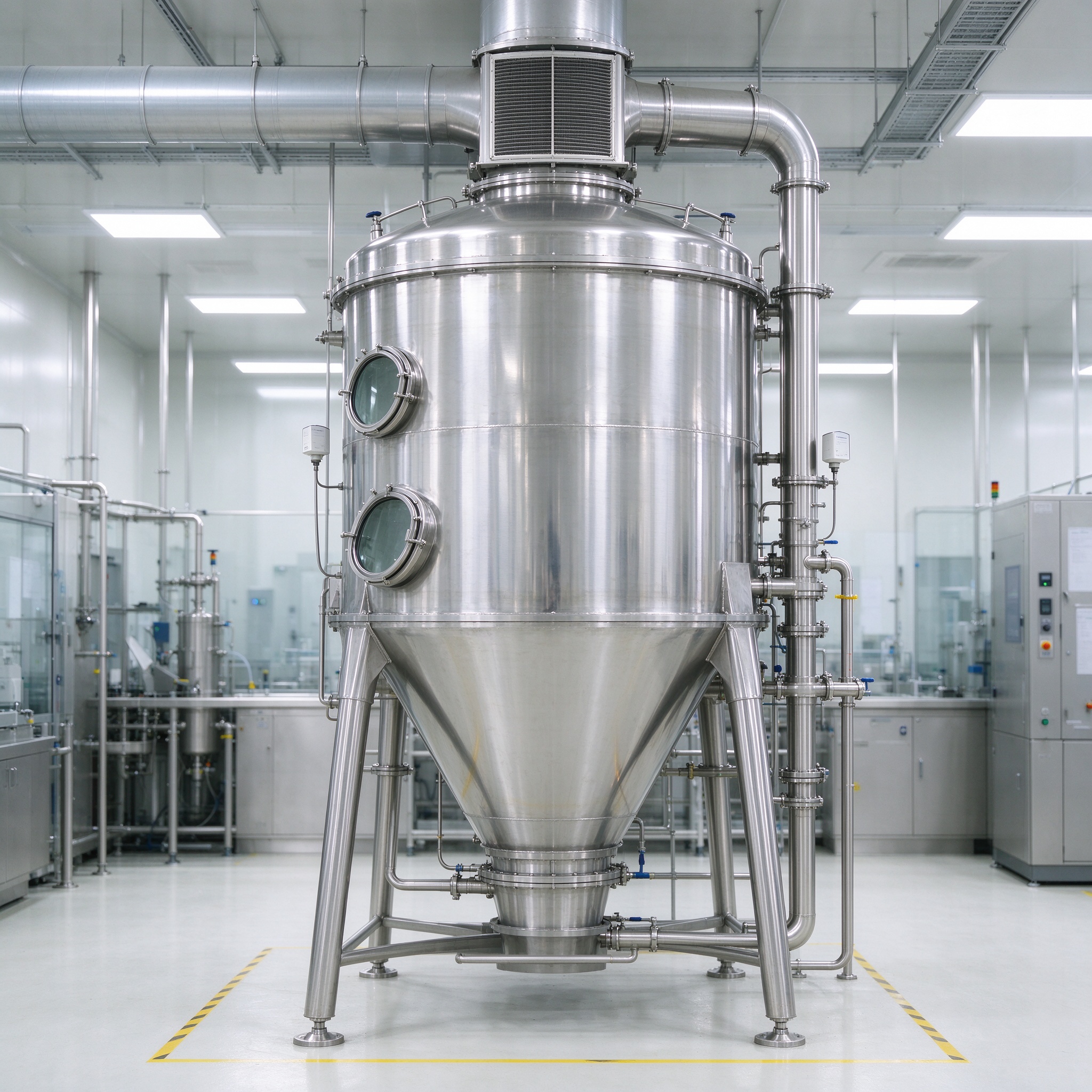
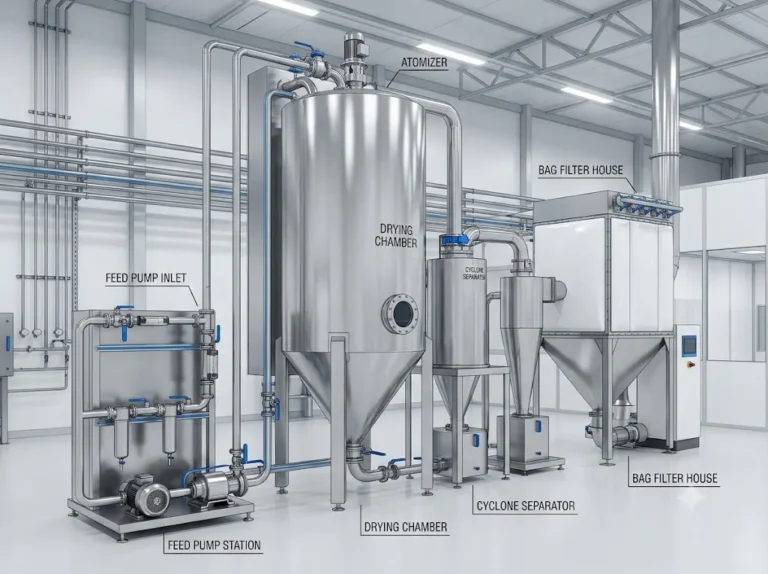
The equipment is evaluated as part of the full manufacturing system. The drying chamber, atomizer, air handling, powder collection, cleaning and controls must work together so that every batch meets its specification and the process can be validated.
That is why the design review must start with the product: API or excipient, potency, heat sensitivity, solvent used, particle size target and cleaning strategy. Our what is a spray dryer explainer covers the process fundamentals behind these pharma design choices.
1. Contact Surface Finish and Materials of Construction
Pharmaceutical contact surfaces must be smooth, non-reactive and easy to clean. 316L stainless steel is the common choice, with surface finish specified to a documented Ra value appropriate for the product contact area.
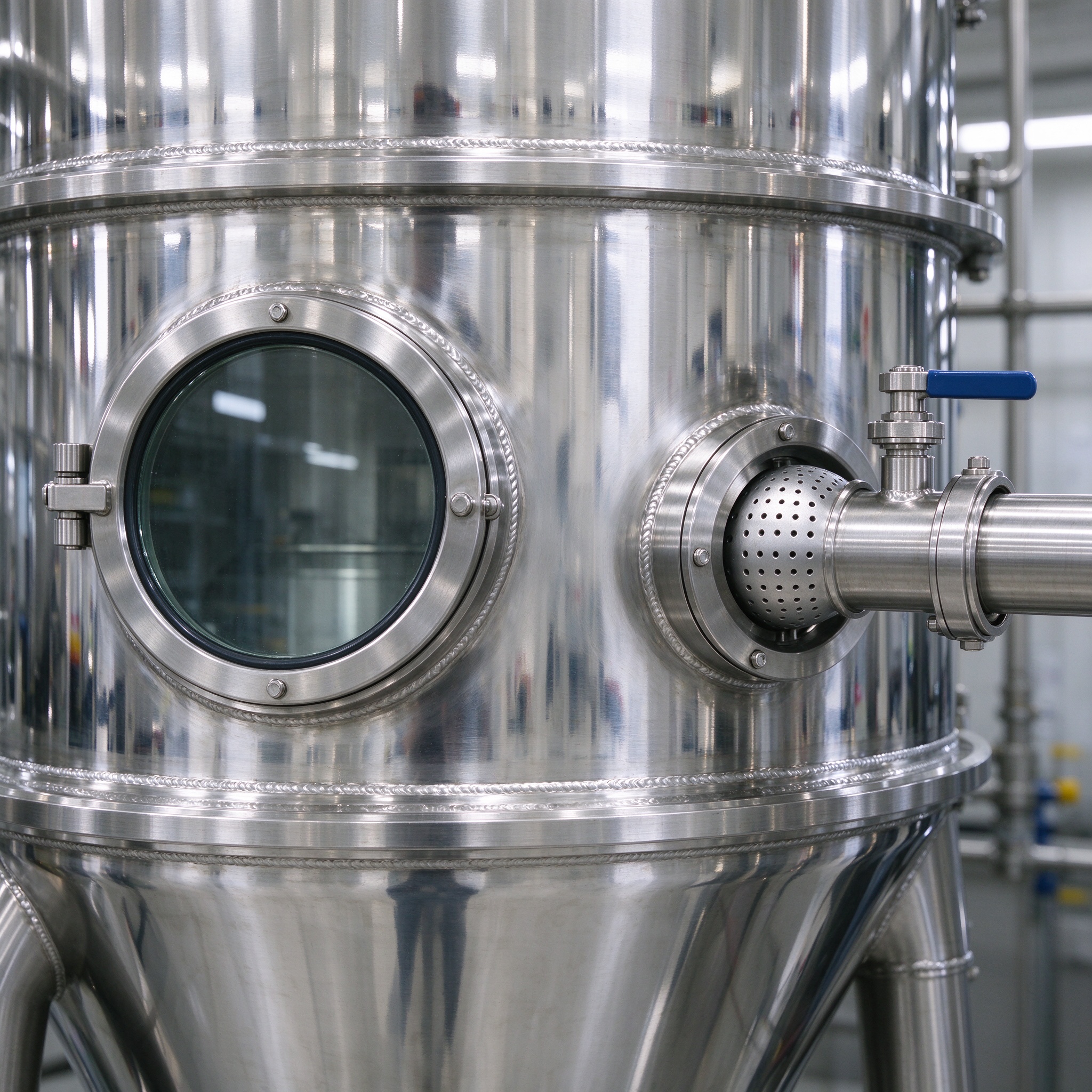
Welds matter as much as the base material. Unpolished welds create micro-crevices that hold product and defeat cleaning validation. In our shop, contact area welds are ground and polished to match the surrounding finish, and the weld specification is part of the documentation package.
Ask for the surface finish specification in writing. If a supplier cannot state the Ra value of the contact surfaces, that is an immediate red flag for a GMP project.
2. Cleanability: CIP Design and Coverage
Clean-in-place is the core of pharma cleanability at production scale. The system must be able to clean all interior surfaces without opening the chamber, and the cleaning must be possible to validate.
That means sanitary rotating spray balls sized for the chamber, piping with no dead legs, and access points that allow verification of cleaning coverage. Closed pre-wash concepts can reduce product residue before opening the system, which also lowers operator exposure for potent compounds.
When we quote a pharma dryer, we provide a CIP coverage drawing and a proposed cleaning validation protocol as part of the engineering package, not as a later extra. Your validation team can review it before the purchase order is signed.
3. Air Handling and Filtration
Process air and atomization gas must be filtered before contacting the product. HEPA filtration on the inlet, plus appropriate exhaust treatment through bag filters and final HEPA, is the standard architecture for GMP spray drying.
Pressure control is product-specific. Slight positive pressure protects the product from ingress in a controlled room environment; negative pressure design is used for potent APIs to contain dust. The choice is a design decision based on your compound, and it must be made during quoting, not after installation.
4. Containment and Operator Safety
Potent pharmaceutical ingredients require containment. The dryer design must control dust exposure during operation, cleaning and changeover, and that containment has to be engineered, not improvised after delivery.
Closed product handling, contained discharge systems and cleaning sequences that reduce residue before opening all contribute to operator safety and to meeting occupational exposure limits. If your compound is highly potent, confirm the containment concept with an industrial hygiene assessment rather than assuming a standard machine is sufficient.
5. Process Control and Data Integrity
GMP production requires repeatable operation and complete records. Process control systems for pharma dryers should be designed for FDA 21 CFR Part 11-compliant data acquisition and audit trails, covering set points, alarms, batch records and cleaning cycles.
That means more than a touchscreen. It means defined user permissions, electronic signatures, secure audit logs and the ability to reproduce a batch record exactly. Confirm the control package meets your local regulatory expectations before purchase; retrofitting data integrity later is expensive.
6. Validation Support: IQ, OQ, PQ
The dryer purchase includes the design and documentation that make validation possible. A GMP buyer should expect installation qualification, operational qualification and performance qualification support from the supplier.
That includes FAT and SAT protocols, cleanability documentation, and support during commissioning. In our experience, the suppliers who provide complete validation documentation during the project are the ones whose machines pass validation without surprise rework. Our spray dryer design guide explains the sizing calculations behind these GMP design choices.
7. CIP/SIP Options for Sterile Processes
Sterile manufacturing requires validated cleaning and, where needed, sterilization. Clean-in-place removes residue; sterilize-in-place uses steam at 121°C or above to achieve sterilization without disassembly.
An aseptic spray drying system needs a pressure-rated design that can handle SIP steam, typically at 1-2 bar, with static spray balls providing full coverage. Powder residue must rinse away completely so that sterilization is not shielding contaminants.
8. Scale-Up: From Lab and Pilot to Production
Pharmaceutical spray drying usually starts small and scales up. A GMP pilot dryer with cleanable construction and documentation support lets you generate data that transfers to production.
Critical quality attributes such as particle size, residual solvent and moisture must remain consistent across scales. Deviation above roughly 10% in a critical attribute is a trigger for revalidation. When we support scale-up, we document the parameters that change with scale so the transfer is planned, not guessed.
9. The Documentation Package
The documentation is part of the equipment. A GMP spray dryer project should deliver material certificates, dimensioned drawings, weld documentation, FAT and SAT protocols, operating procedures and a cleaning validation protocol.
If a supplier treats documentation as an afterthought, the true cost appears later in your validation timeline. We include the documentation package in the quotation scope so there are no surprises at commissioning.
Powder Collection and Handling Under GMP
The drying chamber is only the beginning. Powder collection under GMP must protect the product from contamination and the operator from exposure, while keeping the powder flowing without blockage.
Cyclone and bag filter systems need to be cleanable in place or easily removable, with seals that do not harbor product. Discharge systems should be closed or contained where the product is potent. In our pharma builds, we review the collection train as part of the contamination control concept, because a clean chamber feeding into an unvalidated collector is a process that fails at the end, not the beginning.
Confirm how the supplier handles powder transfer to the next process step. Open transfer points are a common source of GMP observations during audits.
Solvent Handling and Closed-Loop Drying
Many pharmaceutical spray drying processes run from solvent-based feeds, not water. That changes the requirements substantially: explosion protection, solvent recovery and closed-loop gas circulation become core design elements.
A closed system with inert gas (typically nitrogen) circulation allows solvent recovery and reduces the explosion risk compared with an open air system. The design must include solvent recovery, pressure control and the containment measures appropriate to the solvent and the compound.
If your process uses organic solvents, raise this with the supplier before quoting. A dryer quoted for aqueous feeds cannot simply be modified after delivery without significant rework.
Batch Consistency and Process Reproducibility
Pharmaceutical quality depends on every batch matching the specification. That requires the dryer to hold process parameters steady across the batch: feed rate, atomization conditions, inlet and outlet temperature, and gas flow.
In our experience, the control loop quality is what separates a GMP-capable dryer from a production dryer that needs constant operator attention. Automated control that holds outlet temperature within a tight band across feed fluctuations protects residual solvent and moisture specs batch after batch.
Ask how the machine behaves during feed interruptions and cleaning cycles. The recovery logic matters because a GMP batch that drifts out of spec is a rejected batch.
Budget Reality: Where GMP Costs Actually Go
GMP compliance adds cost in specific places: higher material grades and finishes, CIP/SIP hardware, HEPA filtration, containment, control systems with data integrity, and the documentation package. Understanding where the money goes helps you compare quotations fairly.
A low quotation that removes documentation, containment or data integrity is not a saving; it is a deferred cost that appears during validation. We itemize these elements in our quotes so buyers can compare like for like.
When budgeting, include validation support, training and the first cleaning validation run. Those are part of the GMP project, not optional extras.
Supplier Audit Checklist: 5 Documents to Request Before Signing a Purchase Order
Before you commit to a pharmaceutical spray dryer, request these five documents. Each one verifies a specific GMP claim, and each one should be available before you sign:
- 1. Surface finish specification (Ra values) for all product contact surfaces, with material certificates for 316L.
- 2. CIP coverage drawing with spray ball layout and cleaning validation protocol.
- 3. Air handling and filtration diagram showing HEPA stages and pressure control concept.
- 4. FAT/SAT protocol template and list of documentation deliverables included in scope.
- 5. Reference list of pharma spray dryer installations with validation outcomes.
A supplier who cannot produce these documents is not quoting a GMP machine; they are quoting a dryer and leaving the GMP to you. That gap will surface during validation, and you will pay for it twice.
FAQ: Pharmaceutical Spray Dryer GMP Requirements
What does GMP require for a pharmaceutical spray dryer?
GMP requires the dryer to support cleanability, contamination control, validated operation, controlled air handling, complete documentation and repeatable batch quality. Stainless steel alone is not compliance; the design, cleaning system, filtration and records are reviewed together as part of the manufacturing process.
Is 316L stainless steel enough for GMP compliance?
No. Material grade is one input, but compliance also depends on surface finish, weld quality, cleanability, air filtration, process control and validation documentation. Verify the surface finish specification and cleaning protocol in addition to the material grade.
What is the difference between CIP and SIP for spray dryers?
Clean-in-place removes product residue using cleaning solutions through spray coverage inside the closed system. Sterilize-in-place uses steam at 121°C or above to sterilize the interior. Sterile or aseptic processes may need both, with a pressure-rated design that handles SIP conditions.
Do I need HEPA filtration on a pharma spray dryer?
For GMP pharmaceutical production, process and atomization gas should be HEPA filtered before contacting the product, with exhaust treatment appropriate to the compound. The filtration architecture is part of the contamination control design and should be confirmed during quoting.
How do I validate cleaning of a spray dryer chamber?
Cleaning validation starts with documented CIP coverage, then swab or rinse sampling to confirm residue below acceptance limits. The supplier should provide a CIP coverage drawing and cleaning protocol; your QA team then validates the process on your products and compounds.
Contact Us
Need a pharmaceutical spray dryer engineered to GMP requirements, with the documentation included in the quote? Tell us your product, potency and capacity target, and we will prepare the design and validation scope for your review.
Refer to the GEA PHARMA-SD® spray dryer design overview for an independent example of cGMP-compliant pharma drying architecture.