Optimisation de la consommation énergétique des séchoirs industriels: Un guide complet pour réduire les coûts opérationnels
Optimisation de la consommation énergétique des séchoirs industriels
Dans le paysage manufacturier moderne, l'efficacité n'est plus seulement un mot à la mode??C'est la bouée de sauvetage de la rentabilité. Parmi tous les procédés industriels, le séchage s'impose comme l'une des étapes les plus énergivores. Les estimations suggèrent que le séchage consomme entre 10% et 25% de l’énergie industrielle totale utilisée dans les économies développées. Pour les entreprises opérant à grande échelle, Consommation d'énergie des séchoirs industriels représente une part importante des frais généraux, ce qui en fait une cible principale d'optimisation.
À Changshi (jscstech), nous comprenons le fardeau technique et financier qu'un équipement de séchage inefficace impose à vos opérations. Dans ce guide complet, nous analyserons les principaux facteurs de consommation d'énergie dans les séchoirs industriels et vous proposerons des stratégies concrètes pour vous aider à réduire les coûts tout en maintenant une qualité de produit supérieure..
L'acheteur?? Point douloureux: Pourquoi la consommation d'énergie est plus importante que jamais
Pour les responsables des achats et les directeurs d’usines, le défi est double. D'abord, la volatilité des prix du carburant et de l’électricité rend difficile la budgétisation à long terme. Deuxième, la pression mondiale croissante en faveur d’une fabrication durable (Objectifs ESG) signifie que les processus à haute énergie sont sous la surveillance à la fois des régulateurs et des clients.
Un sèche-linge qui était “suffisant” il y a dix ans, cela pourrait coûter à votre entreprise des milliers de dollars en chaleur gaspillée chaque mois. Le but n'est pas seulement de sécher le matériau, mais de le faire avec le minimum d'empreinte thermique possible.
Facteurs influençant la consommation d’énergie des séchoirs industriels
Pour optimiser un système, il faut d'abord comprendre où va l'énergie. La consommation énergétique des séchoirs industriels est influencée par plusieurs variables critiques:
1. Efficacité thermique et perte de chaleur
L'efficacité thermique est le rapport entre l'énergie utilisée pour évaporer l'humidité et l'énergie totale fournie.. Dans les systèmes anciens ou mal conçus, une quantité importante de chaleur est perdue à travers la coque du séchoir (mauvaise isolation) ou rejeté directement dans l'atmosphère.
2. Teneur en humidité (Initiale vs. Final)
La quantité d’eau ou de solvant qui doit être éliminée est le principal facteur de demande d’énergie.. Chaque kilogramme d’eau nécessite une quantité spécifique de chaleur latente pour s’évaporer. Réduire l'humidité initiale par des moyens mécaniques (comme les centrifugeuses ou les filtres-presses) avant qu'il n'atteigne le sèche-linge est souvent le moyen le plus rentable d'économiser de l'énergie.
3. Gestion du flux d'air
Dans de nombreux séchoirs, l'air chauffé est utilisé comme moyen pour évacuer l'humidité. Si le débit d'air est trop élevé, la chaleur est gaspillée car elle traverse le système trop rapidement. S'il est trop bas, la vitesse de séchage ralentit, conduisant à des temps de cycle plus longs et à une dégradation potentielle du produit.
4. Isolation et intégrité des joints
Dans des équipements comme le Sécheur à cylindre rotatif, il est crucial de maintenir une étanchéité parfaite aux extrémités d'alimentation et de déchargement.. Toute fuite d'air oblige les brûleurs à travailler plus fort pour maintenir la température interne.
Stratégies pour réduire la consommation d’énergie des séchoirs industriels
L'optimisation de votre processus de séchage implique une combinaison de sélection intelligente d'équipement et de réglage précis des opérations.. Voici les stratégies que nous recommandons:
Mise en œuvre de systèmes de récupération de chaleur
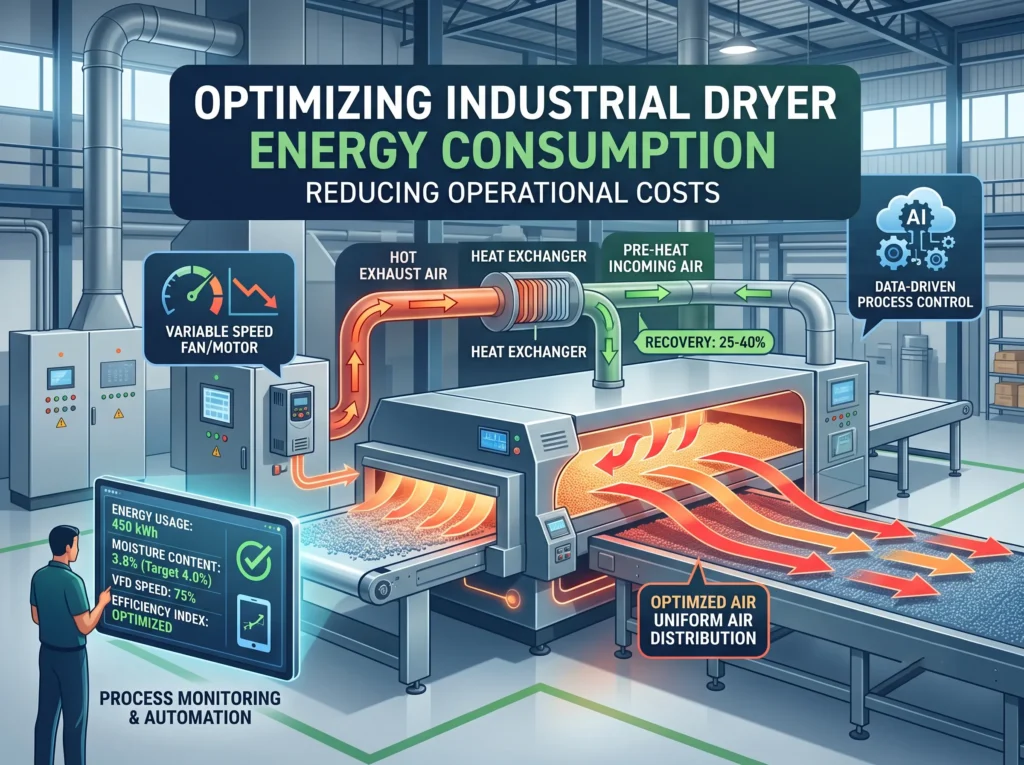
L’un des moyens les plus efficaces de réduire considérablement vos factures d’énergie consiste à capter la chaleur perdue de l’air évacué et à l’utiliser pour préchauffer l’air entrant.. Ce “en boucle fermée” la réflexion peut améliorer l’efficacité thermique globale d’autant 15-30%.
Transition vers des équipements à haute efficacité
Choisir le bon type de séchoir pour votre matériau peut changer radicalement votre profil énergétique. Par exemple:
- Technologie à lit fluidisé: Notre Sécheur fluidisé vertical série FG offre des taux de transfert de chaleur exceptionnels car le matériau est en suspension dans un flux d'air chaud, assurant un contact uniforme et des temps de séchage plus rapides.
- Lit fluidisé vibrant: Pour les matériaux fragiles, le Machine de séchage à lit fluidisé vibrant utilise des vibrations mécaniques pour faciliter la fluidisation, permettant des vitesses d'air plus faibles et une consommation d'énergie réduite pour les ventilateurs.
Systèmes de contrôle intelligents (Industrie 4.0)
Les séchoirs modernes devraient être équipés de capteurs qui surveillent les niveaux d'humidité en temps réel. Au lieu de faire fonctionner le sèche-linge à une température maximale constante, des commandes intelligentes peuvent moduler la source de chaleur en fonction des besoins réels de séchage du lot, empêcher “séchage excessif,” ce qui est à la fois un gaspillage d'énergie et un risque pour la qualité du produit.
Isolation avancée de la coque
La mise à niveau de l'isolation de votre tambour ou de votre chambre de sécheuse est une solution facile. Les fibres céramiques haute densité ou les revêtements spécialisés peuvent conserver la chaleur là où elle doit être??à l'intérieur de la machine.
Comparaison des types de sèche-linge: Quel est le plus économe en énergie?
Tous les sèche-linge ne sont pas égaux. Selon votre matériel??c'est de la poudre, granulés, ou des boues??Les besoins énergétiques varient.
Sécheurs à tambour rotatif
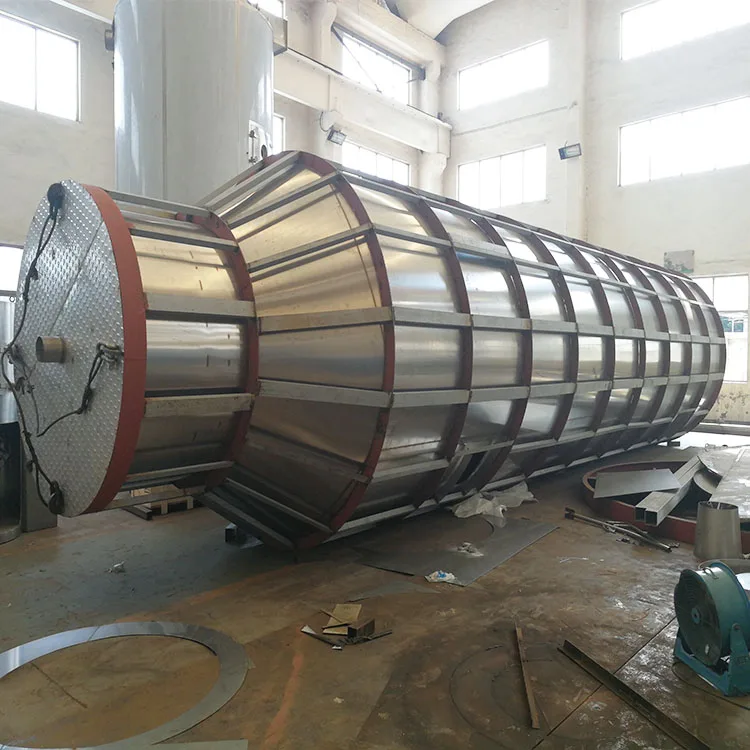
Le Sécheur à cylindre rotatif est le cheval de bataille des industries minières et chimiques. Son efficacité énergétique vient de l'intérieur “vols de levage” qui projettent le matériau à travers le flux d'air chaud, maximiser la surface de contact.
Sécheurs Flash à rotation
Pour les matériaux pâteux, le Sèche-linge Spin Flash est souvent le meilleur choix. Il combine une agitation mécanique à grande vitesse avec de l'air chaud, permettant un séchage instantané. Cette vitesse réduit le temps total pendant lequel la machine doit être allumée.
Séchoirs à palettes creuses
Si vous travaillez avec des boues ou des matières visqueuses, le Séchoir à lame creuse KJG est très efficace car il utilise la conduction (chauffage indirect). Le fluide caloporteur circule à l’intérieur des arbres creux et des pales, ce qui signifie que très peu d'air est nécessaire, ce qui minimise les pertes de chaleur par les gaz d'échappement.
Pourquoi Changshi (jscstech) est votre partenaire en efficacité énergétique
Nous ne vendons pas seulement des machines; nous fournissons des solutions techniques. À Changshi, notre approche de Consommation d'énergie des séchoirs industriels est ancré dans l’innovation et les retours clients.
1. Conception personnalisée: Nous analysons les propriétés spécifiques de vos matériaux (chaleur spécifique, affinité avec l'humidité) pour concevoir un sèche-linge parfaitement adapté à vos besoins, éviter le gaspillage d'énergie de “taille unique” équipement.
2. Fabrication de qualité: Nos machines sont construites avec des matériaux de première qualité et des joints de haute précision pour garantir une rétention thermique maximale.
3. Assistance complète: De la première consultation à la maintenance après-vente, notre équipe technique garantit que votre équipement fonctionne avec une efficacité maximale tout au long de son cycle de vie.
4. Technologie d'économie d'énergie: Nous intégrons les dernières technologies de récupération de chaleur et d'automatisation pour aider nos clients à atteindre leurs objectifs de développement durable et à réduire les OPEX..
Conclusion
La consommation énergétique des séchoirs industriels est un défi complexe, mais cela représente également une énorme opportunité de réaliser des économies. En misant sur l’efficacité thermique, gestion de l'humidité, et choisir la bonne technologie??comme nos séchoirs à lit fluidisé ou rotatifs??les fabricants peuvent améliorer considérablement leurs résultats financiers.
Si vous êtes prêt à auditer votre processus de séchage actuel ou si vous recherchez un remplacement à haute efficacité, Changshi est là pour vous aider. Notre engagement envers des produits de haute qualité et un service après-vente parfait garantit que votre investissement sera rentable pour les années à venir..
Foire aux questions (FAQ)
1. Comment calculer l'efficacité énergétique de mon séchoir industriel?
Vous pouvez estimer l'efficacité en divisant l'énergie nécessaire pour évaporer l'humidité (Chaleur latente de vaporisation ? Masse d'eau retirée) par l'apport énergétique total (Carburant/électricité utilisé). Un système efficace typique devrait être au-dessus 50-60%, bien que cela varie selon le type de sèche-linge.
2. La réduction de la température de séchage permet-elle d'économiser de l'énergie?
Pas nécessairement. Alors qu'une température plus basse consomme moins de chaleur par heure, cela augmente souvent considérablement le temps de séchage, ce qui peut entraîner une consommation totale d’énergie plus élevée et un débit inférieur. La clé est de trouver le “point idéal” température pour votre matériau spécifique.
3. Quel est le séchoir pour poudres le plus économe en énergie?
Pour de nombreuses poudres, le Sécheur fluidisé vertical série FG est très efficace en raison de ses excellentes caractéristiques de transfert de chaleur et de masse. Cependant, si la poudre est sensible à la chaleur, un séchoir sous vide pourrait être globalement plus efficace.
4. Combien puis-je économiser en installant un système de récupération de chaleur?
En fonction de la température et du volume des gaz d'échappement, la plupart des installations industrielles réalisent des économies d'énergie entre 15% et 30%. Dans les opérations à grande capacité, le retour sur investissement d'un système de récupération de chaleur peut souvent être atteint en 12 à 24 mois.
5. Changshi peut-il aider à moderniser les vieux séchoirs pour une meilleure efficacité?
Oui, nous fournissons des conseils et des composants pour la mise à niveau des systèmes existants, y compris des joints améliorés, brûleurs à haut rendement, et modules de contrôle avancés. Contactez-nous aujourd'hui pour discuter de votre configuration spécifique.