Double Conical Mixer Working Principle: Industrial Blending & Design Guide
5 Vérifications éprouvées du principe de fonctionnement du mélangeur double conique
A powder can look uniform inside a vessel and still fail at the packaging line if the mixer, décharge, or transfer route is poorly matched. The double conical mixer working principle uses gentle tumbling as the vessel rotates, allowing powders to exchange position without an aggressive high-shear rotor. We use material testing to connect the mixer choice to the recipe, méthode de nettoyage, and downstream handling.

How does the double conical mixer working principle create a uniform blend?
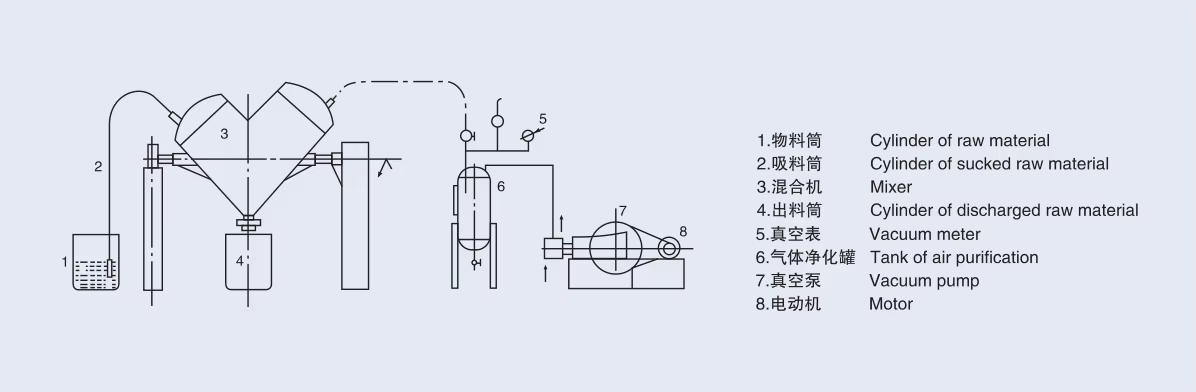
The double-cone vessel rotates around its axis and repeatedly lifts, divides, and recombines the powder bed. This tumbling action promotes convective movement while limiting the shear that could damage fragile granules or create excessive fines.
The result depends on fill ratio, rotation speed, distribution granulométrique, densité apparente, humidité, and the location of any liquid or minor ingredient addition. JSCSTECH evaluates these variables before recommending a vessel volume or cycle-time range.
Which powder properties should be tested before choosing the mixer?
Measure particle size, densité, fluidité, humidité, cohesion, electrostatic behavior, and the ratio of major to minor ingredients. Large density differences can cause segregation, while cohesive fines may remain in corners or attach to larger particles.
For food additives, pharmaceutical powders, produits chimiques, et granules, the required cleaning method is equally important. Define contact material, surface finish, accès pour inspection, and residual hold-up limits before approving the design.
How should a buyer determine mixing time and fill level?
Start with a timed sampling plan covering the early, milieu, and late stages of the cycle. Test the critical ingredient at defined locations and stop when the results meet the agreed uniformity range rather than copying a cycle time from another material.
A vessel that is overfilled may not tumble effectively, while an underfilled vessel can increase dust and reduce production efficiency. Our material precision testing helps connect batch size, fill level, vitesse, échantillonnage, and the expected product release criteria.
What prevents segregation after a double-cone mixer discharges?
Segregation can occur when the powder falls from a high point, travels too fast, vibrates, or enters a bin with an unsuitable geometry. The mixer may have achieved uniformity, but the packaging sample can still drift if the transfer route separates particles by size or density.
Request a complete material-flow drawing that includes the outlet, valve, conveying line, storage bin, and filling point. A full life-cycle review also includes labor, temps de nettoyage, consommation d'énergie, calendrier de livraison, and 24-hour after-sale support.
Double Conical Mixer Working Principle: Selection Table
| Question | What to review | Preuve d'approvisionnement |
|---|---|---|
| How does it mix? | Tumbling, lifting, dividing, and recombining | Process description and test video/report |
| Will it protect granules? | Shear level, speed range, and discharge height | Material test and operating window |
| Will it clean properly? | Surface, access, rétention résiduelle | Cleaning and inspection drawing |
| Will blend quality survive transfer? | Drop height, conveying, bin, and filling | Complete material-flow layout |
Liste de contrôle d'audit des fournisseurs: 5 Documents à demander avant de signer un bon de commande
- Material characterization report for the actual recipe.
- Mixing uniformity test protocol with sample locations and limits.
- Fill-level, speed-range, and cycle-time calculation.
- Nettoyage, inspection, contact-material, et spécification de rétention résiduelle.
- Échantillon de rapport d'inspection avant expédition et calendrier d'assistance à la mise en service.
Foire aux questions
Q: What powders are suitable for a double conical mixer? It is commonly considered for free-flowing powders and granules needing gentle tumbling with limited shear. JSCSTECH checks particle properties and cleaning requirements before recommending the configuration.
Q: How long should a double conical mixer blend a product? There is no universal time. Use a material test and timed sampling sequence to identify the point at which the blend meets the agreed uniformity range.
Q: How can a buyer reduce segregation after mixing? Control discharge height, transfer velocity, bin geometry, and vibration. Validate the entire route, not only the mixer vessel.
Explorez notre équipement de mélange de poudre personnalisé et le powder mixing uniformity test guide before finalizing your QA protocol. Partagez votre recette, taille du lot, target variation, and cleaning requirements so our engineers can recommend a suitable vessel and validation sequence.
For a technical reference on powder processing research, consulter le Revue Technologie des Poudres. Contactez Leta via WhatsApp with your recipe, taille du lot, and uniformity target.