Vacuum Dryer Working Principle: Engineering & Solvent Recovery Guide
Vacuum Dryer Working Principle
When processing thermolabile pharmaceutical actives, easily oxidized vitamins, or volatile chemical intermediates, atmospheric drying risks thermal degradation and solvent loss. Các vacuum dryer working principle relies on negative pressure to depress liquid boiling points, accelerating moisture evaporation at gentle temperatures. Drawing upon 20 years of equipment manufacturing at Jiangsu Changshi Drying Technology Co., Công ty TNHH (Công ty CPSTECH), our vacuum drying systems protect sensitive product molecular structures.
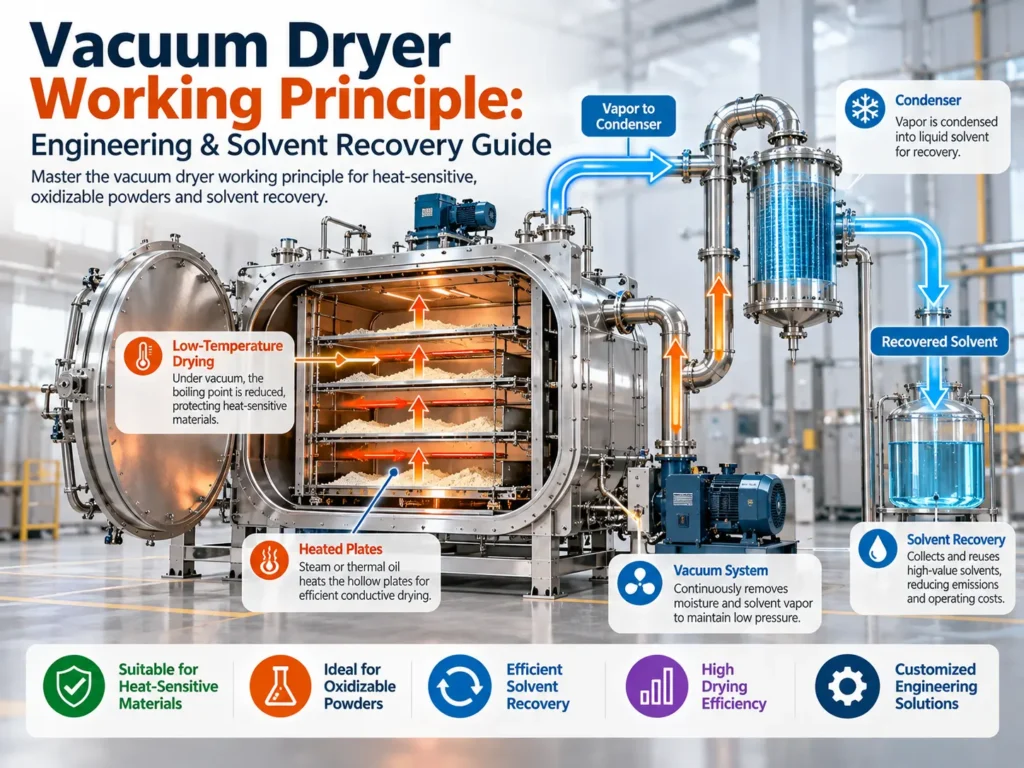
How does the vacuum dryer working principle depress boiling temperatures?
According to thermodynamic vapor-liquid equilibrium, decreasing chamber pressure dramatically lowers the saturation temperature of moisture. Under a deep vacuum of -0.095 ĐẾN -0.098 MPa, water boils and evaporates vigorously at temperatures as low as 35 ĐẾN 45 degrees Celsius. This allows rapid dehydration without subjecting active pharmaceutical ingredients to damaging heat.
The absence of atmospheric oxygen inside the hermetically sealed vessel completely eliminates product oxidation, discoloration, and explosive dust hazards. JSCSTECH fabricates vacuum chambers with thick reinforced shells and heavy door hinge clamps that maintain airtight integrity. This ensures consistent vacuum retention and repeatable batch drying cycles.
Which heat transfer mechanisms drive rapid vacuum evaporation?
Because low-density air under vacuum cannot support convective heat transfer, thermal energy must be delivered by conduction and radiant heating. Thermal fluid, nước nóng, or pressurized steam circulates through hollow shelf plates upon which material trays rest. Conductive contact between the shelf surface and the tray base dictates overall heat transfer rates.
Của chúng tôi 10,000 square meter facility manufactures shelf plates with precision surface flatness tolerances below 1.0 millimeter per meter. This high surface contact maximizes conductive thermal flux across every square centimeter of tray area. Uniform shelf temperature distribution prevents localized hot spots and guarantees homogeneous moisture levels across all tiers.
How does closed-loop solvent recovery protect the environment and plant ROI?
Many pharmaceutical extractions and specialty chemical syntheses utilize expensive or hazardous solvents such as ethanol, acetone, or hexane. During vacuum drying, evaporated vapors are drawn directly into high-efficiency shell-and-tube or plate-type condensers. Sub-cooled glycol circulation condenses vapor into liquid receivers with recovery efficiencies exceeding 95%.
This closed-loop recovery eliminates volatile organic compound (VOC) emissions and substantially reduces fresh solvent procurement costs. JSCSTECH supplies explosion-proof solvent recovery skids fully integrated with vacuum instrumentation and overpressure relief systems. This turnkey architecture simplifies environmental compliance and accelerates plant capital payback.
What vacuum chamber sanitary designs prevent cross-contamination and simplify cleaning?
Batch cross-contamination in vacuum ovens frequently occurs when residual powders adhere to interior shelf crevices or welded corners. Our hygienic vacuum dryers feature internal mirror-polishing to Ra 0.4 microns with fully radiused corner transitions. The vessel floor is slightly sloped toward a central sanitary drain to facilitate complete washdown effluent evacuation.
Integrated clean-in-place (CIP) spray manifolds allow automated solvent or hot water washing of all shelf tiers between product campaigns. Inflatable silicone door gaskets provide reliable pressure-assisted sealing without shedding particulate matter into the drying zone. These pharmaceutical-grade engineering features streamline FDA validation and reduce room turnover downtime.
Vacuum Dryer Working Principle: Engineering Specification Matrix
| Thông số vận hành | JSCSTECH High-Vacuum System | Standard Commercial Oven |
|---|---|---|
| Ultimate Vacuum Level | -0.098 MPa (down to 1 mbar absolute) | -0.080 MPa (higher residual air) |
| Operating Drying Temp | 35°C to 80°C (heat-sensitive safe) | 80°C to 150°C (thermal degradation risk) |
| Shelf Flatness Tolerance | ≤ 1.0 mm/m (maximum thermal contact) | 2.0 – 4.0 mm/m (air gap heat loss) |
| Solvent Recovery Rate | ≥ 95% closed-loop condensation | Vented to atmosphere or low recovery |
| Sanitary Finish | Internal Ra ≤ 0.4 μm mirror polish | Standard mill finish or Ra 0.8 mm |
Danh sách kiểm tra kiểm tra nhà cung cấp: 5 Các tài liệu cần yêu cầu trước khi ký đơn đặt hàng
- Pressure Vessel Calculation Sheet and ASME / GB150 Certificate for jacketed vacuum chambers.
- Helium Mass Spectrometer Leak Test Report verifying chamber airtight integrity (leak rate <1x10⁻⁶ Pa·m³/s).
- Shelf Temperature Mapping and Thermal Uniformity Audit (verified ±1.5°C across all tiers).
- Condenser Heat Transfer Sizing Sheet and Solvent Recovery Mass Balance Calculation.
- Kiểm tra nghiệm thu tại nhà máy (MẬP) Protocol including IQ/OQ validation document templates.
Câu hỏi thường gặp
Q: Why does vacuum drying prevent thermal degradation in heat-sensitive compounds? Lowering system pressure depresses the boiling point of water and volatile organic solvents down to 35 ĐẾN 50 degrees Celsius. JSCSTECH designs vacuum chambers to operate reliably under deep vacuum down to -0.098 MPa. Khi đánh giá nhà cung cấp, verify jacket heating uniformity across all internal trays.
Q: How is closed-loop organic solvent recovery achieved during vacuum drying? Vaporized solvent vapors pass through multi-stage shell-and-tube condensers chilled with glycol coolant at -5 ĐẾN 5 degrees Celsius. Our engineering integrates condensate receivers that capture over 95% of flammable or toxic solvents. Request condenser thermal sizing and vacuum pump vapor load calculations.
Q: What vacuum pump technology is best for handling corrosive or solvent-laden vapors? Liquid ring vacuum pumps utilizing compatible seal liquids or oil-free dry claw pumps eliminate lubricant contamination and corrosion risks. We pair pumps with pre-condensers and exhaust mist eliminators for safe environmental containment. Request pump material compatibility charts before finalizing procurement.
Khám phá phạm vi đầy đủ của chúng tôi thiết bị sấy công nghiệp and compare this technology against our rotary drum scraper dryer working principle guide. You can also study our industrial dryer energy consumption optimization guide.
To examine thermodynamic vapor pressure equations in detail, xem lại ScienceDirect vacuum drying thermodynamics analysis. Liên hệ với Leta qua WhatsApp: +86 137 7529 9712 to submit your solvent and thermal sensitivity parameters for a customized vacuum dryer engineering proposal.