Spray Drying API: Critical Engineering Factors for Pharmaceutical Active Ingredients
In pharmaceutical drug manufacturing, traditional crystallization and milling frequently result in broad particle size distributions, unpredictable polymorphic shifts, and poor batch dissolution. Developing an engineered spray drying API process transforms liquid solutions or suspensions into tightly controlled dry powder in a single continuous operation.
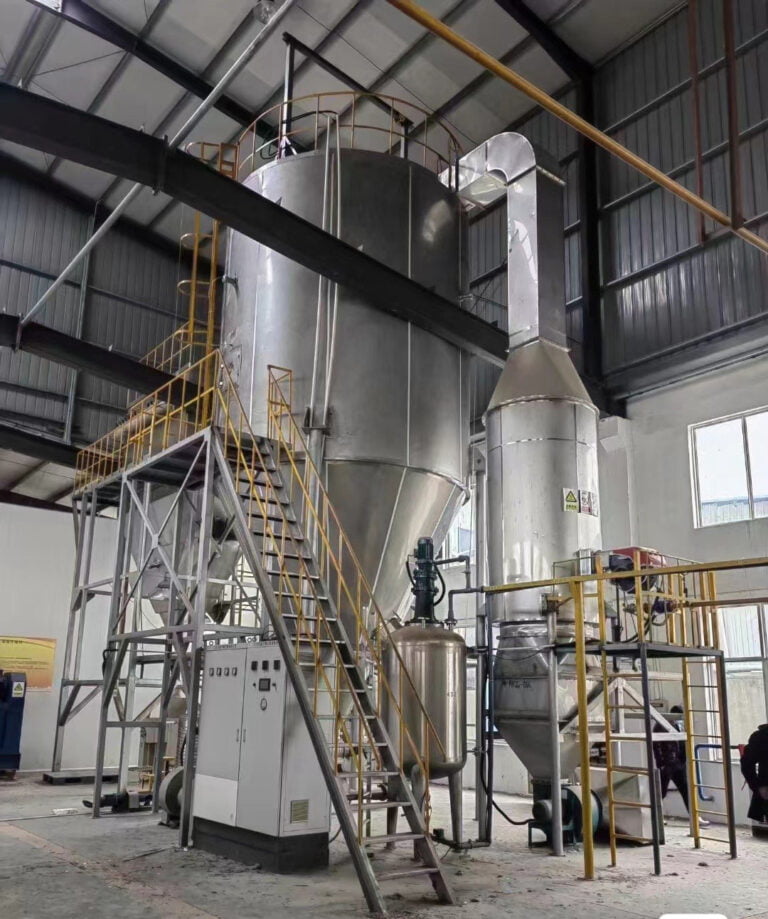
Dựa vào 20 years of non-standard machinery manufacturing at Jiangsu Changshi Drying Technology Co., Công ty TNHH (Công ty CPSTECH), we engineer cGMP-compliant spray drying systems for pharmaceutical active ingredients. Operating across our 10,000 cơ sở sản xuất m2, our team designs custom closed-loop solvent drying loops that protect thermolabile molecules.
Whether your formulation requires amorphous solid dispersion (ASD), controlled microencapsulation, or precise pulmonary dry powder inhalation, understanding the thermal dynamics of spray drying API is critical. Let us examine the evaporative cooling kinetics, inert solvent handling, and cleanroom engineering requirements.

Mục lục
Why Conventional Milling and Freeze Drying Fall Short for Delicate Active Ingredients
Standard pharmaceutical manufacturing often relies on batch crystallization followed by tray drying and mechanical pin milling. Tuy nhiên, jet milling induces localized thermal friction and lattice defects that can trigger unwanted phase transformations in poorly soluble molecules.
Freeze drying offers low thermal stress but requires multi-day cycle times and creates irregular, jagged cake structures requiring secondary grinding. High capital expense and high energy consumption per kilogram make lyophilization uneconomical for mid-to-high volume active ingredients.
Ngược lại, adopting spray drying API delivers spherical, free-flowing particles with uniform bulk density in milliseconds. By eliminating post-drying mechanical crushing, drug developers preserve pure crystalline or amorphous polymorphic states with consistent batch reproducibility.
Thermal Degradation and Solvent Volatility Management in Spray Drying API Operations
Many active pharmaceutical compounds dissolve exclusively in volatile organic solvents like methanol, axeton, ethanol, or dichloromethane. Processing these volatile media demands a closed-cycle inert gas loop operating under high-purity nitrogen blanketing.
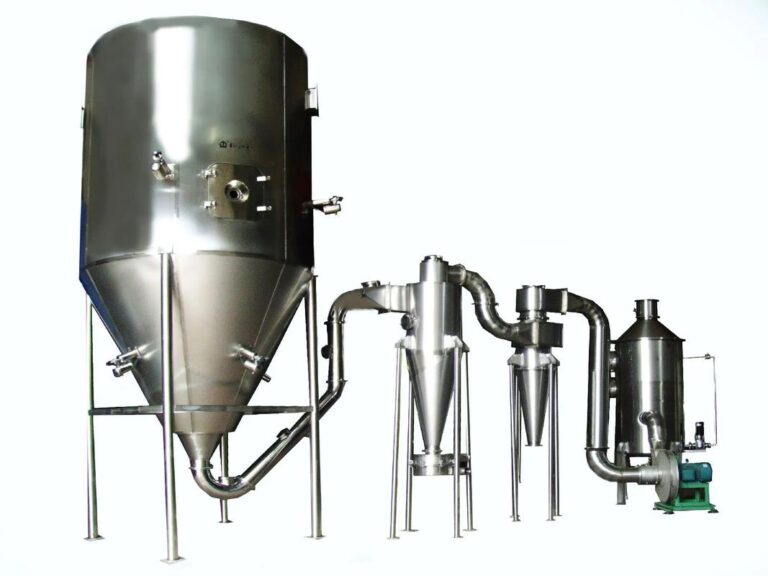
In our manufacturing practice at JSCSTECH, our closed-loop systems maintain chamber oxygen concentrations strictly below 0.5% with triple-redundant paramagnetic sensors. Dual-stage refrigerated condensers recover over 99.5% of evaporated solvent vapors, preventing VOC emissions and safeguarding plant personnel.
Despite drying gas inlet temperatures between 120°C and 180°C, the actual droplet temperature during spray drying API remains below 45°C throughout the constant-rate drying phase. Rapid flash evaporation absorbs latent heat instantly, insulating delicate bio-active peptides and sensitive small molecules from thermal degradation.

Particle Engineering and Bioavailability Optimization in Spray Drying API Formulations
Optimizing oral bioavailability for BCS Class II and Class IV compounds requires co-dissolving the active substance with hydrophilic polymers such as HPMC-AS or PVP-VA. Rapid solvent evaporation freezes the polymer matrix, trapping the drug substance in a stable amorphous solid dispersion.
Controlling the droplet Peclet number during atomization allows process engineers to tune hollow versus solid microsphere morphology. For pulmonary dry powder inhalers (DPI), our precision two-fluid and three-fluid nozzles generate narrow aerodynamic diameters between 1.5 μm and 5.0 mm.
When optimizing a spray drying API campaign, our engineering team balances feed viscosity, nồng độ chất rắn, and atomization gas pressure. Fine-tuning these parameters delivers tap densities between 0.25 Và 0.55 g/cm³ that feed smoothly into automated capsule filling lines.
Aseptic Design and cGMP Compliance Architecture for Spray Drying API Equipment
Pharmaceutical spray drying installations must integrate seamlessly within ISO 7 or ISO 8 cleanroom environments. All product-contact surfaces in our custom towers use certified SUS316L stainless steel, electro-polished to an ultra-smooth finish of Ra ≤ 0.4 μm to prevent cross-contamination.
Process piping features orbital-welded sanitary Tri-Clamp connections with zero dead-leg geometry conforming to ASME BPE standards. Automated clean-in-place (CIP) spray balls operating at 3.0 bar ensure 100% riboflavin-verified surface washdown between active ingredient batches.
Inlet drying gas passes through a three-stage filtration sequence culminating in terminal H14 HEPA filters providing 99.995% particulate retention at 0.3 mm. Strict differential pressure management ensures that sterile spray drying API processes remain isolated from external industrial utility areas.
Technical Comparison of Spray Drying API System Configurations
Selecting the proper drying circuit depends on carrier solvent flammability, required annual capacity, and target particle sterility levels. The table below compares key engineering parameters across primary industrial setups.
| System Parameter | Inert Closed-Cycle Loop | Aqueous Open-Cycle Loop | Sterile Aseptic Isolator Loop |
|---|---|---|---|
| Solvent Compatibility | Methanol, Acetone, DCM, Ethanol | Deionized Water, Buffers | Sterile Water, Volatile Solvents |
| Inert Carrier Gas | High-purity N2 (O2 < 0.5%) | Filtered Ambient Air | Sterile Micro-Filtered Nitrogen |
| Solvent Recovery Efficiency | ≥ 99.5% via dual condenser | Direct exhaust with scrubber | ≥ 99.8% closed cryogenic loop |
| Product Contact Steel | SUS316L (Ra ≤ 0.4 μtôi) | SUS304 / SUS316L (Ra ≤ 0.6 μtôi) | SUS316L Mirror Polished + Passivated |
| Sterilization Method | Automated CIP Washdown | Manual / Automated CIP | Full Steam-In-Place (SIP) at 121°C |
For detailed sizing equations regarding gas volume and heat balance, consult our hướng dẫn tính toán thiết kế máy sấy phun. Proper engineering calculations ensure correct heating coil sizing and cyclone collection efficiency.
Danh sách kiểm tra kiểm tra nhà cung cấp: 5 Crucial Documents to Require for Pharmaceutical Spray Dryers
Before signing a purchase agreement for active ingredient drying machinery, pharmaceutical engineering managers must verify vendor fabrication quality and cGMP traceability. We advise requesting the following 5 critical compliance documents:
- Material Test Certificates (MTC 3.1): Complete chemical and physical mill sheets for all SUS316L contact steel and PTFE/EPDM sanitary gaskets according to EN 10204 tiêu chuẩn.
- Closed-Loop ATEX / Explosion Venting Dossier: Certified explosion relief design, rupture disc pressure ratings, and inert nitrogen loop seal leakage test verification.
- Surface Profilometer Ra Mapping Report: Multi-point surface roughness inspection records verifying Ra ≤ 0.4 μm across internal shell welds and cyclone walls.
- Riboflavin CIP Coverage Qualification Protocol: Documented ultraviolet fluorescence riboflavin washdown tests proving zero internal cleaning shadows.
- Turnkey IQ/OQ/PQ Validation Templates: Comprehensive Installation, Operational, and Performance Qualification documentation with sensor calibration certificates.
For additional cleanroom hardware considerations, explore our in-depth analysis on yêu cầu GMP máy sấy phun dược phẩm. Also check our field tips on bảo trì vòi phun máy sấy phun to maintain tight droplet atomization.
Frequently Asked Questions About Spray Drying API Systems
Q: How does spray drying API prevent thermal degradation of heat-sensitive compounds?
Flash evaporation rapidly absorbs heat from drying gas, keeping droplet temperatures between 35°C and 45°C despite high inlet temperatures. Tại CTCPSTECH, our short residence chambers expose dry powder to outlet temperatures for merely 1.5 ĐẾN 3.0 seconds before cyclone separation. Always request CFD thermal residence modeling from equipment vendors to verify low heat exposure.
Q: What safety interlocks are necessary for flammable organic solvent spray drying?
Inert nitrogen closed-loop systems require dual oxygen sensors, automatic nitrogen purging valves, and positive pressure differential monitoring. Our JSCSTECH closed-loop units trigger an immediate emergency nitrogen purge if chamber oxygen levels exceed 1.0%, automatically shutting down solvent feed pumps. Process managers should always require third-party ATEX explosion-proof certification for all electrical drives, cảm biến, and solvent recovery blowers.
Q: Can spray drying API equipment achieve tight particle size distribution for inhalation?
Đúng, utilizing high-pressure two-fluid nozzles or specialized micro-atomizer disks produces narrow aerodynamic particle distributions between 1.0 Và 5.0 mm. We provide free material precision testing in our laboratory to optimize feed solid ratios and atomization gas-to-liquid mass ratios (ALR) before machinery fabrication. Ensure your prospective vendor provides laser diffraction particle size distribution (PSD) curve guarantees as part of the formal FAT protocol.
Q: What is the typical product recovery yield for high-value API batches?
Equipping high-efficiency sanitary mirror-polished cyclones alongside secondary sanitary cartridge collectors yields product recovery rates between 98.5% Và 99.8%. Tại CTCPSTECH, our drying chambers incorporate pneumatic wall hammers and ultrasonic de-bridging horns to eliminate powder deposition along conical discharge walls. Always request documented yield trial reports with low-loss sanitary collection jars when evaluating equipment proposals.
Tham khảo FDA Q7 Good Manufacturing Practice Guidance for Active Pharmaceutical Ingredients for global compliance standards. Reviewing official validation benchmarks ensures seamless regulatory approval across international markets.