V Mixer Working Principle: Powder Blending & Engineering Guide
7 Vérifications essentielles du principe de fonctionnement du mélangeur V
When manufacturing delicate pharmaceutical capsules, nutritional supplements, or specialty metal powders, mechanical shear often crushes fragile crystals and causes batch degradation. Le v mixer working principle harnesses gravitational division and cross-flow recombining to achieve high-precision blending without thermal buildup. Drawing upon 20 années de fabrication d'équipements chez Jiangsu Changshi Drying Technology Co., Ltée (JSCSTECH), our V blenders deliver reliable uniformity for shear-sensitive ingredients.
How does the v mixer working principle generate symmetrical gravitational flow?
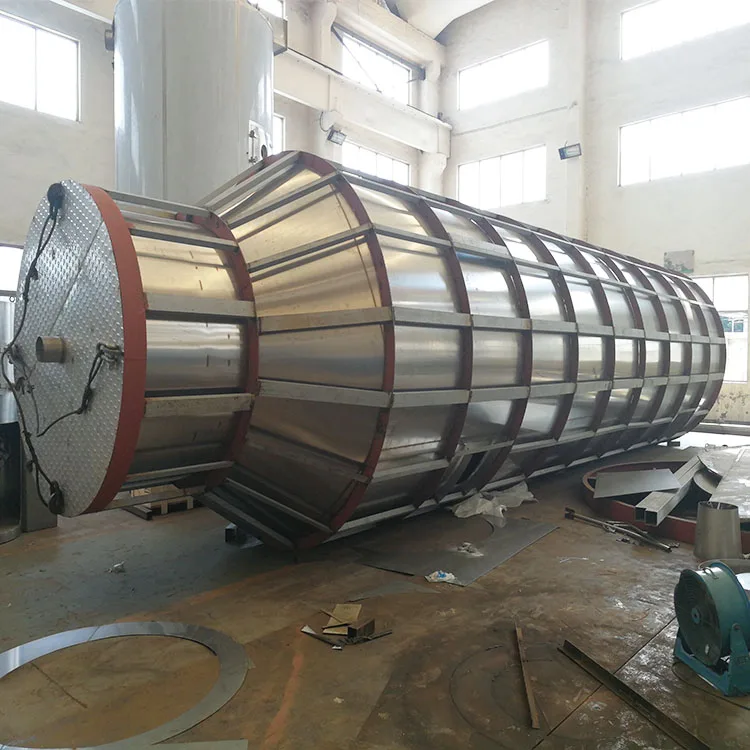
The V-shaped vessel consists of two hollow cylindrical shells welded together at an acute angle of 80 à 90 degrees. As the vessel rotates 360 degrees around its horizontal axis, the powder mass splits into two separate streams inside each cylinder leg. Upon reaching the inverted apex, both streams converge and collide into a unified blend.
This continuous dividing and recombining action creates intensive convective and diffusive dispersion throughout the entire vessel volume. Because tumbling relies on gravity rather than rotating internal paddles, particle attrition and frictional heat generation remain practically zero. This mechanism is ideal for heat-sensitive antibiotics, dry food vitamins, and granular battery cathode precursors.
Which powder parameters determine rotation speed and blending duration?
Blending kinetics depend on particle morphology, difference in ingredient bulk densities, surface cohesion, and static charge accumulation. When active pharmaceutical ingredients differ substantially in density from bulk excipients, rotational speed must stay below critical centrifugal threshold. Our technical laboratory evaluates your raw powder flowability to calculate the exact optimal RPM.
Rotational speed typically ranges from 8 à 22 RPM depending on the total turn radius of the V-shell assembly. JSCSTECH integrates variable frequency drives (VFD) and automated positioning brakes to ensure consistent stop orientation for charging and discharging. This tight process repeatability prevents batch-to-batch variation and simplifies regulatory validation.
When should you specify an internal intensifier chopper bar?
While free-flowing granules blend effortlessly under gravity, cohesive powders or liquid additions require supplemental mechanical energy. An internal intensifier bar rotating at 1,000 à 2,500 RPM provides the localized shear needed to delump agglomerated particles. The intensifier operates independently of the main vessel shell drive through concentric shaft seals.
Notre 10,000 square meter factory equips intensifier bars with liquid injection nozzles for uniform perfume or oil dispersion. Air-purged sanitary mechanical seals eliminate powder migration into bearings and prevent product cross-contamination. This dual-action versatility enables handling both delicate crystalline powders and cohesive micro-dosed blends in a single machine.
What mechanical design aspects ensure complete discharge and rapid CIP cleaning?
Product retention and difficult sanitation represent primary contamination risks in high-purity batch mixing suites. The convergent bottom geometry of a V blender naturally directs powder toward the central discharge port without hang-up. Internal surfaces are mirror-polished to Ra 0.4 microns with continuous seam welds free of cracks or dead angles.
We fit zero-dead-leg sanitary butterfly valves with FDA-compliant silicone gaskets for dust-tight containment. Quick-opening access ports and 360-degree rotating spray nozzles support rapid clean-in-place (CIP) washing protocols. These sanitary features reduce batch turnaround duration and simplify cleanroom GMP audits.
V Mixer Working Principle: Engineering Specification Matrix
| Engineering Parameter | Standard V-Blender Target | Quality Verification Method |
|---|---|---|
| Shell Inclusion Angle | 80° to 90° symmetrical geometry | Precision laser welding inspection & coordinate measurement |
| Optimal Fill Level | 40% – 60% of total vessel volume | Batch mass calculation vs bulk density measurement |
| Surface Roughness | Internal Ra ≤ 0.4 μm, External Ra ≤ 0.8 μm | Surface profilometer measurement certificate |
| Blend Uniformity | Relative Standard Deviation (RSD) ≤ 1.5% | 10-point thief sampling assay across 3 validation batches |
| Drive Safety | Explosion-proof motor & safety cage interlock | CE / ATEX compliance audit & emergency brake test |
Liste de contrôle d'audit des fournisseurs: 5 Documents à demander avant de signer un bon de commande
- Material Test Certificates (EN 10204 3.1) verifying contact parts in SUS304, SUS316L, or Hastelloy.
- Weld Inspection & Passivation Verification Report including internal surface roughness test data (Ra ≤ 0.4 μm).
- Intensifier Shaft Seal Pressure Decay Test and bearing thermal elevation log (<35°C above ambient).
- Drive System Dynamic Balance and Electrical Control Safety Interlock Qualification Documentation.
- Test d'acceptation en usine (GRAISSE) Protocol complete with dry run operational records and IQ/OQ templates.
Foire aux questions
Q: Why is the V mixer preferred for fragile granules and micro-dosed active ingredients? The symmetrical V-shaped vessel divides and recombines powders entirely through smooth gravitational tumbling without high-speed shear blades. JSCSTECH manufactures mirror-polished interior walls down to Ra 0.4 microns to prevent particle breakage. When evaluating blenders, verify that blend relative standard deviation (RSD) remains under 1.5%.
Q: What is the optimal batch loading coefficient for a V-type powder blender? Industrial V blenders achieve peak blending efficiency when loaded between 40% et 60% of total shell volume. Our engineering team conducts bulk density calculations to ensure sufficient expansion space at the cylinder junction. Overfilling past 65% traps particles inside the cylinder legs and degrades mixing uniformity.
Q: How do internal intensifier agitator bars enhance V mixer performance for cohesive powders? Optional high-speed intensifier bars break up soft agglomerates and disperse liquid additives into dry powder streams. We design independent dual-speed drives that permit running the intensifier bar only during critical dispersion phases. Request dynamic seal integrity test records to prevent shaft lubricant ingress.
Discover our full portfolio of équipement de mélange industriel and compare this design against our double conical mixer working principle analyse. You can also consult our technical guide on the square cone mixer working principle for bin-blending operations.
To review academic flow models in tumbling blenders, consulter le ScienceDirect tumbling blender analysis. Contactez Leta via WhatsApp: +86 137 7529 9712 to submit your powder recipe for custom engineering calculations and pilot laboratory trials.