Sécheur à lit fluidisé vs sécheur rotatif: Quel est le meilleur pour les poudres pharmaceutiques et chimiques?
Sécheur à lit fluidisé vs sécheur rotatif
Dans le traitement industriel des poudres en vrac, granulés, et ingrédients pharmaceutiques actifs (Apis), le choix de la technologie de traitement thermique est un facteur déterminant dans la qualité du produit, évolutivité du processus, et conformité réglementaire. Les ingénieurs chimistes et pharmaceutiques sont souvent confrontés à des dépenses d'investissement critiques (CAPEX) décision lors de la conception d’une ligne de processus: Sécheur à lit fluidisé vs sécheur rotatif.
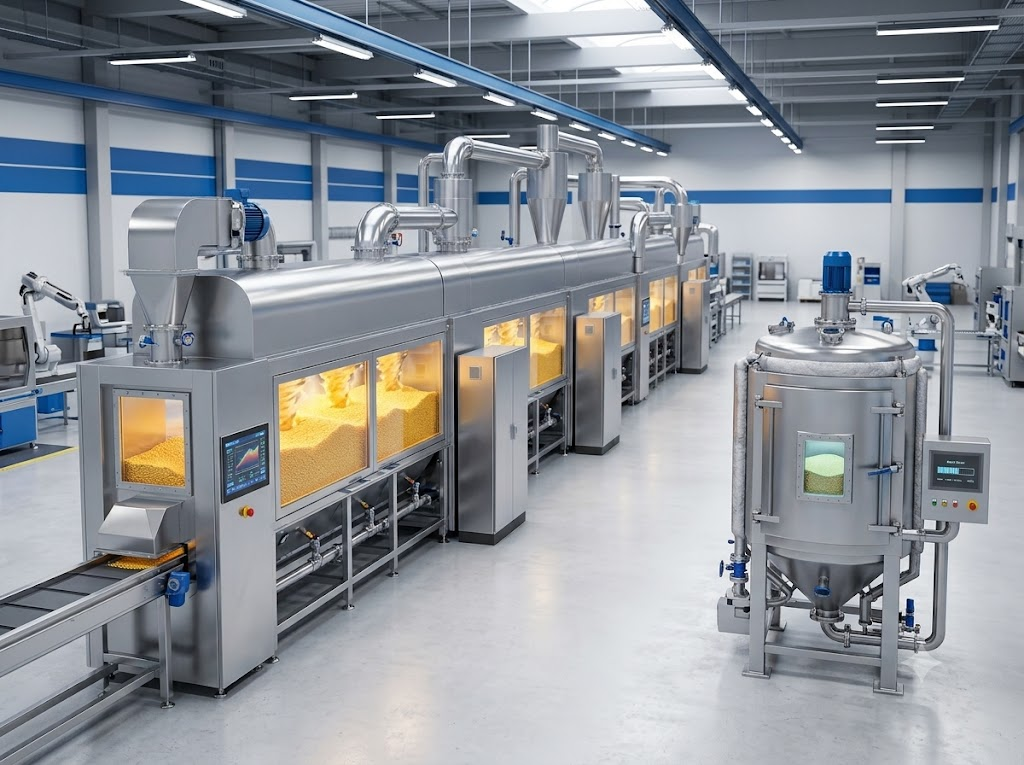
Bien que les deux systèmes soient conçus pour un séchage continu de grande capacité, ils fonctionnent selon des principes thermodynamiques et mécaniques fondamentalement différents. Pour les applications de haute pureté où l'intégrité des particules, contrôle strict de l'humidité, et la sécurité des explosions sont primordiales, la sélection d'une mauvaise configuration peut entraîner une dégradation localisée du matériau, Invalidation BPF, ou explosions de poussières dangereuses. Ce guide fournit une comparaison technique rigide pour aider les gestionnaires d'installations à prendre des décisions d'achat fondées sur des données..
Typologies thermodynamiques: Briser les mécanismes
Pour comprendre quel séchoir convient à votre application de poudre, nous devons d'abord analyser comment les transferts de chaleur et de masse se produisent dans chaque configuration:
[Fluid Bed Dryer (VFB/VFD)] ➔ Upward Airflow ➔ Suspended "Boiling" State ➔ Precise Individual Particle Drying
[Rotary Dryer (Industrial)] ➔ Internal Flight Cascading ➔ Rolling Bed Flow ➔ Aggressive Batch/Continuous Cascading
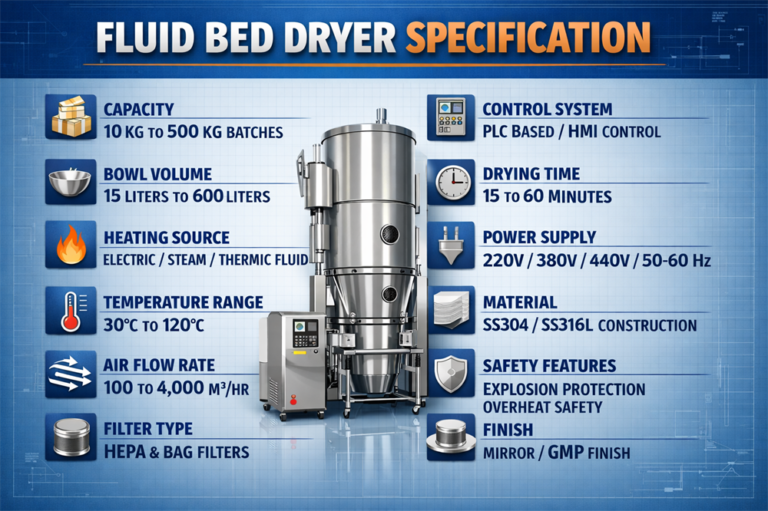
- Sécheurs à lit fluidisé: Réaliser la fluidisation en faisant passer l'air chaud traité vers le haut à travers une plaque distributrice perforée. L'air soulève et suspend le lit de poudre, créer une dynamique, rempli de turbulences “ébullition” État. Chaque particule individuelle est entièrement enveloppée par le milieu chauffé, garantissant des taux de transfert de chaleur extraordinairement élevés et une élimination uniforme de l'humidité.
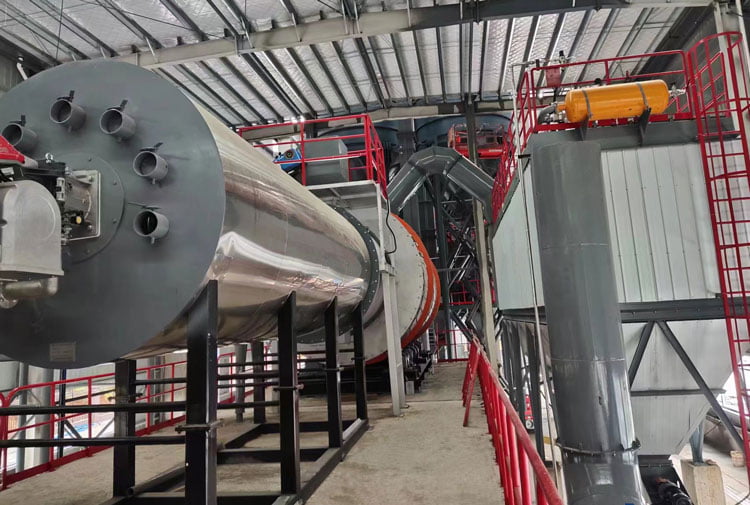
- Séchoirs rotatifs: Utiliser une coque cylindrique à rotation lente. Les volées ou élévateurs internes récupèrent le matériau et le projettent à travers le flux de gaz chaud.. Le matériau descend le cylindre incliné par gravité en cascade., mouvement de roulement.
Comparaison face à face: Intégrité des particules, BPF, et efficacité
Pour les API pharmaceutiques, produits chimiques fins, et poudres alimentaires de haute pureté, l'efficacité du traitement doit être évaluée à travers quatre vecteurs d'ingénierie critiques:
1. Intégrité des particules et sensibilité au cisaillement
Il s’agit du vecteur le plus critique pour les poudres cristallines ou les agrégats sensibles. Les séchoirs rotatifs industriels génèrent un cisaillement mécanique important. Tandis que le matériau tombe en cascade et roule contre les parois métalliques en rotation et les élévateurs, les structures cristallines sont fracturées, entraînant une grave attrition des particules, génération d'amendes indésirables, et une distribution granulométrique asymétrique ($\texte{D50}$).
Les séchoirs à lit fluidisé sont des systèmes de cisaillement proche de zéro. Le matériau est entièrement soutenu par un coussin d’air. Parce qu'aucune pièce interne mobile n'entre en contact avec le produit, les cristaux délicats et les agrégats sensibles conservent leur géométrie tout au long du cycle de séchage.
2. Conformité BPF et nettoyage en place (CIP) Capacité
Pour les usines pharmaceutiques, le ménage validé est non négociable. Les séchoirs rotatifs sont difficiles à désinfecter selon les normes BPF. Les joints tournants, élévateurs internes, et le long tambour cylindrique contient de nombreux points morts, pièges à produits, et surfaces difficiles d'accès, réalisation d'un nettoyage sur place automatisé (CIP) mise en œuvre extraordinairement complexe et nécessitant souvent une intervention manuelle.
Les séchoirs à lit fluidisé sont conçus pour être conformes aux BPF. Leur verticale, la conception statique permet une intégration transparente du CIP. Systèmes avancés, comme ceux de Jiangsu Changshi Technology, disposent de systèmes internes de boule de pulvérisation à haute pression qui nettoient chaque surface de contact, assurer une cohérence, assainissement validé avec un risque de contamination croisée minimisé.
3. Efficacité thermique et contrôle du temps de séjour
Les séchoirs à lit fluidisé atteignent généralement une efficacité thermique par mètre cube de volume de chambre supérieure à celle des systèmes rotatifs.. Parce que la fluidisation crée une surface de transfert de masse maximale, la vaporisation se produit rapidement. En outre, les systèmes PLC automatisés offrent un contrôle précis de la vitesse de l'air et du chauffage par zones, permettant des profils de séchage ciblés qui peuvent protéger les composés sensibles à la chaleur.
4. Automatisation continue et fonctionnement à pression négative
Les deux systèmes peuvent fonctionner en continu. Cependant, pour la chimie fine à base de solvants organiques ou les poudres pharmaceutiques dangereuses, contenir de la poussière est vital. Les lignes de production automatisées en continu à lit fluidisé fonctionnent sous pression négative équilibrée, garantissant l'absence de fuite de poussière tout en s'intégrant parfaitement aux alimentateurs à perte de poids et aux boucles d'emballage automatisées.
La solution d'ingénierie: Ligne de traitement de poudre à haute uniformité
Transition vers une haute uniformité, Le traitement des poudres conforme aux BPF nécessite plus que du matériel de base. Chez Jiangsu Changshi Drying Technology Co., Ltd., nous combinons 20 années d'expérience en ingénierie personnalisée (avec des divisions spécialisées exploitant 30+ années d'expertise) livrer complet, solutions de traitement des poudres automatisées. Opérant à partir de notre centre de fabrication moderne de 10 000㎡ et soutenu par un R d'élite&Groupe D de plus 20 ingénieurs de procédés seniors, nous fournissons des lignes de lit fluidisé sur mesure pour Fortune 500 clients chimiques et pharmaceutiques dans le monde entier.
[Pharma API/Fine Chemical Feed] ➔ [Precision Material Testing] ➔ [Custom GMP/ATEX Engineering] ➔ [Zero-Contamination Output]
Pour garantir une haute efficacité, sortie conforme, nos lignes de traitement de poudre spécialisées intègrent des mesures de protection critiques:
- Correspondance de processus de paramètres personnalisés: Avant de finaliser un schéma d'ingénierie, nous menons des démarches rigoureuses Tests de précision des matériaux dans notre R dédié&D lab pour définir la vitesse de fluidisation exacte de votre matière première, angle de repos, et liant l'énergie de l'humidité.
- Conformité totale aux certifications (BPF/ATEX): Pour les applications exigeantes, nous fabriquons et polissons miroir les surfaces de contact SUS316L, intégrer des moteurs/évents antidéflagrants (Classé ATEX), et configurer des boucles de pression négative pour éliminer les risques d'émissions dans l'environnement et les risques d'explosion.
- Logistique intégrée clé en main: Nous gérons l'intégralité du cycle de vie du projet, depuis la conception initiale de la machine personnalisée jusqu'aux ajustements de tension. (par ex., 380V/440V) à la mise en caisse maritime et complète 7*24 assistance technique en ligne d'une heure.
FAQ: Clarifications techniques à haute intention
T1: Un séchoir rotatif peut-il être utilisé pour les poudres pharmaceutiques s'il est équipé d'une doublure sanitaire?
Bien que possible, il est extrêmement rare pour l'API primaire ou le traitement de chimie fine en raison du cisaillement mécanique inhérent. Doublures sanitaires (comme le titane ou la céramique technique) peut atténuer la contamination par les métaux, mais ils ne font rien pour empêcher la fracture des particules causée par le mécanisme de cascade et de roulement. Pour les étapes de cristallisation ou de granulation de haute pureté, un séchoir à lit fluidisé est presque universellement préféré en raison de sa préservation supérieure des particules.
T2: Quels sont les principaux défis lors de la mise en œuvre d'un séchoir à lit fluidisé continu pour le traitement chimique de plusieurs tonnes?
Le principal défi consiste à gérer la stabilité dynamique en régime permanent. Fluctuations inattendues de la teneur en humidité des aliments, variance de la taille des particules, ou densité de l'air (causé par l’altitude ou la température ambiante) peut causer localisé “défluidisation” ou formation de canaux, conduisant à un matériau sous-séché ou à une agglomération du produit. Notre 20+ L'équipe d'ingénieurs senior du membre résout complètement ce problème pendant la phase de conception de la machine personnalisée en intégrant des capteurs d'humidité en ligne en temps réel., boucles automatisées à vitesse d'air variable, et réglage thermodynamique exclusif.
T3: Comment les cycles de vie de maintenance et la consommation d'énergie se comparent-ils entre les deux systèmes sur une période de 10 ans ??
Les séchoirs à lit fluidisé présentent généralement une usure mécanique récurrente plus faible car ils manquent de gros, pièces rotatives fortement chargées (comme le tambour d'un séchoir rotatif et les tourillons de support). Cependant, leurs grands ventilateurs peuvent consommer une quantité importante d'électricité. Les séchoirs rotatifs industriels sont robustes mais souffrent d'une usure des revêtements due au frottement, vols, et des phoques, conduisant à des reconstructions coûteuses. Une conception sur mesure, Le système à lit fluidisé économe en énergie de Jiangsu Changshi Technology est conçu pour optimiser les boucles d'énergie (par ex., par recirculation de l'air) et minimiser l'usure des composants, offrant un coût total de possession inférieur (Coût total de possession) et un retour sur investissement rapide dans les scénarios de production en vrac.
Maximisez votre retour sur investissement dans le traitement des poudres
Le choix d'un séchoir à lit fluidisé est une étape définitive vers une plus grande uniformité, Conformité BPF, et des coûts d'exploitation réduits. Collaborez avec un fabricant de vente directe établi ayant fait ses preuves dans la fourniture de produits de support et de solutions techniques à Fortune. 500 entreprises.
Contactez les chefs de projets internationaux à Jiangsu Changshi Drying Technology Co., Ltée. dès aujourd'hui pour sécuriser notre catalogue principal d'ingénierie ou organiser une consultation technique en ligne. Laissez notre 20+ Le département d'ingénierie supérieur membre effectue une étude complète Correspondance des processus analyse pour votre ligne de production haute capacité, fournir une solution personnalisée à lit fluidisé continu optimisée pour le budget et les objectifs de performance de votre entreprise.