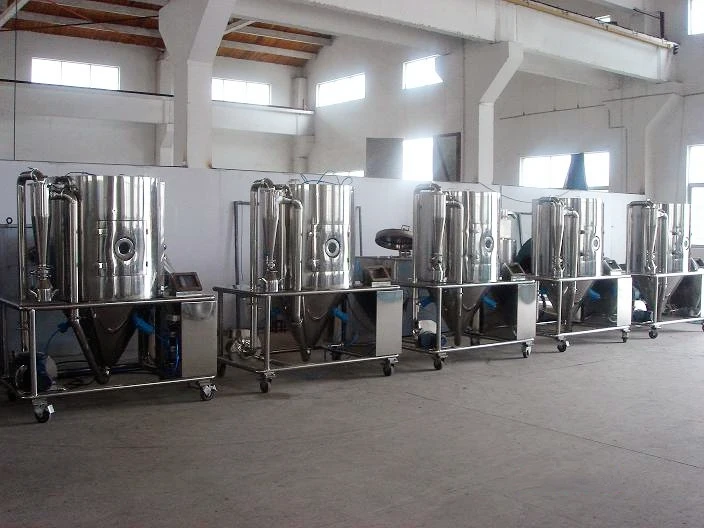
Spray Dryer for Catalyst Support: Engineering Microspherical Alumina & Silica Granules
In fluid catalytic cracking (FCC), hydrotreating, and syngas synthesis, heterogeneous catalyst performance depends heavily on carrier particle roundness, surface area, and mechanical durability. Selecting an engineered spray dryer for catalyst support ensures precise microsphere formation from pseudoboehmite, silica sol, and titania slurries.
Drawing upon 20 years of non-standard machinery manufacturing at Jiangsu Changshi Drying Technology Co., Ltd (JSCSTECH), we build specialized catalyst drying systems for chemical plants worldwide. Operating across our 10,000 m² factory, our engineering team customizes high-temperature towers that preserve delicate mesoporous channel networks.
Plant managers and chemical process engineers often struggle with particle breakage, binder crusting, and severe atomizer erosion. Understanding the drying dynamics of a spray dryer for catalyst support helps plants maximize catalytic activity while reducing fines loss in fluidized bed reactors.

Table of Contents
Why Conventional Extrusion and Pan Granulation Fail for High-Efficiency Catalyst Supports
Traditional paste extrusion and disc pan agglomeration generate cylindrical pellets or irregularly shaped grains with wide particle size distributions. In turbulent fluidized bed chemical reactors, non-spherical catalyst particles suffer from severe hydrodynamic drag, excessive attrition, and bed channeling.
Furthermore, mechanical extrusion shears wet hydrogels and sol-gel precursors, causing dense outer skins that block gas diffusion to internal active sites. Uneven mass transfer across extruded pellets accelerates localized coking and premature catalyst deactivation during high-temperature cracking cycles.
In contrast, utilizing a purpose-built spray dryer for catalyst support produces perfectly spherical microspheres with smooth outer contours and consistent tap densities. Homogeneous spherical geometry promotes uniform fluidization, lowers pressure drops, and extends catalyst run life in commercial refining reactors.
Preserving Pore Volume and Surface Area in Catalyst Spray Drying Operations
Maintaining specific surface areas between 150 and 350 m²/g and pore volumes above 0.45 cm³/g requires preventing capillary collapse during moisture evaporation. As water evaporates from droplet menisci, intense surface tension forces pull alumina nanoplatelets together, threatening internal mesopore integrity.
In our engineering practice at JSCSTECH, we optimize hot gas air disperser fluid dynamics to provide laminar co-current flow around the atomization cloud. Controlled drying rates prevent rapid binder migration (such as silica sol or PVA) toward the droplet periphery, avoiding dense impermeable crusts.
By balancing inlet temperatures between 350°C and 550°C with steady outlet temperatures between 120°C and 150°C, our spray dryer for catalyst support preserves uniform radial porosity. This open internal channel matrix ensures unhindered reactant diffusion after downstream calcination and active metal impregnation.

Controlling Particle Size Distribution and Attrition Resistance in Catalyst Microspheres
Fluidized bed refining and gas-phase chemical synthesis require catalyst carrier granules centered tightly within the 40 μm to 120 μm size bracket (d50 = 65–80 μm). Generating granules below 20 μm leads to cyclone carryover loss, whereas granules above 150 μm fail to fluidize smoothly.
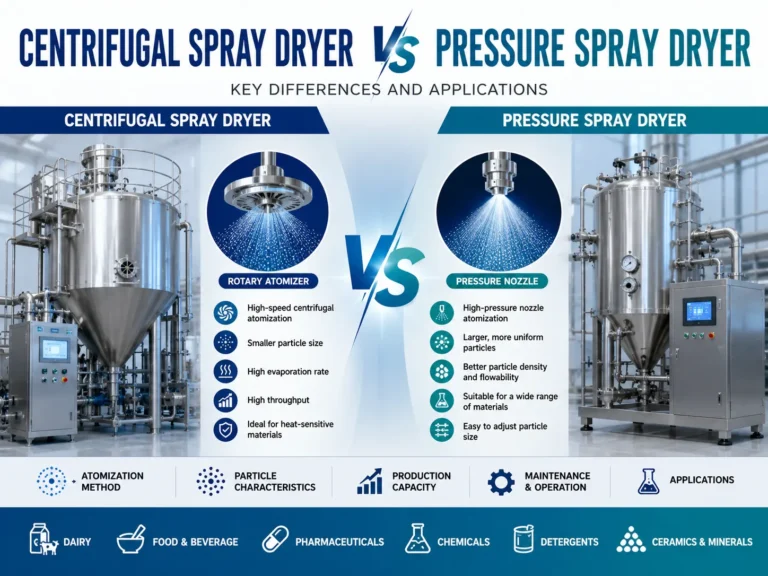
Achieving high mechanical hardness and low Air Jet Attrition Index (AJAI < 1.0 wt%/h) requires high slurry solids loading between 40% and 58%. Our high-speed centrifugal atomizers operate at tip speeds exceeding 140 m/s with variable-frequency speed regulation up to 18,000 RPM.
For specialized alumina microspheres, our engineering team outfits each spray dryer for catalyst support with precision tungsten carbide and silicon carbide atomizer wheels. Wear-resistant atomization geometry maintains stable droplet shear even under continuous pumping of abrasive inorganic slurries.
Wear Protection and Thermal Energy Recovery Architecture in Catalyst Drying Towers
Continuous commercial chemical production requires robust machinery engineered to resist abrasive ceramic erosion and thermal fatigue. Our drying tower cones, transition ducts, and primary cyclone bodies feature high-alumina ceramic tile linings or hard-chrome armor coatings.
To cut fuel consumption in high-temperature chemical operations, our systems integrate air-to-air tubular heat exchangers and flue gas waste heat recuperators. Preheating clean incoming combustion air reduces primary natural gas consumption by 18% to 25% across continuous production runs.
Exhaust emissions pass through dual-stage high-efficiency cyclone batteries and automated pulse-jet baghouses equipped with PTFE membrane filter bags. This multi-stage collection system on our spray dryer for catalyst support ensures product recovery rates exceeding 99.8% while complying with environmental particulate limits.
Technical Sizing Matrix for Industrial Catalyst Support Spray Dryers
Matching tower dimensions and atomizer configurations to production throughput ensures optimal drying residence times and consistent microsphere morphology. The engineering matrix below outlines standard configurations across manufacturing scales.
| Specification | Pilot Development Unit | Commercial Chemical Unit | Heavy Refining FCC Tower |
|---|---|---|---|
| Evaporation Capacity | 15 – 50 kg/h water | 150 – 500 kg/h water | 1,000 – 3,500 kg/h water |
| Atomization Technology | Precision Rotary / 2-Fluid | Tungsten Carbide Rotary Disk | Heavy-Duty Multi-Nozzle / Disk |
| Inlet Air Temperature | 250°C – 400°C | 350°C – 500°C | 450°C – 550°C |
| Target Granule d50 | 35 – 65 μm | 55 – 85 μm | 65 – 110 μm |
| Pore Volume Retention | > 92% of wet gel volume | > 95% of wet gel volume | > 96% of wet gel volume |
To understand powder behavior across related high-hardness materials, see our guide on spray dryer for ceramic powder. You can also review thermal balance methods in our spray dryer design calculations guide.
Supplier Audit Checklist: 5 Crucial Tests to Verify Before Ordering a Catalyst Spray Dryer
Procuring industrial drying machinery for inorganic catalyst carriers requires rigorous technical validation. We recommend requesting the following 5 critical quality and performance verification documents before finalizing equipment contracts:
- Pilot Slurry Trial & SEM Micrograph Report: Experimental test data verifying target d50 particle size distribution, spherical circularity index (> 0.90), and cross-sectional SEM images.
- Atomizer Wear Component Hardness Certification: Hardness inspection reports (HRC ≥ 88 or Vickers hardness) for tungsten carbide or silicon carbide nozzle inserts and disk bushings.
- Thermal Efficiency & Specific Fuel Consumption Sheet: Guaranteed heat consumption per kilogram of evaporated water, including waste heat recuperator recovery efficiency.
- Cyclone & Baghouse Particulate Emission Guarantee: Certified dust collection efficiency and exhaust stack emission guarantees conforming to local environmental regulations.
- Tower Structural & High-Temperature Refractory Test Data: Certified pressure calculations, thermal expansion joint designs, and exterior skin temperature insulation verification.
For strategies on preventing sticky precursor deposits on tower cones, consult our detailed analysis on spray dryer wall sticking solutions. Addressing wall buildup early protects product yields and prevents thermal discoloration.
Frequently Asked Questions About Catalyst Support Spray Dryers
Q: How does a spray dryer for catalyst support preserve high pore volume in pseudoboehmite alumina?
Preserving pore volume requires controlling droplet evaporation kinetics so water vapor escapes without collapsing internal microcapillary networks. At JSCSTECH, our drying towers use specialized co-current air dispersers that deliver uniform thermal profiles, preventing sudden crust formation and pore shrinkage. When auditing machinery vendors, ask for before-and-after nitrogen adsorption (BET) pore volume test data from real slurry pilot trials.
Q: What atomizer design is best suited for abrasive catalyst slurries?
High-speed centrifugal atomizers equipped with tungsten carbide or silicon carbide wear-resistant pins and distributor plates provide the best balance of longevity and narrow particle distribution. Our JSCSTECH rotary atomizers feature variable frequency drives capable of 12,000 to 18,000 RPM, maintaining constant droplet shear even with 50% solids slurries. Ensure your equipment supplier provides replaceable modular wear bushings to minimize future maintenance downtime.
Q: How can chemical plants minimize fines generation in fluidized bed catalysts?
Fines generation is prevented by optimizing the slurry binder ratio, increasing atomization droplet uniformity, and operating high-efficiency cyclone separators. In our test facility, we perform free raw material precision testing to determine the ideal feed viscosity and solid concentration before finalizing nozzle geometry. Always verify that your equipment fabricator guarantees an Air Jet Attrition Index (AJAI) below 1.0 wt%/h on calcined microspheres.
Q: What thermal energy efficiency can be achieved in continuous catalyst spray drying?
Integrating hot flue gas air-to-air recuperators and double-skin rock wool insulated tower shells delivers thermal efficiencies between 68% and 78%. At JSCSTECH, our heat recovery ducting preheats incoming ambient process air by up to 80°C using clean exhaust streams, reducing primary natural gas consumption by up to 25%. Ask prospective manufacturers to supply calculated heat balance flowcharts before approving equipment designs.
Refer to the ASTM D5757 Standard Test Method for Determination of Attrition and Abrasion of Powdered Catalysts by Air Jets for standardized attrition measurement protocols. Applying recognized ASTM testing standards guarantees reliable quality benchmarking across commercial petrochemical supply chains.