Spray Drying vs Freeze Drying: Differences, 优点, and Industrial Applications

Spray Drying vs Freeze Drying
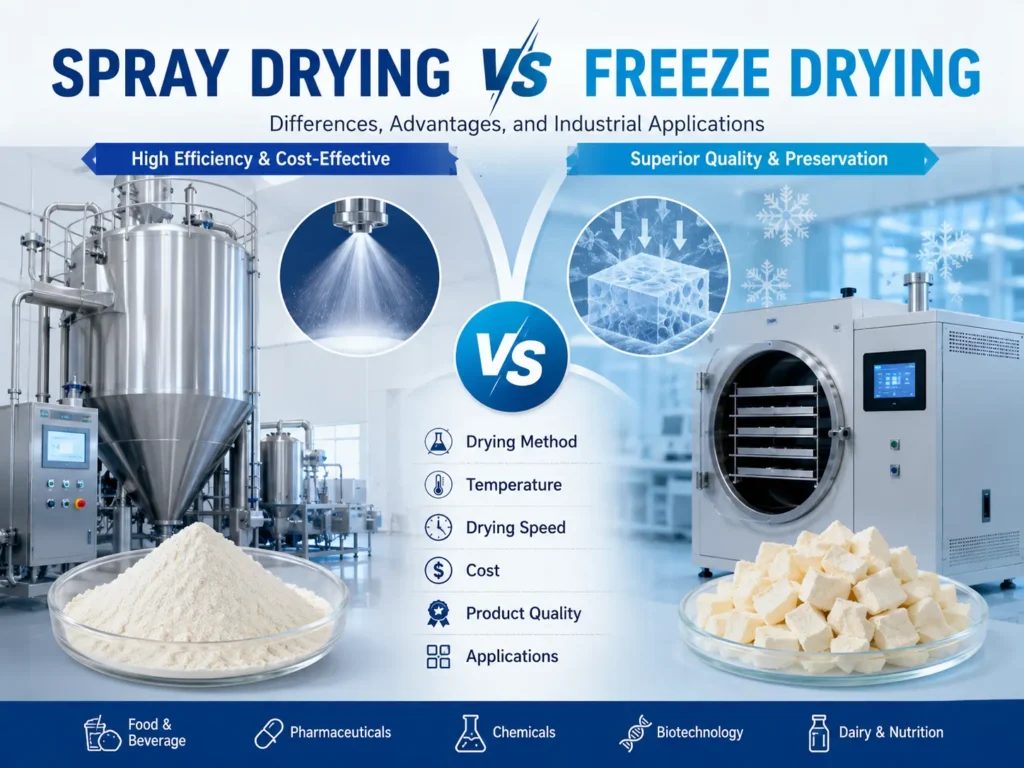
When it comes to industrial drying methods, two technologies stand out as the most widely used and debated: spray drying and freeze drying. Understanding their core differences is critical for businesses looking to optimize production, control costs, and deliver high-quality products. At a glance, the key distinctions lie in their working principles, cost efficiency, material suitability, and industrial scalability. Spray drying relies on high-temperature air to evaporate moisture from liquids, converting them into powders quickly and cost-effectively, making it ideal for large-scale production of common materials like milk and coffee. 冷冻干燥, by contrast, uses low temperatures and a vacuum environment to sublime moisture, preserving the nutritional value and active components of sensitive materials—though it comes with higher costs and slower processing times.
In industrial settings, the choice between spray drying and freeze drying ultimately hinges on four core factors: the sensitivity of the material being dried, production volume requirements, budget constraints, and desired product quality. 以下, we break down each technology in detail, compare their key features, and guide you through how to choose the right method for your industrial needs.
什么是喷雾干燥
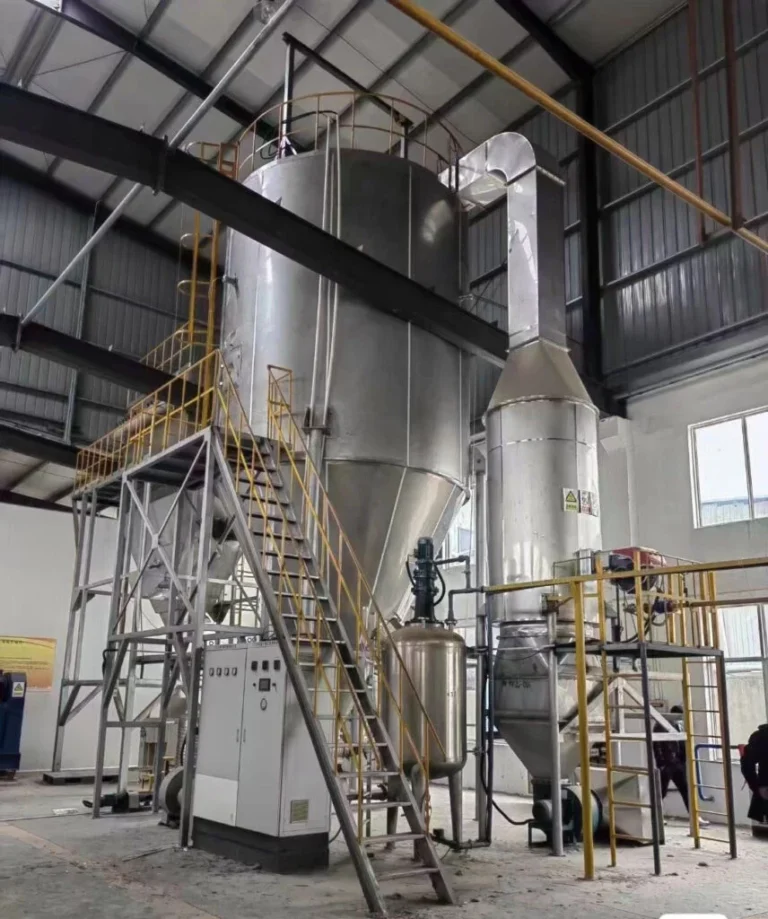
Spray drying is a widely used industrial drying method that converts liquid or slurry feed into a dry powder in a single continuous process. Its working principle is straightforward: a liquid feed (such as milk, coffee extract, or chemical slurries) is atomized into tiny droplets using a spray nozzle, which are then contacted with a stream of hot air in a drying chamber.
The hot air instantly evaporates the moisture from the droplets, transforming them into fine, free-flowing powder that is collected at the bottom of the chamber. This process is known for its speed and efficiency, making it ideal for continuous (连续生产) on a large industrial scale.
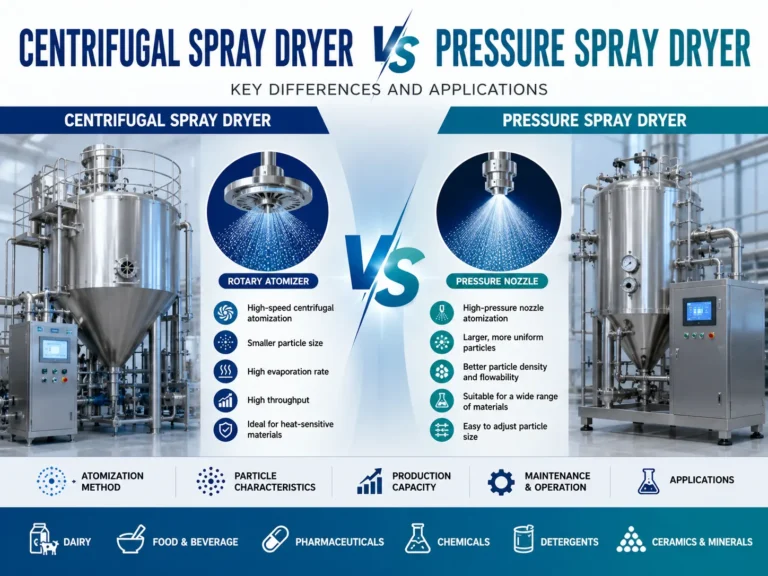
There are several types of industrial spray dryers designed to meet different production needs. The centrifugal spray dryer uses a high-speed rotating disk to atomize the liquid, producing uniform droplets that result in consistent powder quality—this is ideal for materials that require precise particle size control. The pressure spray dryer, 另一方面, uses high-pressure pumps to force the liquid through a nozzle, creating a fine spray; it is commonly used in large-scale food and chemical production due to its high throughput. Regardless of the type, the industrial spray dryer is valued for its ability to handle high volumes of feed, operate continuously, and produce a consistent powder product with minimal waste.
What Is Freeze Drying
冷冻干燥, also known as lyophilization, is a specialized industrial drying method that preserves the integrity, nutritional value, and active components of sensitive materials. Unlike spray drying, which uses high temperatures, freeze drying operates in a vacuum environment at low temperatures, relying on the principle of sublimation—the process by which frozen water (ice) turns directly into vapor without passing through the liquid phase. The process begins by freezing the material to sub-zero temperatures, which converts all moisture into ice. The frozen material is then placed in a vacuum chamber, where the pressure is reduced to allow the ice to sublime, leaving behind a dry, porous product that retains its original structure and properties.
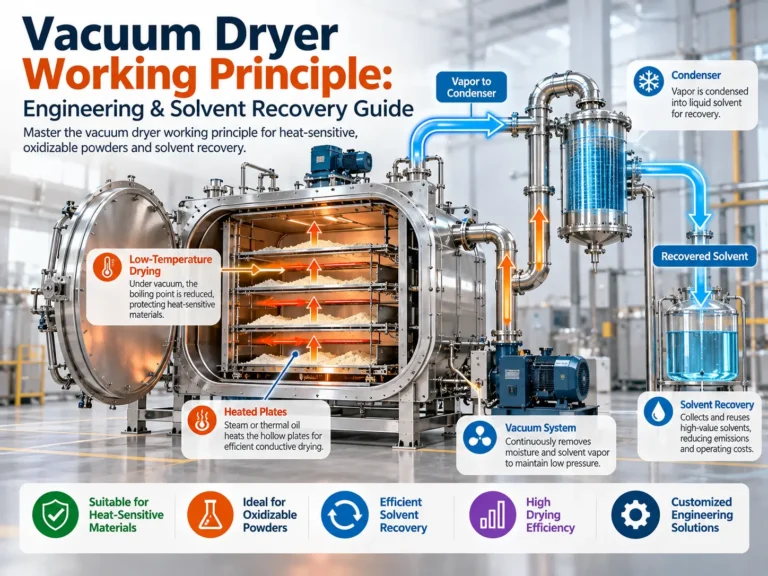
The vacuum freeze drying process is particularly valuable for materials that are sensitive to heat, as the low-temperature environment prevents degradation of heat-sensitive components like vitamins, 酶, 和活性药物成分. A freeze dryer typically consists of a freezing chamber, a vacuum system, and a condenser to capture the sublimated water vapor. This technology is prized for its ability to produce high-quality products with excellent rehydration properties—meaning the dry product can easily return to its original form when water is added—making it ideal for premium and sensitive materials.
Spray Drying vs Freeze Drying: 主要差异
To help you quickly understand the core differences between spray drying and freeze drying, we’ve compiled a comprehensive comparison table—an essential element for Google Featured Snippet eligibility, as search engines prioritize clear, structured comparisons for user intent.
| 特征 | 喷雾干燥 | 冷冻干燥 |
|---|---|---|
| 干燥方法 | Hot air evaporation | Sublimation under vacuum |
| 温度 | 高的 (typically 150–300°C for inlet air) | 低的 (typically -40°C to -80°C during freezing, low vacuum during sublimation) |
| 干燥速度 | 快速地 (seconds to minutes per batch) | 慢的 (hours to days per batch) |
| 成本 | 降低 (lower equipment and operational costs) | 更高 (expensive equipment, higher energy and maintenance costs) |
| 产品质量 | 好的 (consistent powder, but some heat-related degradation possible) | 出色的 (preserves nutrients, active components, and original structure) |
| Particle Shape | 美好的, spherical powder (粒径均匀) | Porous, fragile structure (easy rehydration) |
| 工业规模 | 大规模 (连续生产, 高通量) | Small to medium (batch production, lower throughput) |
| 能源消耗 | 降低 (efficient heat transfer, continuous operation) | 更高 (energy required for freezing and vacuum system) |
| Suitable Materials | Milk, 咖啡, 化学品, 洗涤剂, 食品添加剂 | 药品, 益生菌, 水果, biological products, heat-sensitive materials |
喷雾干燥的优点
Spray drying is a preferred choice for industrial applications due to its numerous advantages, particularly when it comes to scalability and cost efficiency. One of its most significant benefits is high production capacity—industrial spray dryers can handle large volumes of liquid feed, 使它们成为大规模制造的理想选择. This high throughput is paired with continuous production capabilities, meaning the system can operate 24/7 with minimal downtime, maximizing productivity and reducing labor costs.
Cost-effectiveness is another key advantage of spray drying. Compared to freeze drying, spray drying systems have lower upfront capital costs (CAPEX) and lower operational costs, including energy and maintenance. The process is also highly automated, requiring minimal human intervention, which further reduces labor expenses and ensures consistent product quality. 此外, spray drying offers excellent spray drying efficiency, with high moisture removal rates and minimal product waste. This makes it the go-to technology for industrial powder production, where large quantities of uniform powder are required at a low cost.
Other advantages include the ability to produce powders with controlled particle size and density, which is critical for applications like food processing and chemical manufacturing. The process is also versatile, capable of handling a wide range of liquid feeds, from aqueous solutions to viscous slurries.
Advantages of Freeze Drying
The primary advantage of freeze drying is its ability to preserve the quality and integrity of sensitive materials, making it indispensable for high-value applications. Unlike spray drying, which uses high temperatures, freeze drying operates at low temperatures, preventing the degradation of heat sensitive materials such as vitamins, 酶, 益生菌, 和活性药物成分. This preservation of nutritional value and biological activity is why freeze drying is the preferred method for pharmaceutical drying and the production of premium food products.
Another key benefit of freeze drying is the preservation of the material’s original structure and shape. The sublimation process leaves behind a porous, lightweight product that retains its original texture and rehydrates quickly—this is particularly important for products like freeze-dried fruits, which need to maintain their appearance and texture when rehydrated. Freeze-dried products also have a longer shelf life, as the low moisture content prevents microbial growth and oxidation.
For high-value, sensitive materials, the advantages of freeze drying outweigh its higher costs. The process ensures that the final product meets strict quality standards, making it ideal for pharmaceuticals, biological products, and premium food and beverage items where product quality is paramount.
喷雾干燥的缺点
While spray drying offers numerous benefits, it is not without its drawbacks—addressing these objectively is crucial for Google’s ranking algorithm, which favors balanced, informative content. The most significant disadvantage of spray drying is its use of high temperatures, which can damage heat-sensitive components in the feed material. This means it is not suitable for extreme热敏材料 (heat-sensitive materials) like certain pharmaceuticals, 益生菌, or enzymes, as the high heat can denature or degrade these components, reducing their effectiveness.
Another drawback is the potential for uneven drying or particle agglomeration, which can affect the quality of the final powder. While modern industrial spray dryers are designed to minimize this, it remains a concern for applications that require extremely uniform particle size. 此外, while spray drying has lower energy consumption compared to freeze drying, it still requires significant energy to heat the air, which can contribute to operational costs—especially in regions with high energy prices. 最后, spray drying is not ideal for materials with high viscosity or high solids content, as these can be difficult to atomize into fine droplets.
Disadvantages of Freeze Drying
Freeze drying’s main drawbacks are centered around cost, 速度, and scalability—factors that make it less suitable for large-scale, cost-sensitive applications. The most significant disadvantage is the high cost of equipment: freeze drying systems are typically several times more expensive than industrial spray drying systems, making them a significant upfront investment for businesses. 此外, the process is much slower than spray drying, with batch times ranging from hours to days, which limits throughput and makes it impractical for large-scale production.
Energy consumption is another major drawback. Freeze drying requires significant energy to freeze the material and maintain the vacuum environment, resulting in higher operational costs compared to spray drying. Maintenance costs are also higher, as freeze dryers have complex components (such as vacuum pumps and condensers) that require regular servicing. 最后, freeze-dried products are often more fragile and porous, making them more susceptible to damage during handling and transportation—this can increase packaging costs and reduce product yield.
Applications of Spray Drying
Spray drying is a versatile technology with applications across multiple industries, making it a critical component of industrial manufacturing. Its ability to produce large quantities of uniform powder at a low cost makes it ideal for the following sectors:
食品工业
The food industry is one of the largest users of spray drying. Common applications include the production of milk powder, 咖啡粉, and flavor powder. Spray drying allows food manufacturers to extend the shelf life of liquid products, reduce storage and transportation costs, and create convenient, easy-to-use powder products. 例如, milk powder is produced by spray drying liquid milk, preserving its nutritional value (to a certain extent) while making it easier to store and transport. Coffee powder, meanwhile, is made by spray drying coffee extract, ensuring a consistent flavor and texture.
化学工业
在化学工业, spray drying is used to produce a wide range of products, including detergents, 陶瓷, 和催化剂. Detergent powders are often produced via spray drying, as the process allows for the uniform distribution of ingredients and creates a free-flowing powder that dissolves easily. Ceramics manufacturers use spray drying to produce ceramic powders with controlled particle sizes, which are then used to make ceramic components. 催化剂, used in chemical reactions, are also spray-dried to ensure consistent performance and stability.
Battery Materials Industry
A growing application of spray drying is in the production of lithium materials for batteries. Spray drying is used to produce uniform lithium-based powders, which are critical for the performance of lithium-ion batteries. The process ensures that the powder has the correct particle size and morphology, improving the battery’s energy density and cycle life.
Applications of Freeze Drying
Freeze drying is primarily used for high-value, sensitive materials where product quality is more important than cost or speed. Its ability to preserve nutritional value and active components makes it ideal for the following industries:
医药行业
The pharmaceutical industry is the largest user of freeze drying, as it is the only method that can preserve the activity of sensitive drugs and biological products. Freeze drying is used to produce lyophilized pharmaceuticals, 比如疫苗, 抗生素, and protein-based drugs, ensuring that they remain effective during storage and transportation. The process also improves the stability of these products, extending their shelf life.
Probiotics Industry
Probiotics are live microorganisms that provide health benefits, and they are highly sensitive to heat and moisture. Freeze drying is the preferred method for preserving probiotics, as it maintains their viability while removing moisture. This allows probiotic manufacturers to produce stable, long-lasting products such as probiotic supplements and functional foods.
Food and Beverage Industry (Premium Products)
While spray drying is used for mass-market food products, freeze drying is used for premium food items where quality and texture are paramount. Freeze-dried fruits, 蔬菜, and meats retain their original flavor, 质地, and nutritional value, making them popular in health foods, emergency rations, and gourmet products. 例如, freeze-dried strawberries retain their sweet flavor and crisp texture, while freeze-dried meats can be rehydrated to taste like fresh meat.
Biological Products Industry
Freeze drying is used to preserve biological products such as blood plasma, 酶, and cell cultures. These materials are highly sensitive to heat and moisture, and freeze drying ensures that their biological activity is preserved, making them suitable for research, medical, and industrial applications.
Which Drying Method Is Better?
There is no one-size-fits-all answer to whether spray drying or freeze drying is better— the choice depends on your specific needs and priorities. The key is to match the drying method to your material, production requirements, 和预算.
Choose Spray Drying If You Need:
- Large-scale production with high throughput
- Cost control (lower upfront and operational costs)
- Continuous production to maximize efficiency
- A uniform powder product for mass-market applications
- Materials that are not highly sensitive to heat (例如, 牛奶, 咖啡, 化学品)
Choose Freeze Drying If You Need:
- Preservation of nutritional value and active components
- High product quality for premium or medical applications
- Materials that are highly sensitive to heat (例如, 药品, 益生菌)
- A product with excellent rehydration properties
- High-value products where quality outweighs cost
Cost Comparison: Spray Dryer vs Freeze Dryer
Cost is a critical factor for businesses when choosing between spray drying and freeze drying, and it is one of the most commonly searched topics related to industrial drying methods. To help you make an informed decision, we break down the key cost components:
CAPEX (Capital Expenditure)
Freeze drying systems are typically several times more expensive than industrial spray drying systems. A small-scale freeze dryer can cost tens of thousands of dollars, while large-scale industrial freeze dryers can cost hundreds of thousands or even millions. 相比之下, industrial spray dryers are more affordable, with small-scale systems starting at a few thousand dollars and large-scale systems costing hundreds of thousands of dollars—still significantly less than freeze dryers of similar capacity.
Energy Cost
Freeze drying has much higher energy costs than spray drying. The process requires energy to freeze the material (often to sub-zero temperatures) and maintain a high vacuum, which consumes a significant amount of electricity. 喷雾干燥, while energy-intensive, uses heat more efficiently, and its continuous operation helps to reduce energy costs per unit of product.
Maintenance Cost
Freeze dryers have more complex components (such as vacuum pumps, condensers, and freezing systems) that require regular maintenance, leading to higher maintenance costs. Spray dryers are simpler in design, 活动部件较少, resulting in lower maintenance costs and less downtime.
Throughput and Cost Per Unit
Spray drying has a much higher throughput than freeze drying, meaning it can produce more product per hour. This results in a lower cost per unit of product, making it ideal for mass-market applications. Freeze drying’s slow batch process leads to a higher cost per unit, which is only justifiable for high-value products.
How to Choose the Right Drying Method
Choosing the right industrial drying method requires careful consideration of several key factors. To ensure you select the best system for your needs, evaluate the following:
- 材料敏感性: Is your material sensitive to heat? If yes, freeze drying is likely the better choice. 如果不, spray drying may be more cost-effective.
- 生产能力: Do you need large-scale, 连续生产? Spray drying is designed for high throughput, while freeze drying is better for small to medium batches.
- Operating Cost: What is your budget for energy and maintenance? Spray drying has lower operational costs, making it ideal for cost-sensitive applications.
- Product Quality Requirements: Do you need to preserve nutritional value or active components? Freeze drying delivers higher quality, while spray drying offers consistent, good-quality powder.
- Moisture Requirements: What is the desired final moisture content of your product? Both methods can achieve low moisture levels, but freeze drying may be better for materials that require minimal residual moisture.
Ultimately, the best way to choose the right drying equipment is to consult an experienced industrial dryer manufacturer. They can assess your specific needs, test your material, and recommend the most suitable system to optimize your production process and deliver the best possible product.
Need Help Choosing the Right Drying Equipment?
Our team of experienced engineers can help you select the best industrial drying system based on your material properties, production capacity, and energy targets. We offer personalized consultations, material testing, and custom solutions to ensure your drying process is efficient, 性价比高, and tailored to your needs. Contact us today to get started.
常问问题 (Frequently Asked Questions)
常问问题 1: Is spray drying cheaper than freeze drying?
是的, spray drying is generally cheaper than freeze drying. Spray drying has lower upfront capital costs (CAPEX), 降低能源成本, and lower maintenance costs compared to freeze drying. 此外, its higher throughput results in a lower cost per unit of product, making it more cost-effective for large-scale applications.
常问问题 2: Which drying method preserves nutrients better?
Freeze drying preserves nutrients better than spray drying. Freeze drying operates at low temperatures and uses sublimation to remove moisture, which prevents the degradation of heat-sensitive nutrients like vitamins, 酶, and proteins. Spray drying uses high temperatures, which can damage some nutrients, though it still preserves most of the material’s nutritional value for non-sensitive products.
常问问题 3: Can spray drying be used for pharmaceuticals?
Spray drying can be used for some pharmaceuticals, but it is not ideal for highly heat-sensitive drugs. For pharmaceuticals that are stable at high temperatures (例如, some antibiotics, 片剂), spray drying can be a cost-effective option. 然而, for heat-sensitive pharmaceuticals (例如, 疫苗, protein-based drugs), freeze drying is the preferred method, as it preserves their biological activity.
常问问题 4: Why is freeze drying expensive?
Freeze drying is expensive due to several factors: high upfront equipment costs (freeze dryers are more complex and costly than spray dryers), high energy consumption (required for freezing and maintaining a vacuum), and high maintenance costs (complex components like vacuum pumps and condensers require regular servicing). 此外, the slow batch process reduces throughput, increasing the cost per unit of product.
常问问题 5: Which drying method is better for milk powder?
Spray drying is the better method for milk powder production. It is fast, 性价比高, and capable of large-scale continuous production, which is essential for meeting the high demand for milk powder. While spray drying uses high temperatures, it preserves most of the milk’s nutritional value, and the resulting powder is uniform, free-flowing, and easy to store and transport. Freeze drying is not used for milk powder due to its high cost and slow processing time.