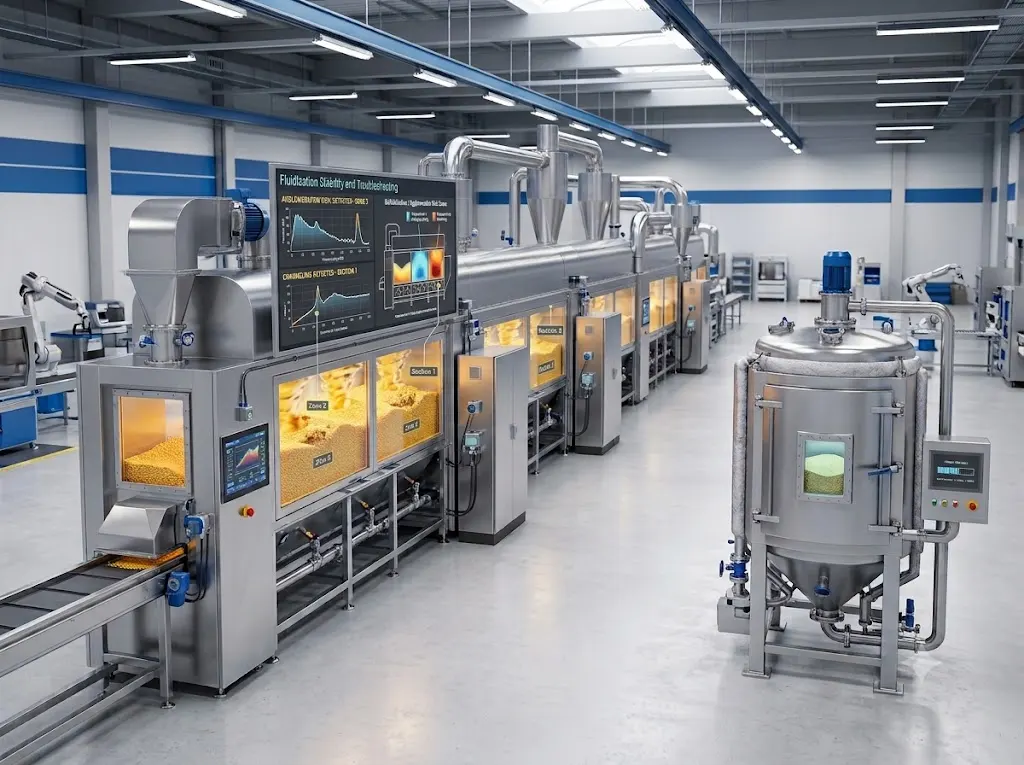
连续流化床干燥机中的结块和沟道故障排除
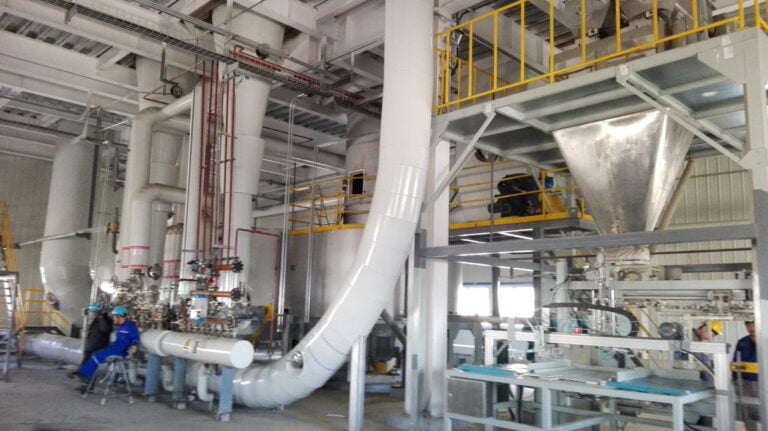
Continuous Fluidized Bed Dryers

In continuous bulk solids processing, 保持稳定, uniform fluidization state is the absolute cornerstone of thermal efficiency. When operating correctly, a continuous fluidized bed dryer behaves as an ideal thermodynamic reactor, offering exceptional heat and mass transfer rates. 然而, process engineers and plant operators frequently encounter two highly disruptive aerodynamic failures that can bring an entire production line to a standstill: powder agglomeration 和 gas channeling.
These twin failures do not merely result in wet or unevenly dried product; they can cause severe mechanical stress on the dryer structure, lead to localized overheating of heat-sensitive materials, and significantly increase energy consumption. To resolve these chronic fluidization disruptions, operators must transition from reactive adjustments to a systematic, thermodynamic troubleshooting framework.
The Aerodynamics of Fluidization Failures
To accurately diagnose fluidization failures, we must analyze the interaction between the upward gas velocity vector and the physical properties of the powder bed.
[Normal Fluidization] ➔ Balanced Gas Velocity ➔ Uniform Voidage ➔ Homogeneous Heat Transfer
[Channeling (Rat-holing)] ➔ Gas Paths of Least Resistance ➔ Static Bed Zones ➔ Zero Heat Exchange
[Agglomeration (Caking)] ➔ Liquid Bridges ➔ Particle Cohesion ➔ Complete Defluidization
- Gas Channeling (Rat-holing): Occurs when the fluidizing gas bypasses the bulk of the powder bed, carving out high-velocity “chimneys” or paths of least resistance. 因此, the gas shoots straight through these channels, leaving the surrounding bed static, cold, and un-fluidized.
- Powder Agglomeration: Happens when individual wet particles collide and stick together, forming larger, heavier lumps. If the cohesive forces (often driven by surface moisture or melting binders) exceed the aerodynamic drag of the fluidizing gas, the bed undergoes localized defluidization, collapsing into a solid, sticky mass on the distributor plate.
Root Cause Analysis: Why Your Fluidized Bed is Failing
When a continuous fluidized bed experiences chronic channeling or agglomeration, the issue can typically be traced to one of three primary system imbalances:
1. Inadequate Gas Velocity and Pressure Drop Configuration
Every powder formulation has a unique Minimum Fluidization Velocity ($U_{MF}$). If the primary supply fan operates too close to this lower limit, any slight restriction in the system can drop the local gas velocity below $U_{MF}$. This causes immediate localized defluidization, which acts as the precursor to both channeling and bed caking. 此外, if the pressure drop across the distributor plate ($\Delta P_d$) is too low relative to the pressure drop across the powder bed ($\Delta P_b$), the air will distribute unevenly, naturally forcing channels to form.
2. High Feed Moisture and Viscous Liquid Bridges
Continuous dryers must handle a constant inflow of wet cake or slurry. If the moisture content of the incoming feed spikes unexpectedly, or if the feed rate exceeds the system’s design capacity, excess surface moisture forms liquid bridges between adjacent particles. This cohesive force binds the particles together, rapidly shifting the material from a free-flowing powder to a sticky, heavy aggregate that the air stream can no longer fluidize.
3. Flawed Distributor Plate Engineering and Uneven Feed Placement
In many low-end fluidized bed setups, generic distributor plate configurations fail to account for the specific gravity or cohesion of the material. If the distributor holes plug easily, or if the wet feed is dropped onto a single spot without immediate dispersion, a static wet zone forms instantly at the inlet. This zone blocks the upward airflow, forcing the air to find paths of least resistance elsewhere, triggering severe channeling downstream.
工程解决方案: Precision Aerodynamics and Intelligent Automation
Resolving continuous fluidization failures requires a deep understanding of particle dynamics and customized system geometry. 江苏昌实干燥科技有限公司, 有限公司, we leverage over 20 多年的定制工程经验 (with specialized divisions drawing on 30+ years of industrial design) to engineer high-stability continuous fluidized bed lines. Backed by our 10,000㎡ manufacturing center and a dedicated R&D team of over 20 高级工艺工程师, we deliver custom, self-balancing fluid bed systems that eliminate fluidization failures.
[Unstable Wet Feed] ➔ [Precision Material Testing] ➔ [Optimized Distributor Geometry] ➔ [Stable Continuous Fluidization]
To entirely prevent channeling and agglomeration, our engineers integrate proprietary mechanical and digital safeguards:
- Material Precision Testing and $U_{MF}$ Mapping: Prior to finalizing any machine design, we perform extensive testing on your specific raw materials to map their exact fluidization curves, boundary moisture levels, and cohesive properties, ensuring the drying system is scaled precisely to your product’s physical boundaries.
- High-$\Delta P$ Anti-Clogging Distributor Plates: We custom-engineer distributor plates with specific bubble-cap or directional nozzle designs. This maintains an optimal pressure drop ratio ($\Delta P_d / \Delta P_b \ge 0.3$), forcing a highly uniform air distribution across the entire bed length and preventing powder from sifting back through the plate.
- Dual-Vibration and Mechanical Agitation Integration: For sticky, cohesive, 或热敏材料, we offer Vibrating Fluidized Bed Dryers (VFB). The mechanical vibration adds a shear force vector to the bed, breaking up liquid bridges and assisting fluidization even at lower gas velocities, completely eliminating caking at the wet feed zone.
- PLC-Enabled Dynamic Pressure Control: Our advanced control panels integrate real-time differential pressure sensors and automated variable-frequency drives (变频器) on the blower fans. If the system detects an anomalous drop in bed resistance (a key indicator of channeling), the PLC automatically modulates gas velocity and temperature profiles to re-stabilize the fluidized bed immediately.
常问问题: 高意图的技术澄清
Q1: How do I distinguish between gas channeling and normal bubble behavior in a fluidized bed?
Normal fluidization exhibits a uniform, bubbling pattern across the entire visible bed surface, accompanied by a stable, oscillating pressure drop reading on your control terminal. 相比之下, gas channeling manifests as localized, violent “geysers” of air shooting through specific zones while the rest of the bed remains completely static. This is accompanied by a sudden, permanent drop in overall bed differential pressure ($\Delta P_b$), indicating that air is bypassing the material.
Q2: Can we retrofit an existing, unstable fluidized bed dryer to prevent chronic agglomeration?
是的. Depending on the current system’s structural integrity, retrofitting is highly viable. Common corrective steps include re-engineering the distributor plate to increase the localized pressure drop, upgrading to directional non-clogging bubble caps, or integrating an auxiliary mechanical lump breaker at the primary wet inlet zone. 我们的 20+ member senior engineering team regularly audits existing third-party installations to provide tailored optimization and component upgrades.
第三季度: What is the ideal ratio between distributor plate pressure drop ($\Delta P_d$) and bed pressure drop ($\Delta P_b$)?
To guarantee uniform air distribution and prevent the formation of channels, the pressure drop across the distributor plate ($\Delta P_d$) should generally be at least $30\%$ of the maximum pressure drop across the powder bed ($\Delta P_b$) (i.e., $\Delta P_d / \Delta P_b \ge 0.3$). If the bed is exceptionally deep or highly cohesive, this ratio may need to be scaled even higher. At Jiangsu Changshi Technology, our engineers utilize advanced computational fluid dynamics (差价合约) to calculate this exact balance for every custom order.
Safeguard Your Plant’s Operational Uptime
Do not let chronic bed caking, gas channeling, or frequent maintenance shutdowns erode your factory’s daily output and inflate energy costs. Upgrading to a custom-engineered, self-balancing continuous fluidized bed dryer is the definitive way to secure high-purity, uniform yields.
联系国际项目部: Jiangsu Changshi Drying Technology Co., 有限公司. today to secure our master catalog or to schedule a professional consultation. 让我们的 20+ senior process engineers analyze your material parameters and design a high-efficiency, zero-failure continuous drying line tailored to your exact production goals.