Princípio de funcionamento do secador de ancinho a vácuo: Projeto Térmico & Guia de Engenharia
Em síntese química, processamento de pigmentos, e intermediários farmacêuticos, processamento inflamável, oxidável, or heat-sensitive pastes under vacuum presents distinct thermal challenges. O vacuum rake dryer working principle offers an indirect batch conductive solution that combines deep vacuum evaporation with continuous mechanical agitation.
Baseando-se em 20 years of non-standard machinery manufacturing at JSCSTECH, we have engineered custom vacuum rake dryers for viscous slurries, crystalline cakes, and toxic solvent recovery applications. Operating under deep vacuum levels down to -0.098 MPa, our systems boil off moisture and solvents at temperatures as low as 35°C to 50°C.
A thorough understanding of the vacuum rake dryer working principle enables plant managers and process engineers to eliminate surface crusting, optimize jacket heat transfer, and protect delicate organic bonds. Let us explore the internal agitation dynamics, sizing formulas, and engineering selection parameters.
Why Static Vacuum Ovens Fail When Processing Viscous Pastes and Slurries
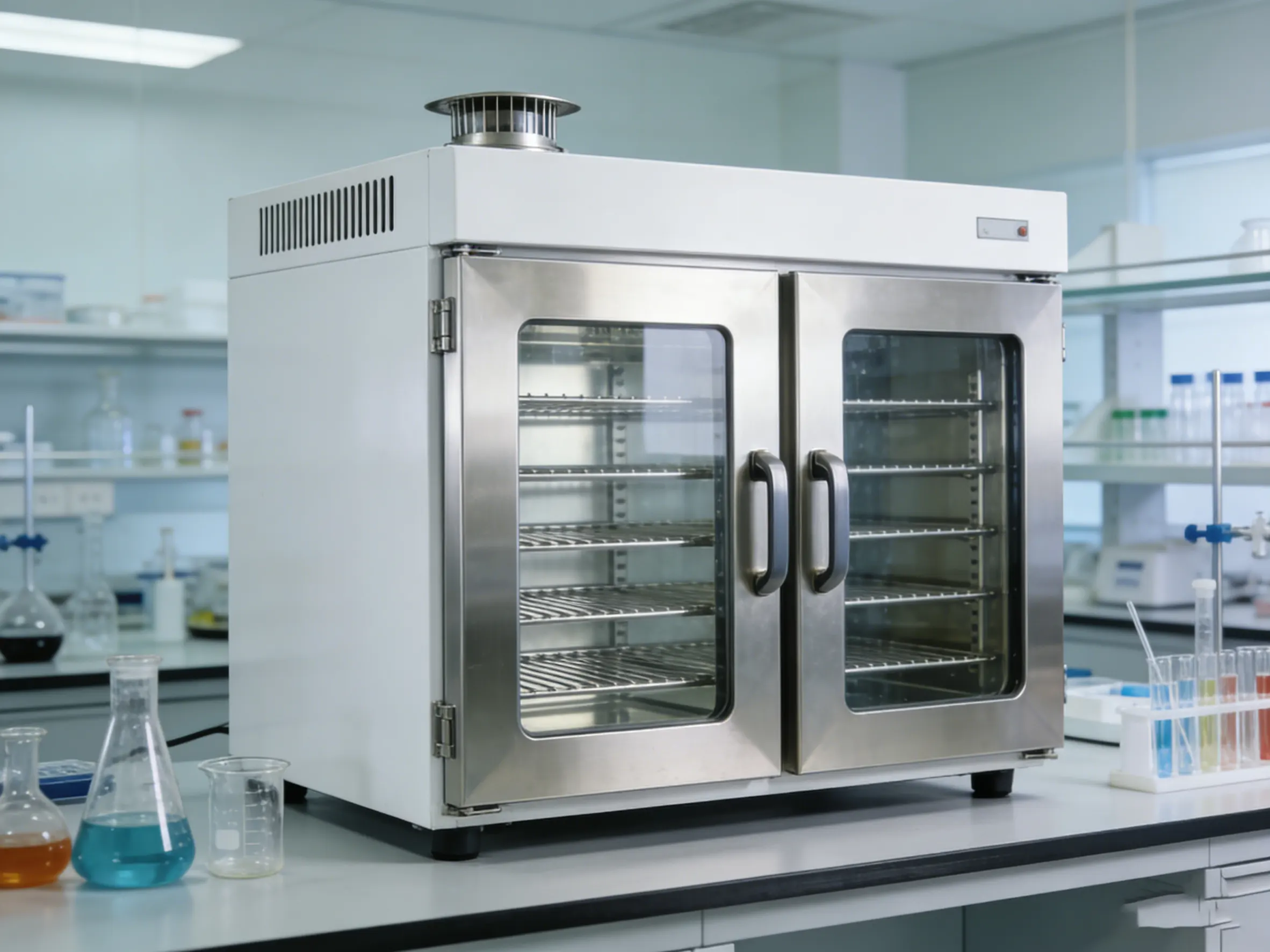
Static vacuum tray dryers rely entirely on unassisted conductive heat transfer from heated shelves through thick stationary material beds. When handling viscous pastes or crystalline slurries, the outer material layer dries rapidly into an insulating crust that severely impedes heat transfer to the wet core.
This phenomenon creates extensive drying cycles exceeding 24 para 48 horas, resulting in uneven residual moisture and thermal degradation of temperature-sensitive ingredients. Manual tray loading and discharging also generate hazardous dust exposure and high labor overhead.
Em contraste, o vacuum rake dryer working principle overcomes thermal resistance through continuous rake agitation. Rotating rake teeth dynamically turn over the material bed, continuously renewing contact with the heated cylinder wall and accelerating solvent vapor release.
Core Mechanics of the Vacuum Rake Dryer Working Principle
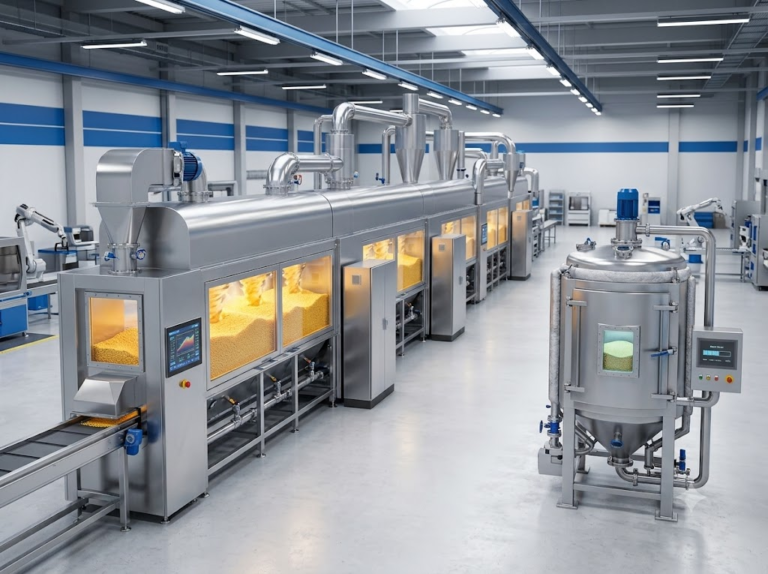
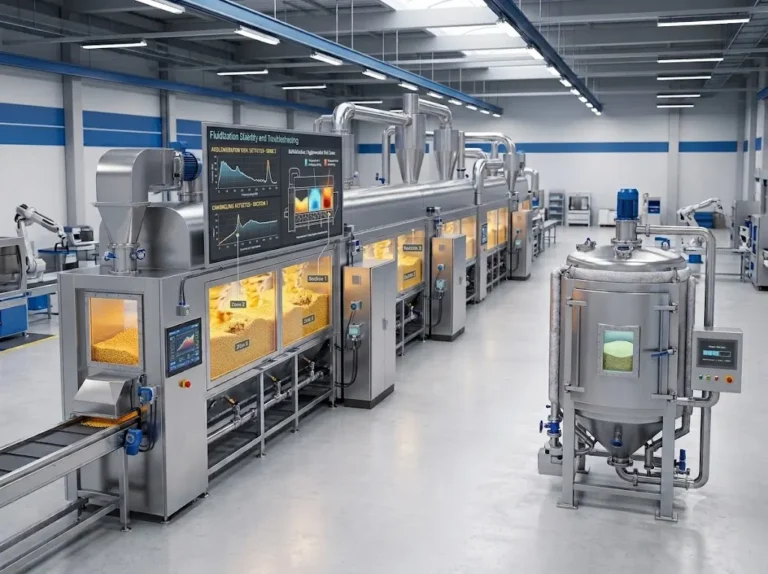
The vacuum rake dryer consists of a horizontal stationary cylindrical vessel surrounded by a heating jacket for steam, água quente, ou óleo térmico. Inside the vessel, a heavy-duty central agitator shaft supports multiple pairs of forward and reverse rake teeth positioned at alternating angles.
As the central shaft rotates slowly at 6 para 12 RPM, the rake teeth continuously slice through the wet paste, lifting material from the bottom shell and pushing it outward toward both ends. When the drive motor reverses rotation, the opposing teeth sweep material backward toward the central discharge port.
This reciprocating axial turnover ensures that all material particles make frequent direct contact with the heated shell wall. For materials prone to forming hard lumps, hollow crushing rods or secondary breaker bars roll freely between the rake arms to crush agglomerates into uniform free-flowing granules.
Thermal Duty Calculations and Sizing Models for Vacuum Rake Dryers
Accurate sizing of a vacuum rake dryer requires calculating total heat duty based on sensible heat, latent heat of vaporization, and effective jacket contact area. Process engineers evaluate material specific heat and solvent boiling point curves under vacuum.
The governing conductive thermal relationship is defined by $$Q = K \cdot A \cdot \Delta T_m$$. Nesta fórmula, $Q$ represents total required heat duty (kJ/h), $K$ is the overall heat transfer coefficient typically ranging between 60 e 180 C/(m²·K), $A$ is effective jacketed contact area (m²), and $\Delta T_m$ is the mean temperature difference across the vessel shell.
Em nosso 10,000 m² manufacturing plant, we evaluate batch slurry rheology to determine effective filling ratios between 50% e 80% do volume total do navio. Ensuring adequate vapor expansion space prevents liquid carryover into upstream vacuum condenser systems.
Vacuum Rake Dryer vs. Alternative Industrial Vacuum Dryers
Selecting the ideal vacuum drying configuration requires evaluating agitation intensity, paste handling capabilities, and batch volume scalability across equipment types. Understanding these differences prevents process bottlenecks.
| Recurso / Parâmetro | Secador de Ancinho a Vácuo | Double Cone Vacuum Dryer | Static Vacuum Shelf Oven |
|---|---|---|---|
| Material State | Viscous Pastes, Filter Cakes, Slurries | Grânulos de fluxo livre, Pellets | Delicate Trays, Static Parts |
| Agitation Style | Internal Rotating Rake Agitator | Entire Vessel Tumbling Rotation | Zero Agitation (Stationary) |
| Agglomerate Crushing | Excelente (Optional Breaker Rods) | Pobre (Relies on gravity fall) | Nenhum |
| Recuperação de Solventes | >98% in Enclosed Condenser Loop | >98% in Enclosed Condenser Loop | 85% – 92% |
| Installation Space | Low Overhead (Horizontal Fixed Shell) | High Overhead (Clearance for rotation) | Moderate Footprint |
| Limpeza de Descarga | Central Bottom Flush Valve | Bottom Butterfly Valve | Manual Tray Unloading |
Integration and Solvent Recovery Within Closed-Loop Systems
In hazardous chemical processing, vacuum rake dryers integrate directly with shell-and-tube condensers, condensate collection tanks, and liquid ring vacuum pumps. Explore nosso completo equipamento de secagem industrial catalog for turnkey thermal engineering solutions.
For free-flowing powder drying, compare com o nosso vacuum dryer working principle guide e nosso princípio de funcionamento do secador de pá oca guia. These technical articles provide detailed equipment selection benchmarks.
For academic research on vacuum conductive heat transfer and dynamic agitation modeling, consultar Análise termodinâmica de secagem a vácuo ScienceDirect. These peer-reviewed papers offer rigorous data on boundary layer renewal kinetics.
Lista de verificação de auditoria de fornecedor: 5 Documents to Request Before Ordering a Vacuum Rake Dryer
When procuring an industrial vacuum rake dryer, thorough verification of pressure vessel welding, shaft seal design, and material metallurgy is critical. Insist that prospective equipment manufacturers provide the following 5 engineering validation documents:
- ASME / CE Pressure Vessel & Vacuum Jacket Certificate: Certifies internal full vacuum (-0.1 MPa) and external jacket pressure (até 0.8 MPa) structural ratings.
- Mechanical Seal & Packing Box Pressure Test Report: Confirms helium or nitrogen leak rate under deep vacuum to guarantee zero air ingress.
- Certificados de teste de moinho de materiais (MTC EN 10204 3.1): Proves stainless steel grades (SS304, SS316L, 2205 Dúplex, or Hastelloy C276) for all contact surfaces.
- Shaft Concentricity & Rake Clearance Inspection Sheet: Documents laser-measured rake tooth-to-wall clearances between 3.0 milímetros e 5.0 milímetros.
- Teste de aceitação de fábrica com carga total (GORDO) Protocol: Validates forward/reverse motor torque, bearing vibration curves, and automatic discharge operation.
Frequently Asked Questions About Vacuum Rake Dryers
1º trimestre: What types of materials are best suited for a vacuum rake dryer?
Vacuum rake dryers are ideal for sticky pastes, centrifuge filter cakes, chemical pigment slurries, and heat-sensitive polymers that cannot tolerate high temperatures or air oxidation. Na JSCSTECH, we custom-engineer internal rake blade angles and breaker rods to handle materials transitioning through viscous sticky phases during drying. Request our factory testing facility to evaluate your material rheology.
2º trimestre: How does the vacuum rake dryer maintain sealing under high vacuum and temperature?
Sealing is maintained through specialized mechanical seals or balanced multi-stage packing glands with integrated nitrogen purge barriers and external cooling jackets. This prevents atmospheric oxygen ingress into flammable solvent vapors and protects bearing housings from abrasive powder migration. Always verify that supplier seal designs comply with ATEX explosion-proof standards.
3º trimestre: What is the typical drying cycle time in an industrial vacuum rake dryer?
Drying cycles typically range from 2 para 8 hours depending on initial moisture content, batch volume, heating medium temperature, and solvent heat of vaporization. Continuous mechanical renewal of the heated contact surface cuts drying time by 50% para 70% compared to static vacuum ovens. We recommend incorporating jacket temperature profiling to prevent thermal degradation during final moisture trim.
Entre em contato com nossa equipe de engenharia via WhatsApp: +86 137 7529 9712