Continuous Plate Dryer Working Principle: Thermal Design & Engineering Guide
Continuous Plate Dryer Working Principle
Processing dense chemical filter cakes, toxic pesticides, or solvent-wet powders often leads to massive energy waste and dust leakage in conventional dryers. O continuous plate dryer working principle delivers multi-tiered conductive heat transfer with gentle mechanical movement and enclosed containment. Backed by 20 anos de fabricação de equipamentos na Jiangsu Changshi Drying Technology Co., Ltd (JSCSTECH), our plate dryers provide high thermal efficiency in a compact vertical footprint.
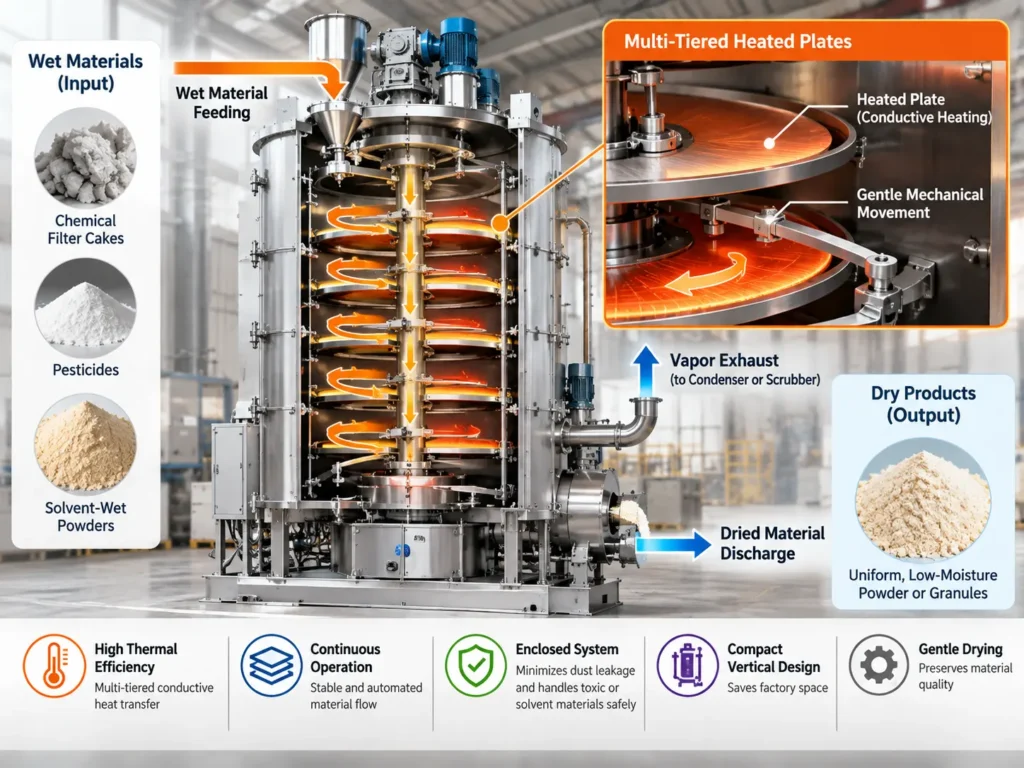
How does the continuous plate dryer working principle drive material cascade flow?
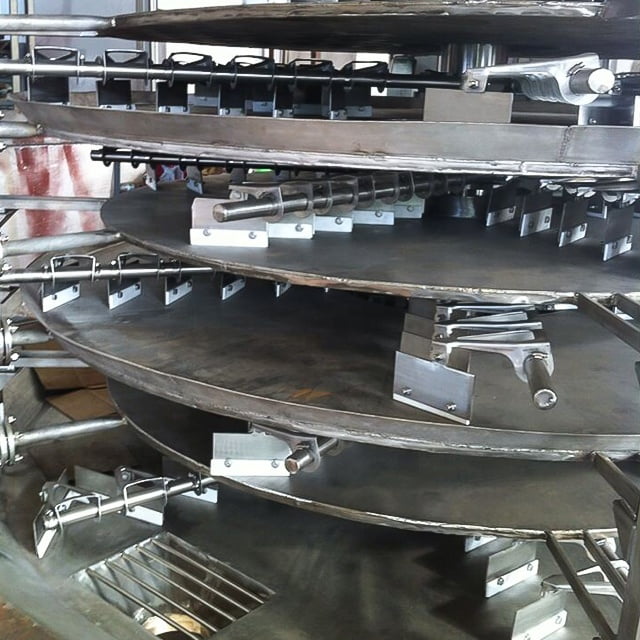
The machine consists of a vertical cylindrical shell housing multiple tiers of stationary horizontal hollow heating plates. Wet feed enters through the top inlet and drops onto the center of the first large heating disc. Rotating harrow arms fitted with angled plow blades continuously spread the material outward toward the disc perimeter.
The powder then falls over the outer edge onto the next smaller plate tier, where reverse-angled plows guide it toward a central discharge drop. This continuous zigzag cascading across alternating plate tiers constantly creates fresh renewal surfaces against the heated metal. JSCSTECH calculates plate step spacings precisely to ensure steady plug-flow transport without product stagnation.
Why does conductive heat transfer deliver superior thermal efficiency?
Unlike convection dryers that heat massive volumes of airflow, plate dryers deliver thermal energy directly by conduction through hollow metal discs. Heating media such as saturated steam, água quente, or thermal oil circulates through internal labyrinth baffles within each plate. Because exhaust air volume is minimal, thermal efficiency routinely surpasses 80% para 85%.
Steam consumption typically remains below 1.2 para 1.4 kilograms of steam per kilogram of evaporated moisture. Em nosso 10,000 instalação de metro quadrado, plate surfaces are precision-machined to ensure uniform heat conduction across the entire diameter. This direct energy transfer slashes boiler fuel expenses compared to single-pass rotary or pneumatic flash drying systems.
How do enclosed casing designs handle toxic materials and closed solvent recovery?
When wet cakes contain hazardous solvents or toxic active compounds, atmospheric release creates grave safety and environmental liabilities. Continuous plate dryers operate within totally enclosed vertical columns equipped with inert nitrogen purging or deep vacuum systems. Evaporated solvent vapors are extracted at high concentration and condensed in compact surface heat exchangers.
Solvent recovery yields routinely exceed 98%, protecting operator health and eliminating costly solvent disposal fees. We fit heavy-duty double mechanical seals with nitrogen barrier fluid along the central rotating drive shaft. This zero-leakage construction guarantees ATEX and environmental compliance across demanding chemical and agrochemical plants.
What design details govern harrow plow wear life and crust prevention?
Abrasive crystals or sticky pasty cakes can cause accelerated plow blade wear and form insulating crusts on heating surfaces. Our engineering team fabricates harrow plows from wear-resistant alloys, high-density PTFE, or Stellite-tipped stainless steel. Plow blades maintain a calibrated micro-gap against the plate surface to prevent material build-up without scoring metal discs.
Variable frequency drive (VFD) controllers allow operators to adjust harrow rotation speed from 1 para 8 RPM. This provides precise control over material residence time from 15 minutes up to 90 minutos. Fine-tuning dwell duration ensures exact final moisture discharge targets even during fluctuating upstream filter cake moisture feeds.
Continuous Plate Dryer Working Principle: Technology Comparison Matrix
| Parâmetro do Processo | Secador de Placa Contínua (JSCSTECH) | Secador de tambor rotativo |
|---|---|---|
| Primary Heat Transfer Mode | Direct conduction through stationary plates | Convection / mixed conduction in tumbling drum |
| Exhaust Airflow Volume | Extremely low (minimal dust entrainment) | Very large volume (requires huge baghouses) |
| Thermal Energy Efficiency | 80% – 85% (low steam consumption) | 50% – 65% (large stack heat losses) |
| Enclosed Solvent Recovery | Excelente (compact closed-loop condenser) | Difícil / cost-prohibitive due to air volume |
| Equipment Footprint | Vertical compact tower (minimal floor area) | Large horizontal footprint with heavy foundations |
Lista de verificação de auditoria de fornecedor: 5 Documentos a serem solicitados antes de assinar um pedido de compra
- Heating Plate Pressure Test Certificate and Hydrostatic Pressure Log (tested to 1.5x design pressure).
- Thermal Conduction Simulation Report and Steam / Thermal Oil Consumption Sizing Calculation.
- Harrow Shaft Dynamic Balancing and Double Mechanical Seal Nitrogen Barrier Qualification Documentation.
- Solvent Recovery Condenser Sizing Sheet and VOC Emission Containment Guarantee.
- Teste de aceitação de fábrica (GORDO) Protocol verifying harrow blade rotation clearance and plate surface flatness.
Perguntas frequentes
P: Why is a continuous plate dryer more energy-efficient than a rotary drum dryer? Continuous plate dryers transfer heat purely through conduction from stationary heated plates directly into thin material layers. JSCSTECH achieves thermal efficiencies exceeding 80% because virtually no thermal energy is wasted heating huge exhaust air volumes. Request thermal balance calculations comparing steam consumption per kilogram of water evaporated.
P: How do rotating harrow plows regulate material dwell time and prevent crusting? Specially angled plow blades continuously turn, spread, and propel the wet cake across alternating large and small plate tiers. We customize plow pitch angles and variable drive speeds to dial in dwell times from 15 para 90 minutos. When auditing designs, verify that harrow blades utilize wear-resistant non-stick materials.
P: Can a continuous plate dryer operate under sealed conditions for hazardous chemical powders? Sim, the enclosed vertical cylindrical housing can be fully hermetically sealed with inert nitrogen blanketing or connected to a vacuum condenser system. Our designs prevent hazardous dust emissions and achieve closed-loop solvent recovery above 98%. Request casing pressure rating and shaft mechanical seal certifications.
Conheça nosso portfólio completo de equipamento de secagem industrial e estude nosso princípio de funcionamento do secador de correia de malha guide for food and biomass processing. You can also consult our technical analysis on the princípio de funcionamento do secador de leito fluidizado vibratório.
For comprehensive academic literature on thin-layer conductive heat transfer, revisar o ScienceDirect conductive drying thermal analysis. Entre em contato com Leta via Whatsapp: +86 137 7529 9712 with your filter cake throughput and moisture parameters for a tailored continuous plate dryer proposal.