Secador por spray centrífugo vs secador por spray de pressão: Principais diferenças e aplicações
Secador por spray centrífugo vs secador por spray de pressão
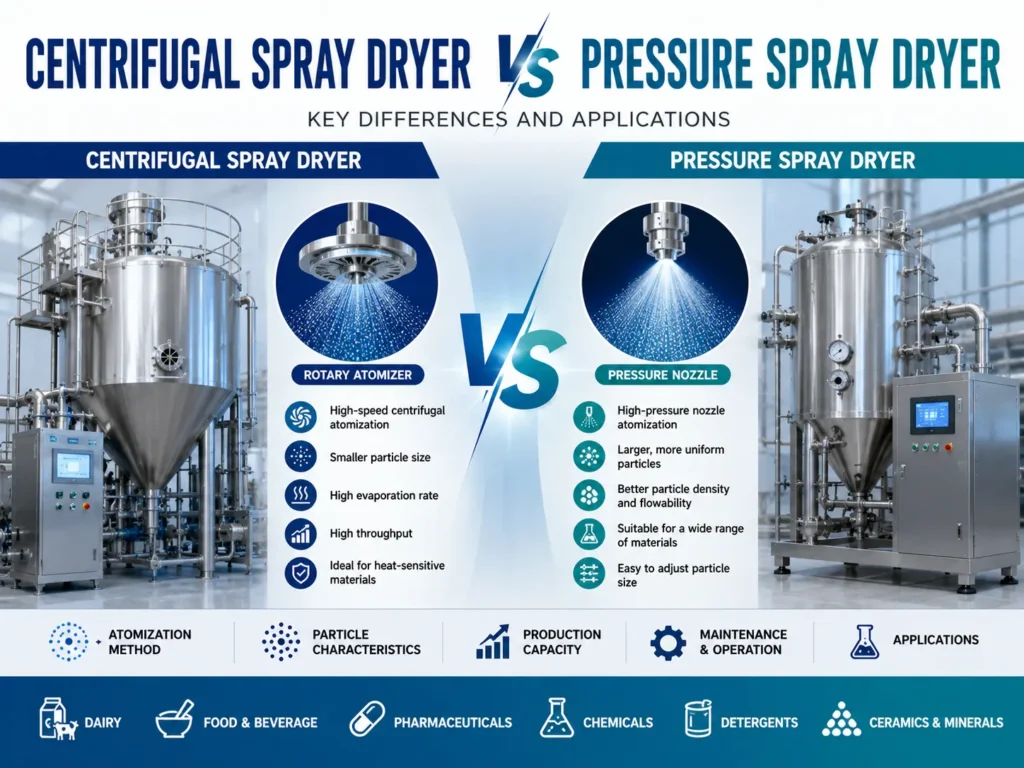
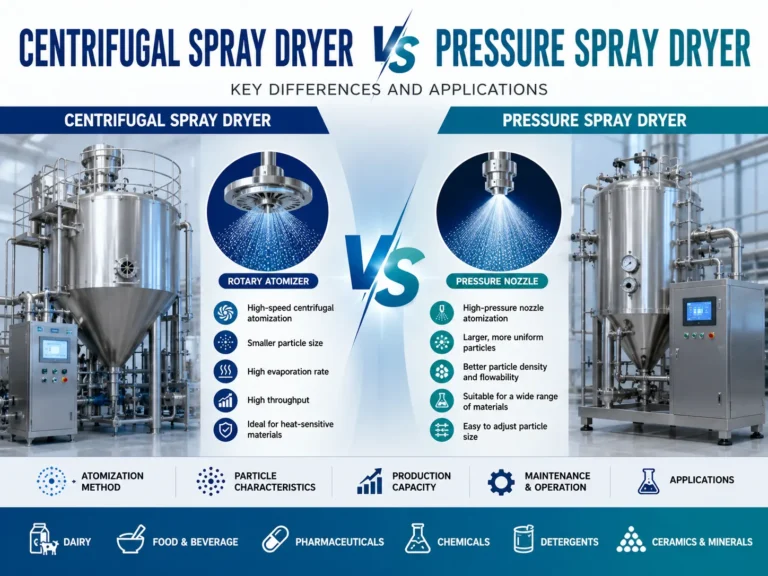
Os secadores por spray centrífugos e os secadores por spray de pressão são os dois tipos mais comuns de equipamentos usados no processo de secagem por spray., com a principal diferença em seus métodos de atomização. Cada sistema é projetado para atender às necessidades industriais específicas, tornando-os adequados para diferentes indústrias e aplicações.
O secador por spray centrífugo depende de um disco giratório de alta velocidade para atomizar alimentos líquidos, enquanto o secador por spray de pressão usa bombas e bicos de alta pressão para obter atomização. Compreender como essas duas tecnologias diferem é fundamental para empresas que buscam otimizar seu processo de secagem por pulverização, garantir a qualidade do produto, e alinhar seus equipamentos com seus requisitos de produção. Abaixo, detalhamos cada tipo de secador por spray, compare seus principais recursos, e orientá-lo na seleção do sistema certo para suas necessidades.
O que é um secador por spray centrífugo?
Um secador por spray centrífugo é um equipamento industrial especializado usado no processo de secagem por spray, caracterizado por seu método de atomização exclusivo. No centro deste secador está um atomizador rotativo, que consiste em um disco centrífugo de alta velocidade que gira em velocidades extremamente altas (tipicamente 10,000 para 30,000 RPM). A alimentação líquida (como pastas, soluções, ou emulsões) é alimentado no centro do disco giratório, onde a força centrífuga arremessa o líquido para fora. À medida que o líquido sai do disco, está dividido em minúsculos, gotículas uniformes através do processo de atomização centrífuga.
Essas gotículas são então imediatamente contatadas com uma corrente de ar quente na câmara de secagem, onde a umidade é rapidamente evaporada, convertendo as gotas em uma multa, pó de fluxo livre. Este processo de secagem por pulverização de alta velocidade é conhecido pela sua eficiência e capacidade de lidar com grandes volumes de ração, tornando-o uma escolha popular para produção em escala industrial. O método de atomização centrífuga garante que as gotas sejam distribuídas uniformemente, resultando em pó de qualidade consistente com variação mínima no tamanho das partículas.
O que é um secador por spray de pressão?
Um secador por spray de pressão é outro tipo amplamente utilizado de equipamento de secagem por spray, distingue-se pelo uso de atomização sob pressão para quebrar alimentos líquidos. Ao contrário do secador por spray centrífugo, que usa um disco giratório, o secador por spray de pressão utiliza uma bomba de alta pressão para forçar a alimentação do líquido através de um bico de pressão em pressões extremamente altas (tipicamente 100 para 300 bar). O bico de pressão é projetado para criar um jato fino de gotículas à medida que o líquido sai do bico, com a pressão determinando o tamanho e a uniformidade das gotículas.
O processo de secagem por pulverização de alta pressão produz gotas que são mais uniformes em tamanho e formato em comparação com os secadores por pulverização centrífugos. À medida que as gotas entram em contato com o ar quente na câmara de secagem, eles secam rapidamente e ficam densos, partículas esféricas. Essa capacidade de produzir resultados consistentes, partículas esféricas tornam o secador por spray de pressão ideal para aplicações onde a uniformidade do produto e a morfologia das partículas são críticas, como na produção de detergentes e cerâmicas.
Principais diferenças entre secadores centrífugos e por spray de pressão
Para ajudá-lo a compreender rapidamente as principais distinções entre secadores por spray centrífugos e de pressão, compilamos uma tabela de comparação abrangente - um elemento essencial para a elegibilidade do Google Featured Snippet, já que os mecanismos de pesquisa priorizam a clareza, comparações estruturadas para intenção do usuário.
| Recurso | Secador de Pulverização Centrífugo | Secador por spray de pressão |
|---|---|---|
| Método de atomização | Disco rotativo | Bocal de alta pressão |
| Forma de Partícula | Pó fino | Partículas esféricas densas |
| Tamanho de partícula | Menor | Maior |
| Capacidade de produção | Grande | Médio a grande |
| Consumo de energia | Pressão mais baixa da bomba | Maior demanda de pressão |
| Manutenção | Manutenção de disco | Manutenção do bico |
| Uniformidade do Produto | Bom | Excelente |
| Materiais adequados | Leite, produtos químicos | Cerâmica, detergentes |
Como a atomização afeta a qualidade do produto
O método de atomização é o fator mais crítico que influencia a qualidade do produto no processo de secagem por pulverização, pois determina diretamente a distribuição do tamanho das partículas, morfologia do pó, e desempenho geral do produto. Atomização centrífuga, usado em secadores de spray centrífugos, produz menor, partículas mais finas com formato mais irregular. Isso resulta em um pó com excelente fluidez, que é ideal para aplicações como leite em pó instantâneo ou proteína em pó, onde a dissolução rápida e o fácil manuseio são importantes.
Por outro lado, atomização por pressão - usada em secadores por spray de pressão - produz maior, partículas mais densas com formato esférico mais uniforme. A morfologia esférica aumenta a densidade de empacotamento do pó, tornando-o adequado para produtos que exigem alta densidade aparente, como detergentes ou pós cerâmicos. Adicionalmente, a distribuição estreita do tamanho das partículas obtida pela atomização sob pressão garante uma qualidade consistente do produto, o que é crítico para aplicações industriais onde a uniformidade é um requisito fundamental.
Vantagens dos secadores por spray centrífugos
Os secadores por spray centrífugos oferecem diversas vantagens importantes que os tornam a escolha preferida para muitas aplicações industriais.. Um de seus benefícios mais significativos é sua alta capacidade de produção, tornando-os ideais para fabricação em larga escala. Eles também são altamente adaptáveis, capaz de lidar com uma ampla variedade de alimentações líquidas com viscosidades variadas — desde soluções de baixa viscosidade até pastas de alta viscosidade — sem comprometer a qualidade da atomização.
Outra vantagem é sua operação estável, com risco mínimo de entupimento ou tempo de inatividade. Essa confiabilidade os torna adequados para ambientes de produção contínua. Os secadores por pulverização centrífugos são particularmente adequados para a produção de leite em pó, aditivos alimentares, e proteína em pó, onde tamanho de partícula fino e boa fluidez são essenciais. Seus requisitos de pressão de bomba mais baixos também contribuem para menor consumo de energia em comparação com secadores por spray de pressão.
Vantagens dos secadores por spray de pressão
Os secadores por spray de pressão são excelentes em aplicações onde a uniformidade do produto e a morfologia das partículas são críticas. Sua principal vantagem é a capacidade de produzir, partículas esféricas com excelente, distribuição estreita do tamanho das partículas – resultando em uniformidade superior do produto. Isso os torna ideais para produtos como detergentes, onde partículas esféricas garantem dissolução e desempenho consistentes.
Adicionalmente, as partículas esféricas produzidas por secadores por spray de pressão têm uma densidade aparente mais alta, o que reduz os custos de armazenamento e transporte. Eles também são adequados para a produção de pós cerâmicos, catalisadores, e outros materiais industriais onde o formato e a densidade das partículas afetam diretamente o desempenho do produto. O método de atomização por pressão também permite controle preciso sobre o tamanho das partículas, tornando mais fácil adaptar o produto aos requisitos específicos da aplicação.
Desvantagens dos secadores por spray centrífugos
Embora os secadores por spray centrífugos ofereçam inúmeros benefícios, eles têm suas desvantagens. Uma das principais desvantagens é que as partículas produzidas têm uma forma ligeiramente menos esférica em comparação com as dos secadores por pulverização de pressão., o que pode afetar a densidade aparente e a fluidez em algumas aplicações. Adicionalmente, o disco giratório de alta velocidade (atomizador rotativo) está sujeito a desgaste ao longo do tempo, exigindo manutenção regular e substituição ocasional.
Os componentes de alta velocidade dos secadores por pulverização centrífugos também requerem manutenção mais frequente para garantir um desempenho ideal, o que pode aumentar os custos operacionais. Além disso, enquanto eles lidam com uma ampla gama de viscosidades, alimentações de viscosidade extremamente alta ainda podem representar desafios para a atomização, levando a tamanhos de partículas inconsistentes.
Desvantagens dos secadores por spray de pressão
Os secadores por spray de pressão têm várias desvantagens importantes que as empresas devem considerar. A questão mais significativa é o risco de entupimento do bico, especialmente ao manusear alimentos com alto teor de sólidos ou impurezas. O entupimento pode levar a tempo de inatividade e aumento dos custos de manutenção, pois os bicos podem precisar ser limpos ou substituídos regularmente.
Outra desvantagem é o custo mais elevado associado ao sistema de alta pressão. As bombas e bicos de alta pressão requerem mais energia para operar, aumentando o consumo de energia em comparação com secadores por spray centrífugos. Os secadores por spray de pressão também apresentam custos de manutenção mais elevados, especialmente para substituição de bicos, que pode aumentar com o tempo. Adicionalmente, eles têm requisitos mais rígidos para a qualidade da ração – rações com impurezas excessivas ou viscosidade inconsistente podem afetar a atomização e a qualidade do produto.
Aplicações de secadores por spray centrífugos
Os secadores por spray centrífugos são versáteis e amplamente utilizados em vários setores, graças à sua alta capacidade e adaptabilidade. Abaixo está uma análise de suas principais aplicações por setor:
Indústria alimentícia
A indústria alimentícia é uma das maiores usuárias de secadores por spray centrífugos. As aplicações comuns incluem a produção de leite em pó, pó de café, e aromatizantes. O tamanho fino das partículas produzido pela atomização centrífuga garante rápida dissolução, tornando esses produtos ideais para consumo instantâneo. Adicionalmente, os secadores por spray centrífugos podem lidar com os grandes volumes de alimentação líquida necessários para a produção de alimentos em grande escala.
Indústria farmacêutica
Na indústria farmacêutica, secadores de spray centrífugos são usados para produzir extratos, enzimas, e outros ingredientes farmacêuticos. O processo de secagem suave (quando combinado com temperaturas de entrada controladas) ajuda a preservar os componentes ativos desses materiais sensíveis, enquanto a forma de pó fino os torna fáceis de formular em comprimidos, cápsulas, ou outras formas farmacêuticas.
Indústria química
Os secadores por spray centrífugos são usados na indústria química para produzir pigmentos, aditivos, e outros pós químicos. Sua capacidade de lidar com uma ampla gama de viscosidades e tipos de alimentação os torna adequados para diversas aplicações químicas, de produtos químicos orgânicos a inorgânicos.
Aplicações de secadores por spray de pressão
Os secadores por spray de pressão são usados principalmente em indústrias onde a uniformidade do produto e a morfologia das partículas são críticas. Suas principais aplicações incluem:
Indústria de Detergentes
A indústria de detergentes é uma grande usuária de secadores por spray de pressão, pois produzem denso, partículas de detergente esféricas que se dissolvem uniformemente e têm excelente desempenho de limpeza. O tamanho uniforme das partículas garante qualidade consistente do produto, que é essencial para a confiança do consumidor.
Indústria Cerâmica
Os secadores por spray de pressão são usados para produzir pós cerâmicos com tamanho e densidade de partícula controlados. As partículas esféricas garantem um empacotamento uniforme durante o processo de conformação cerâmica, resultando em componentes cerâmicos de alta qualidade com resistência e durabilidade consistentes.
Indústria química
Na indústria química, secadores por spray de pressão são usados para produzir sais inorgânicos, catalisadores, e outros produtos químicos. O controle preciso sobre o tamanho e a morfologia das partículas os torna ideais para aplicações onde o desempenho do produto depende das características das partículas.
Qual secador de spray é melhor?
Não existe uma resposta única para qual secador por spray é melhor – depende das características do material e dos requisitos de produção. A chave é combinar o método de atomização e os recursos do equipamento com suas necessidades específicas:
Escolha a secagem por pulverização centrífuga se:
- Alto rendimento é necessário para produção em larga escala
- É necessário pó fino com boa fluidez
- Ampla adaptabilidade de materiais (por exemplo, lidar com diferentes viscosidades) é necessário
- Menor pressão da bomba e consumo de energia são prioridades
Escolha secagem por spray de pressão se:
- Denso, partículas esféricas são necessárias
- Uma distribuição estreita de tamanho de partícula é necessária para uma qualidade consistente do produto
- Grânulos esféricos são preferidos para aplicações como detergentes ou cerâmica
- O controle preciso sobre a morfologia das partículas é crítico
Comparação de custos
O custo é um fator crítico para as empresas ao escolher entre secadores centrífugos e por spray de pressão, já que os usuários industriais estão particularmente focados nos custos operacionais de longo prazo. Abaixo está uma análise dos principais componentes de custo:
Investimento Inicial
O investimento inicial para secadores por pulverização centrífugos é normalmente menor do que para secadores por pulverização sob pressão, pois não requerem bombas de alta pressão ou bicos especializados. Os secadores por spray de pressão têm custos iniciais mais elevados devido ao complexo sistema de alta pressão e aos bicos de precisão.
Pressão operacional e custo de energia
Os sistemas de secagem por pulverização sob pressão geralmente exigem pressão de bombeamento mais alta e custos de manutenção do bico, levando a um maior consumo de energia em comparação com secadores por spray centrífugos. Os secadores por pulverização centrífugos têm requisitos de pressão de bomba mais baixos, resultando em custos de energia mais baixos ao longo do tempo.
Custo de manutenção
Os secadores por pulverização centrífugos requerem manutenção regular do disco rotativo (atomizador), incluindo limpeza e substituição devido ao desgaste. Os secadores por spray de pressão têm custos de manutenção mais elevados relacionados à substituição e limpeza dos bicos, pois os bicos são propensos a entupimento e desgaste devido à alta pressão.
Custos operacionais de longo prazo
Ao longo do tempo, os secadores por pulverização centrífugos tendem a ter custos operacionais mais baixos devido ao menor consumo de energia e à substituição menos frequente de componentes principais. Os secadores por spray de pressão têm custos mais elevados a longo prazo devido à substituição contínua dos bicos, maior uso de energia, e manutenção mais frequente.
Como escolher o secador por spray certo
A escolha do secador por spray certo requer consideração cuidadosa de vários fatores-chave para garantir que ele esteja alinhado com suas necessidades de produção e características do material. Para tomar uma decisão informada, avalie o seguinte:
- Viscosidade: Qual é a viscosidade da sua alimentação líquida? Os secadores por spray centrífugos lidam com uma ampla gama de viscosidades, enquanto os secadores por spray de pressão exigem uma viscosidade mais consistente.
- Conteúdo Sólido: Qual é o conteúdo sólido do seu feed? Alto teor de sólidos pode aumentar o risco de entupimento do bico em secadores por spray de pressão.
- Tamanho de partícula desejado: Você precisa de pó fino (centrífugo) ou maior, partículas esféricas (pressão)?
- Taxa de evaporação: Qual é a taxa de evaporação necessária para o seu processo de produção? Os secadores por spray centrífugos normalmente têm taxas de evaporação mais altas para produção em larga escala.
- Capacidade de produção: Você precisa de grande escala (centrífugo) ou médio a grande (pressão) capacidade de produção?
Nossa equipe de engenharia podemos recomendar a solução ideal de secagem por pulverização com base nas propriedades do material e nas metas de produção. Oferecemos consultas personalizadas, testes de materiais, e soluções personalizadas para garantir que seu processo de secagem por pulverização seja eficiente, econômico, e adaptado às suas necessidades específicas.
Perguntas frequentes (Perguntas frequentes)
Adicionar uma seção de perguntas frequentes é uma das maneiras mais eficazes de melhorar o desempenho de SEO, já que o Google costuma apresentar perguntas frequentes em trechos em destaque. Abaixo estão as perguntas frequentes recomendadas para direcionar pesquisas de usuários comuns:
Perguntas frequentes 1: Qual é a diferença entre secagem centrífuga e por pulverização sob pressão?
A principal diferença está nos métodos de atomização: a secagem por pulverização centrífuga usa um disco rotativo de alta velocidade para atomizar alimentos líquidos, enquanto a secagem por pulverização sob pressão usa bombas e bicos de alta pressão. Isso leva a diferenças no tamanho das partículas, forma, capacidade de produção, e requisitos de manutenção – os secadores por spray centrífugos produzem partículas mais finas e lidam com volumes maiores, enquanto os secadores por spray de pressão produzem, partículas esféricas.
Perguntas frequentes 2: Qual secador por spray produz partículas menores?
Os secadores por spray centrífugos produzem partículas menores em comparação com os secadores por spray de pressão. O método de atomização centrífuga, usando um disco giratório de alta velocidade, quebra o líquido em gotículas mais finas, resultando em um pó fino com tamanhos de partículas menores.
Perguntas frequentes 3: A secagem por pulverização sob pressão é mais cara??
Sim, a secagem por pulverização sob pressão é geralmente mais cara do que a secagem por pulverização centrífuga. Os secadores por spray de pressão têm custos de investimento iniciais mais elevados (devido a bombas de alta pressão e bicos de precisão), maior consumo de energia (de requisitos de pressão mais elevados), e maiores custos de manutenção (desde a substituição e limpeza do bico).
Perguntas frequentes 4: Qual secador por spray é melhor para leite em pó?
Os secadores por pulverização centrífugos são melhores para a produção de leite em pó. Eles lidam com grandes volumes de leite líquido de forma eficiente, produzir bem, pó de fluxo livre que se dissolve rapidamente, e são mais econômicos para produção em larga escala – todos fatores críticos para a fabricação de leite em pó.
Perguntas frequentes 5: Os secadores por spray de pressão podem lidar com materiais de alta viscosidade?
Os secadores por spray de pressão são menos adequados para materiais de alta viscosidade. Alimentações de alta viscosidade podem entupir o bocal de pressão, levando a tempo de inatividade e atomização inconsistente. Os secadores por spray centrífugos são mais adaptáveis e podem lidar com uma ampla gama de viscosidades, tornando-os uma melhor escolha para materiais de alta viscosidade.