Why Is Your Industrial Dryer Consuming So Much Energy? 5 Hidden Causes & Practical Optimization Solutions
If you’re a plant manager or procurement engineer running continuous production, you’ve probably felt the pain: your drying equipment is an unsung “energy hog” that eats through your monthly utility budget long after the initial purchase. For powder processing industries-from dairy powder to pharmaceutical ingredients-drying can account for 30-40% of total plant energy consumption. And when energy costs creep up, that extra kilowatt-hour directly hits your bottom line.
In this article, we’ll break down the most common hidden reasons behind excessive energy use in industrial drying, and share practical solutions that deliver measurable savings-no full equipment replacement required.
1. Poor Insulation: The Silent Energy Leak You Can’t See
It sounds obvious, but many operations overlook insulation degradation over years of high-temperature operation. When insulation cracks, falls off, or was improperly installed from the start, 20-30% of your thermal energy simply radiates into the factory instead of going into drying your material.
Practical fixes:
- Do a walk-around infrared scan to detect hot spots on the dryer body and ductwork
- Replace worn insulation with high-density ceramic fiber insulation for high-temperature applications
- Add removable insulation blankets on valves and flanges for better maintenance access and less heat loss
2. Over-drying: The Costly Habit That’s Hard to Break
Many operators run drying cycles longer than necessary “just to be safe”-especially when dealing with new materials or variable feed moisture content. Over-drying not only wastes energy, it can also degrade product quality (for example, making food powders more brittle or changing the crystalline structure of pharmaceutical ingredients).
Practical fixes:
- Install outlet moisture sensors to automatically stop the drying cycle once your target moisture is reached
- Work with your equipment supplier to adjust air flow and temperature profiles based on your specific material
- For continuous dryers, calibrate the feed rate and residence time to match your incoming moisture
3. Inefficient Airflow & Poor Heat Recovery
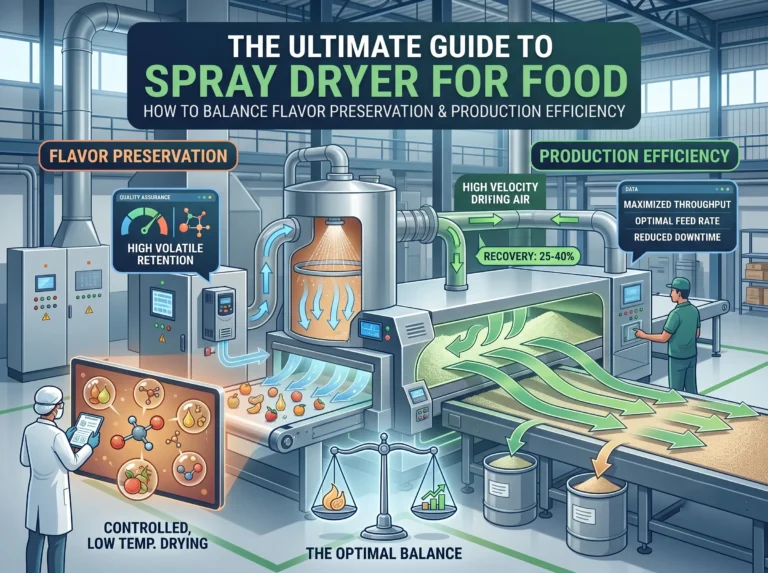
In most convective drying systems, hot air carries away moisture-but if the air recirculation system isn’t optimized, much of that heated air never gets into contact with your wet material, or exhausts without recovering heat. Open-loop systems without heat recovery can waste up to 60% of the input energy through the exhaust stack.
Practical fixes:
- Add a heat recovery exchanger to preheat incoming fresh air using exhaust heat
- Check for clogged air filters and blocked ducts that reduce airflow efficiency
- Work with an expert to rebalance air distribution across the drying chamber
4. Wrong Dryer Selection for Your Material
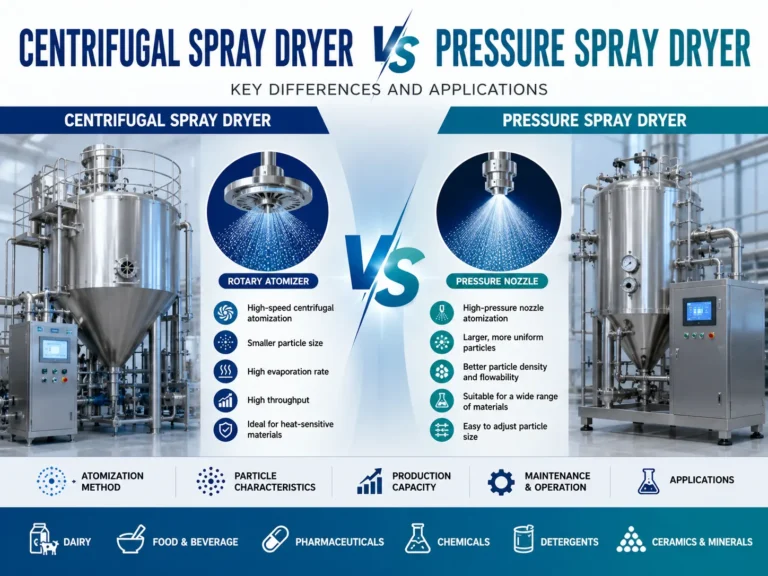
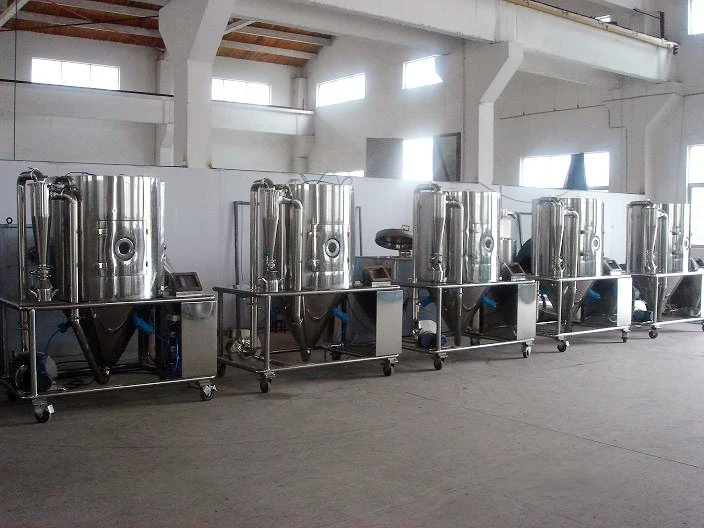
This is the most fundamental mistake, and it haunts buyers for the entire life of the equipment. A spray dryer designed for dairy powder won’t run efficiently on high-viscosity chemical pastes, just as a rotary drum dryer isn’t optimized for fine crystalline materials. Trying to force the wrong equipment to do the job always means higher energy consumption and poorer product quality.
Practical fixes:
- Before purchasing, share full material characteristics with your supplier (particle size, feed moisture, heat sensitivity, desired final moisture)
- Ask for a small-scale test run with your actual material to verify energy consumption before committing
- If you’re stuck with the wrong equipment, ask for a retrofitting consultation-sometimes minor modifications can deliver big savings
5. Lack of Regular Maintenance
Over time, scale builds up on heating coils, fans become unbalanced, and seals wear out, allowing hot air to leak. These gradual changes don’t happen overnight, so many operations don’t notice until their energy bill jumps 15-20%.
Practical fixes:
- Create a simple maintenance checklist: monthly filter changes, quarterly inspection of seals and insulation, annual balance check for fans
- Clean heating surfaces regularly to maintain good heat transfer efficiency
- Keep a log of energy consumption per ton of product-this helps you spot efficiency trends before costs get out of hand
How Jiangsu Changshi Drying Technology Helps You Cut Energy Costs
At Jiangsu Changshi, we know that for industrial buyers, the “low upfront price” tag doesn’t mean much if your operating costs kill your margins over the long term. That’s why every drying solution we deliver is engineered with energy efficiency from the start:
- ? 100% Made-to-measure for your material: We design the airflow, temperature profile, and retention time specifically for your product characteristics-no one-size-fits-all that wastes energy
- ? Optimized heat recovery systems: We integrate energy recovery exchangers into our designs wherever possible, cutting fresh energy input by 20-35%
- ? Full transparency in performance: We share clear energy consumption estimates based on your operating conditions before you order
- ? 24/7 technical support: When you need help optimizing your process, our engineering team is ready to respond quickly to keep your line running efficiently
If you’re planning a new drying line or struggling with an existing dryer that’s eating too much energy, contact our engineering team today for a free consultation. We’ll help you identify the real energy hogs and find a solution that fits your budget and production needs.
This article was written for plant managers, process engineers, and procurement professionals in the food, pharmaceutical, chemical, and mineral processing industries who need practical, actionable information to improve their drying process efficiency.