Qu'est-ce qu'un séchoir par pulvérisation? Guide complet du débutant pour les achats B2B
Dans la fabrication industrielle moderne, convertir des matières premières liquides en stables, fluide, et des poudres très uniformes constituent une exigence fondamentale dans plusieurs secteurs. Des ingrédients pharmaceutiques de haute pureté et catalyseurs chimiques avancés aux ingrédients alimentaires en vrac comme les poudres laitières, la manipulation efficace des liquides nécessite une technologie de traitement thermique à la fois exceptionnellement rapide et respectueuse du matériau. C’est là que le séchoir par pulvérisation industriel devient indispensable.
Pour les responsables des achats, ingénieurs de procédés, et directeurs d'installations entrant sur le marché des machines de traitement thermique, comprendre les mécanismes fondamentaux, variantes de configuration, et les critères de sélection d'un séchoir par pulvérisation constituent la première étape vers l'optimisation d'une ligne de production automatisée. Ce guide sert de guide opérationnel complet sur les systèmes de séchage par pulvérisation industriels..
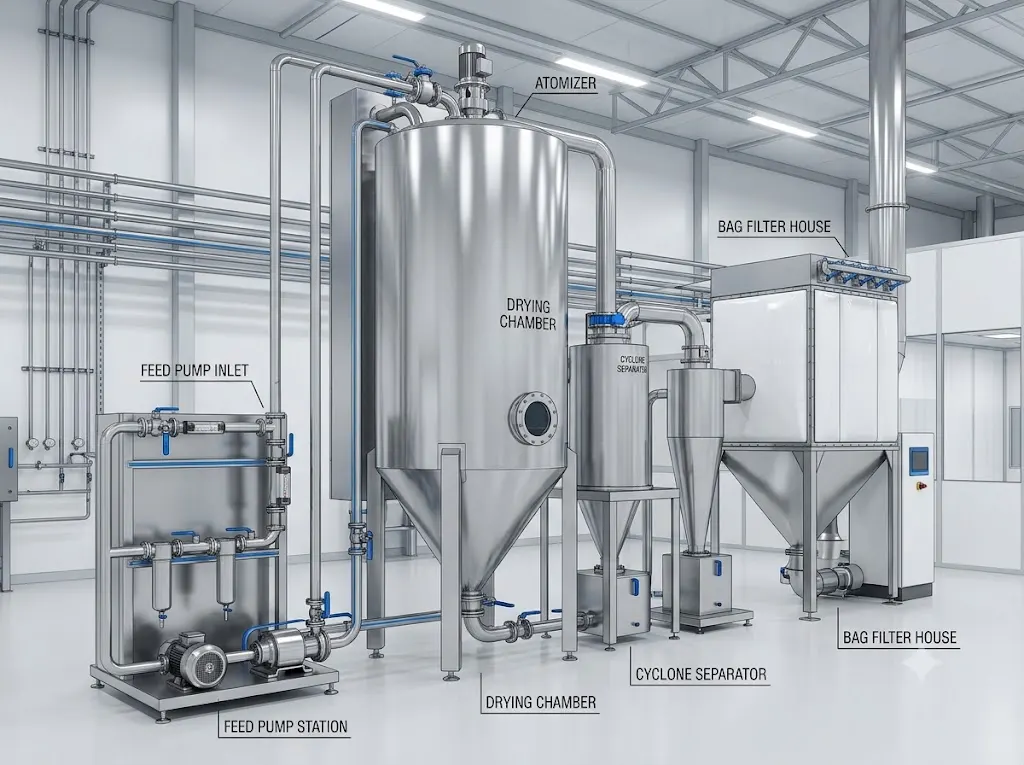
Définition du processus de séchage par pulvérisation
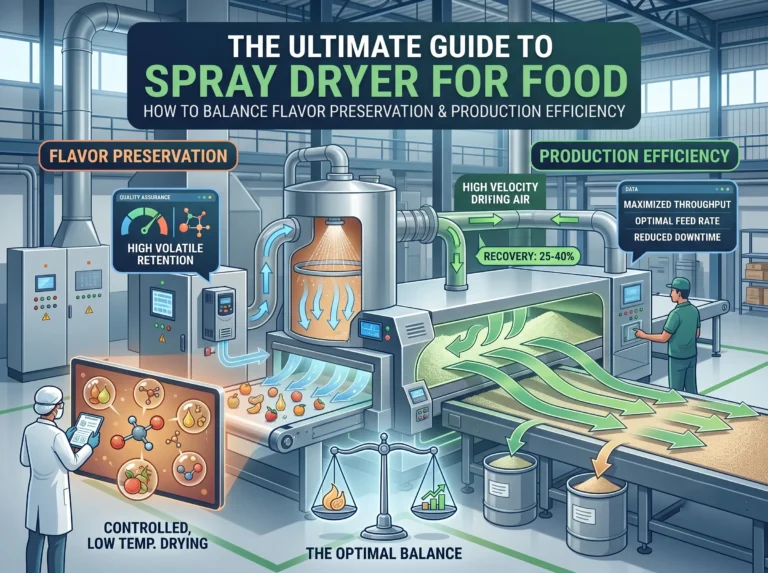
À la base, un séchoir par pulvérisation est un système thermodynamique hautement spécialisé qui réalise simultanément la formation et le séchage des particules. Le processus implique de prendre une matière première liquide, ce qui peut être une solution, suspension, émulsion, ou du lisier - et en l'atomisant en un fin brouillard de gouttelettes à l'intérieur d'une grande chambre de séchage.
Lorsque ces gouttelettes entrent en contact avec un flux contrôlé d'air chaud à grande vitesse, l'humidité s'évapore presque instantanément. Le liquide se transforme en solide, particules sèches en quelques secondes (ou même des fractions de seconde), tombant au fond du système de collecte sous forme d'une poudre parfaitement uniforme, éliminant complètement le besoin de broyage mécanique intermédiaire ou de tamisage post-traitement.
Les quatre étapes principales d'un système de séchage par pulvérisation industriel
Un optimisé, Le séchoir par pulvérisation robuste fonctionne grâce à un flux continu, cycle thermodynamique en quatre étapes. Chaque étape doit être précisément calibrée pour éviter la dégradation des matériaux, répartition inégale de la taille des particules, ou accumulation de parois de chambre.
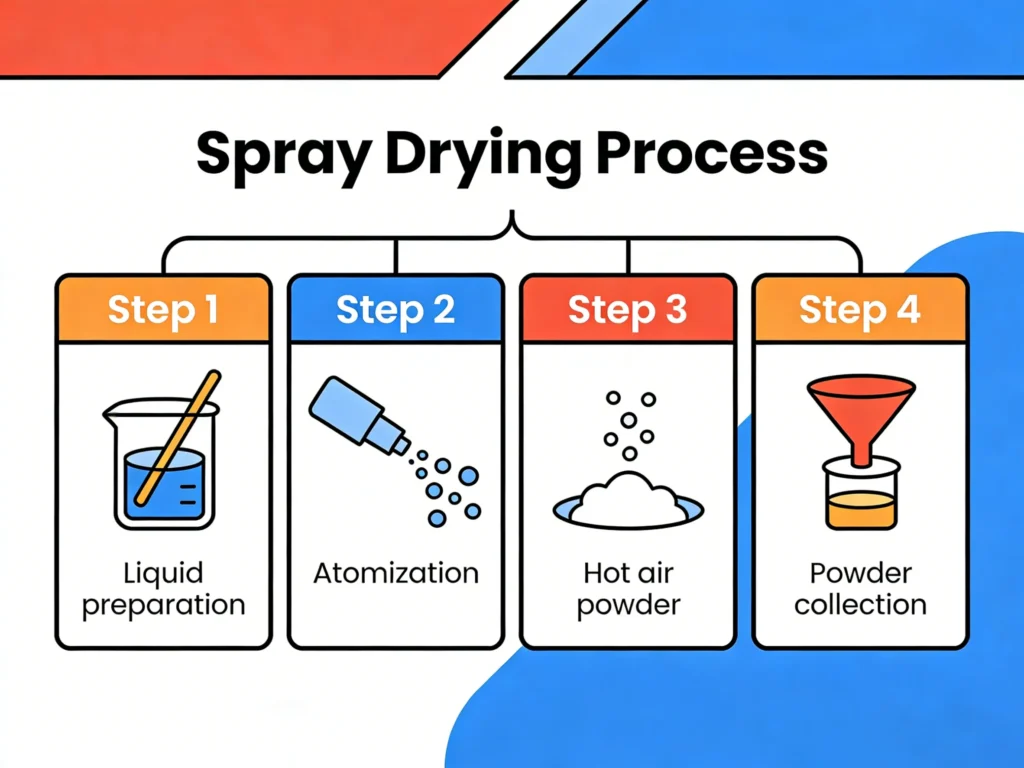
[Liquid Feedstock] ➔ [1. Atomization] ➔ [2. Air-Droplet Contact] ➔ [3. Rapid Evaporation] ➔ [4. Powder Separation]
1. Atomisation des matières premières
L'étape d'atomisation est le cœur du système. Son objectif est de maximiser le rapport surface/volume ($$AV/V) de l'alimentation liquide, facilitant un transfert de chaleur ultra-rapide. Il existe deux principaux types d'atomiseurs utilisés dans les configurations industrielles:
- Atomiseurs rotatifs (Disques centrifuges): Utilisez un disque rotatif à grande vitesse pour projeter le liquide vers l'extérieur via la force centrifuge.. Ils excellent dans la gestion des boues à haute viscosité et offrent un contrôle flexible de la taille des particules via le réglage de la vitesse du disque..
- Atomiseurs à buse (Pression ou bifluide): Forcer le liquide à travers un orifice calibré sous haute pression ou utiliser du gaz comprimé pour briser le fluide.. Ils sont idéaux pour produire des distributions granulométriques étroites et sont largement utilisés dans les applications pharmaceutiques..
2. Contact air-gouttelette et aérodynamique des fluides
Une fois atomisé, le panache de gouttelettes pénètre dans la chambre de séchage, où il rencontre le milieu de séchage chauffé (généralement de l'air, ou un gaz inerte comme l'azote pour les solvants organiques volatils). Le modèle de flux d'air détermine la trajectoire et le temps de séjour des particules:
- Flux de co-courant: L'air chaud et les gouttelettes se déplacent dans la même direction. C'est idéal pour les matériaux sensibles à la chaleur, car l'air le plus chaud entre en contact avec les gouttelettes les plus humides., refroidir l'air instantanément par évaporation avant que le produit ne surchauffe.
- Flux à contre-courant: L'air et les gouttelettes se déplacent dans des directions opposées. Ceci est adapté aux matériaux résistants à la chaleur nécessitant une humidité résiduelle extrêmement faible..
- Flux mixte: Un modèle de combinaison utilisé pour des, conceptions industrielles robustes.
3. Évaporation de l'humidité et formation de particules
Alors que l'air chaud entoure les gouttelettes atomisées, transfert de chaleur dans le liquide, provoquant une vaporisation rapide du solvant. La gouttelette passe par une étape critique de formation de croûte, se transformer d'une sphère liquide en un solide, coque de particules sèches. Parce que l'évaporation se produit si rapidement, la température du produit à cœur reste nettement inférieure à la température de sortie de l'air, préserver les principes actifs délicats.
4. Séparation et collecte cycloniques des produits
La dernière étape consiste à séparer la poudre sèche du flux d’air humide évacué.. Les systèmes industriels déploient des séparateurs cycloniques à haute efficacité qui utilisent les forces centrifuges pour déposer la poudre la plus lourde dans des trémies de collecte tout en évacuant la poudre propre., air filtré hors de la cheminée d'échappement via des filtres à manches ou des épurateurs humides pour répondre aux normes strictes d'émissions environnementales.
Aller au-delà des machines standard du catalogue: L’impératif de l’ingénierie personnalisée
Pour les acheteurs B2B, un point d'échec courant est l'achat d'un générique, un séchoir par pulvérisation disponible dans le commerce et s'attend à ce qu'il gère les propriétés matérielles uniques dès le départ. Différentes matières premières présentent des comportements très divers en termes de viscosité, caractère collant, stabilité thermique, et structures de conformité légale.
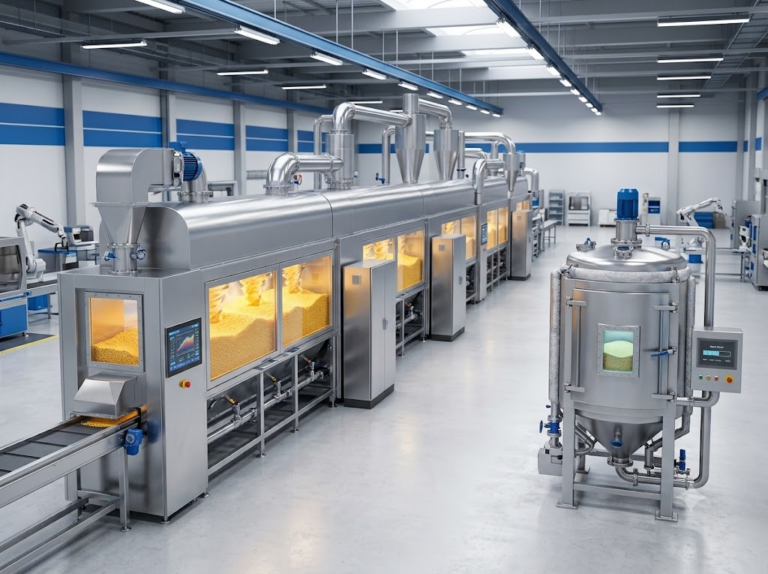
Chez Jiangsu Changshi Drying Technology Co., Ltd., nous avons dépensé plus 20 années (avec certaines divisions internes spécialisées s'appuyant sur plus de 30 années d'expérience en fabrication) ingénierie de solutions de traitement des poudres personnalisées. Opérant à partir de notre infrastructure d'atelier standard moderne de 10 000㎡ et soutenu par un R d'élite&Centre D avec plus de 20 ingénieurs seniors expérimentés, nous ne vendons pas simplement des machines : nous concevons des systèmes complets de production de poudre clé en main.
[Raw Product Parameters] ➔ [Material Precision Test] ➔ [Custom Engineering & Scale-Up] ➔ [GMP Factory Integration]
Notre équipe d'ingénieurs comble le fossé entre le matériel de base et le traitement haute performance en intégrant des normes propriétaires rigoureuses.:
- Tests de précision des matériaux: Avant de finaliser toute configuration de machine, nous proposons une adaptation complète des processus et des tests de matériaux pour cartographier avec précision les courbes d'évaporation et les points de transition vitreuse de vos matières premières.
- Conformité stricte aux certifications: Pour les clients pharmaceutiques et alimentaires, nos systèmes sont conçus, brillant, et fabriqué entièrement conformément à des normes strictes Normes de certification BPF, avec nettoyage en place sans couture (CIP) intégrations de nettoyage.
- Fortune 500 Sélection de composants éprouvés: Au fil des années, nos usines ont livré avec succès des équipements de support et des solutions techniques pour des dizaines de Fortune 500 entreprises, utilisant un système électrique de classe mondiale, acier inoxydable de première qualité, et intégrations de sécurité antidéflagrantes.
- Exécution du projet de bout en bout: De la conception initiale de machines personnalisées à l'emballage maritime international, personnalisation de la tension standard (par ex., 380V/415V/440V, 50Hz/60 Hz), et complet 7*24 support technique en ligne, nous veillons à ce que votre calendrier d’approvisionnement reste transparent et sécurisé.
FAQ: Clarifications techniques à haute intention
T1: Quelles informations une équipe d'approvisionnement B2B doit-elle fournir pour obtenir un devis précis pour un séchoir par pulvérisation?
Pour concevoir un plan de système précis et un devis, votre équipe devrait fournir: 1) Le nom précis et les caractéristiques chimiques de la matière première; 2) Le pourcentage de matière solide de l'alimentation liquide; 3) La capacité d’entrée initiale requise (kg/h d'aliment liquide) et cibler le pourcentage d'humidité final (par ex., <0.5%); 4) La disponibilité de la source de chaleur (vapeur, électricité, gaz naturel, ou du fioul); et 5) Tout mandat de conformité spécifique au secteur, tels que les classements antidéflagrants ou les configurations GMP.
T2: Pourquoi choisir un séchoir par pulvérisation plutôt qu'un séchoir à plateaux traditionnel ou un séchoir à étagères sous vide?
Les séchoirs à plateaux traditionnels fonctionnent selon des cycles discontinus, nécessitant un travail manuel important pour le chargement, déchargement, et broyage mécanique ultérieur pour transformer un gâteau séché en poudre, ce qui augmente le risque de contamination. Un séchoir par pulvérisation fonctionne en continu, boucle entièrement automatisée, transition du liquide directement vers le structuré, poudre uniforme en quelques secondes. Cela réduit considérablement les coûts de main-d'œuvre, réduit considérablement la dépense énergétique par kilogramme de production, et élimine complètement le risque de contamination croisée de l'environnement.
T3: Comment votre usine garantit-elle la disponibilité des pièces et le support technique après une installation globale?
En tant que fabricant industriel établi de vente directe, générant un chiffre d'affaires annuel de plus de 200 unités de traitement dans le monde entier, Jiangsu Changshi Technology maintient un inventaire mondial dédié de pièces de rechange. Nous fournissons des schémas d'implantation techniques complets et une documentation technique pour chaque unité personnalisée.. En outre, nos équipes commerciales et techniques professionnelles fournissent 7*24 Service d'assistance en ligne d'une heure pour diagnostiquer les problèmes opérationnels, assurer le remplacement des buses, scellés, ou des composants électriques automatisés peuvent être expédiés immédiatement sur votre site via une logistique internationale prioritaire.
Concevez votre prochaine ligne de production de poudre
Investir dans un séchoir par pulvérisation industriel haute performance est une étape opérationnelle qui dicte la capacité de production et la qualité des produits de votre usine pour les décennies à venir.. Assurez-vous que vos dépenses en capital génèrent un retour sur investissement maximal en vous associant à un leader vérifié du secteur..
Contactez le service projets internationaux au Jiangsu Changshi Drying Technology Co., Ltée. dès aujourd'hui pour demander un catalogue d'équipement gratuit ou planifier une consultation technique virtuelle. Laissez notre 20+ L'équipe d'ingénierie des membres évalue vos objectifs de traitement et conçoit un système personnalisé, système de séchage par pulvérisation à haute efficacité parfaitement optimisé pour votre matière première.