Hollow Paddle Dryer Working Principle: Thermal Design & Engineering Guide
If you operate a chemical processing plant or sludge recovery facility, you know the severe operational headache of handling sticky pastes, cake filters, and heat-sensitive sludges. Der hollow paddle dryer working principle offers an indirect, conductive thermal solution that maximizes thermal efficiency while drastically reducing exhaust gas volume.
In unserem 20 years of manufacturing custom industrial dryers at JSCSTECH, we have engineered hollow paddle systems across chemical, environmental, and metallurgical sectors. Unlike direct convective dryers that require massive air filtration and baghouses, hollow paddle dryers transfer over 80% Zu 90% of thermal energy directly through heated metal surfaces.
Understanding how the hollow paddle dryer working principle operates enables plant managers and process engineers to prevent material agglomeration, optimize heat transfer coefficients, and achieve precise moisture targets. Let us examine the internal thermodynamics, mechanical design, and selection criteria.

Why Direct Convective Dryers Fail with Viscous Pastes and Sludges
Direct hot air dryers such as rotary drums and flash dryers depend on massive volumes of heated air passing across wet material. When handling high-viscosity pastes, filter cakes, or hazardous chemical sludges, direct air creates severe material entrainment and massive thermal losses in exhaust stacks.
Außerdem, fine toxic particulates and volatile organic compounds (VOCs) become suspended in the airflow, necessitating complex and expensive multi-stage cyclone separators, wet scrubbers, and baghouses. Dust explosion risks and thermal degradation of heat-sensitive compounds represent persistent operational hazards.
By contrast, Die hollow paddle dryer working principle relies on conductive heat transfer without requiring sweeping carrier gas streams. Only a minimal carrier airflow or inert nitrogen purge is needed to evacuate evaporated solvent vapors from the sealed drying trough.
Core Mechanics of the Hollow Paddle Dryer Working Principle
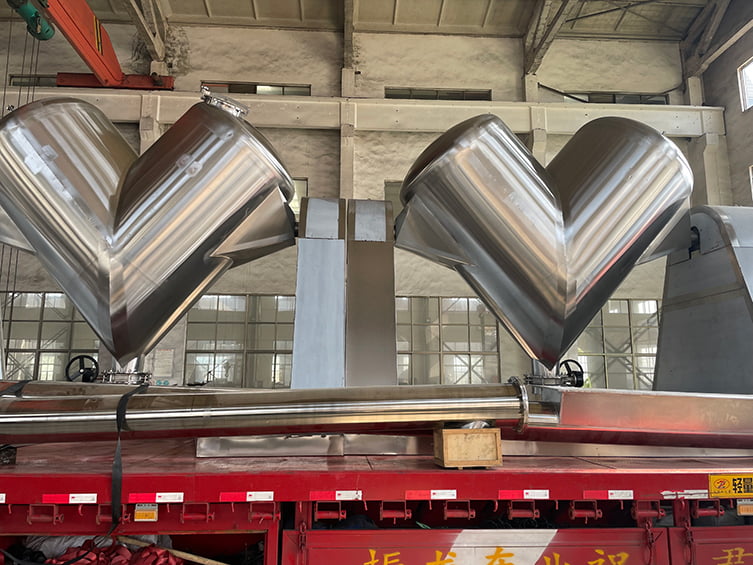
The hollow paddle dryer consists of a horizontal W-shaped jacketed vessel housing two or four intermeshing hollow shafts. Specially designed wedge-shaped hollow paddle blades are welded along the shafts, creating a dense heating surface within a compact footprint.
Heating media such as saturated steam (0.3 Zu 1.0 MPa), Thermoöl (up to 280°C), or pressurized hot water circulates through both the outer jacket and the interior hollow shafts and blades. As the twin shafts rotate slowly in counter-directions at 5 Zu 20 U/min, the wedge-shaped blades slice through the material bed.
The inclined surfaces of the wedge blades push material forward while simultaneously exerting a self-cleaning shearing action against adjacent blades. This continuous renewal of the contact boundary layer achieves exceptional heat transfer coefficients ranging from 80 Zu 250 W/(m²·K).
Key Engineering Parameters for Hollow Paddle Dryer Sizing
Accurate sizing of a hollow paddle dryer requires calculating the required thermal contact area based on feed moisture, target discharge moisture, and material specific heat. Thermal engineers rely on established heat duty models to determine exact equipment geometry.
The governing conductive thermal relationship is expressed as $$Q = K \cdot A \cdot \Delta T_m$$. In this formula, $Q$ represents the total required heat duty (kJ/h), $K$ is the overall heat transfer coefficient (W/m²·°C), $A$ is the total effective heating area (m²), and $\Delta T_m$ is the logarithmic mean temperature difference between the heating medium and the material bed.
At our 10,000 m² Produktionsstätte, we test slurry rheology to determine the specific evaporation rate, which typically ranges from 10 Zu 35 kg of water per square meter of heating area per hour (kg H₂O/m²·h). Selecting the correct shaft speed and weir height ensures optimal bed residence time between 30 Und 120 Minuten.
Hollow Paddle Dryer vs. Alternative Industrial Drying Technologies
Selecting the appropriate thermal drying technology requires comparing thermal efficiency, exhaust gas volume, and material handling capabilities across industrial equipment classes. Evaluating these parameters helps plant engineers avoid costly equipment mismatches.
| Besonderheit / Metrisch | Hohlschaufeltrockner | Rotary Drum Scraper Dryer | Kontinuierlicher Plattentrockner |
|---|---|---|---|
| Primary Heat Mode | Indirect Conduction (Jacket + Blades) | Indirect Thin-Film Conduction | Indirect Multi-Tier Conduction |
| Thermische Effizienz | 80% – 90% (High Steam Economy) | 75% – 85% | 80% – 88% |
| Feed Consistency | Sticky Pastes, Sludge, Granules | Liquid Slurries, Viscous Emulsions | Free-Flowing Granules, Powders |
| Exhaust Gas Volume | Extremely Low (Evaporation only) | Low to Moderate | Niedrig (Optional Enclosed Sweep) |
| Footprint per Area | Very Compact (High area density) | Mäßig | Vertical Column (Low footprint) |
| Lösungsmittelrückgewinnung | Exzellent (>95% in sealed loop) | Mäßig | Exzellent (Enclosed Casing) |
Integration and Material Handling Within Continuous Processing Lines
In complex production facilities, hollow paddle dryers frequently integrate with upstream dewatering centrifuges and downstream pulverizing systems. Explore our comprehensive industrielle Trocknungsgeräte catalog for complete thermal drying line configurations.
For thin-film slurry drying applications, compare with our rotary drum scraper dryer working principle guide. To evaluate energy consumption across drying types, refer to our industrial dryer energy consumption optimization guide.
For authoritative thermodynamic models on indirect contact conductive drying and paddle agitation mechanics, consult ScienceDirect paddle dryer thermal research. These peer-reviewed engineering papers provide valuable benchmarks for overall heat transfer coefficients.
Checkliste für Lieferantenaudits: 5 Documents to Request Before Ordering a Hollow Paddle Dryer
When procuring an industrial hollow paddle dryer, technical validation of fabrication tolerances and pressure ratings is essential. Require prospective equipment manufacturers to provide the following 5 engineering documents prior to signing commercial contracts:
- ASME / CE Pressure Vessel Calculation & Certificate: Verifies jacket and hollow shaft pressure integrity under design steam pressure and temperature.
- Hollow Shaft Dynamic Balancing & Concentricity Report: Confirms runout tolerances below 0.05 mm to prevent premature mechanical seal wear and bearing failure.
- Material Mill Test Certificates (MTC EN 10204 3.1): Proves metallurgy for contact surfaces (SS304, SS316L, 2205 Duplex, or Titanium).
- Welding Procedure Specification (WPS) & NDT X-Ray Inspection: Validates full-penetration welding on hollow paddle blades to eliminate thermal media leakage risks.
- Full-Load Factory Acceptance Test (FETT) Run Record: Documents 4-hour idle and continuous torque monitoring with full hydraulic drive verification.
Frequently Asked Questions About Hollow Paddle Dryers
Q1: What heating media can be utilized in a hollow paddle dryer?
Hollow paddle dryers operate reliably with saturated steam (0.2 Zu 1.2 MPa), high-temperature thermal oil (up to 300°C), or pressurized hot water. Bei JSCSTECH, we custom-engineer rotary joint assemblies and internal baffle distributors to match your plant available thermal utilities. When assessing suppliers, verify rotary joint pressure ratings and thermal expansion clearances.
Q2: How does the hollow paddle dryer prevent material buildup and wall baking?
The triangular wedge geometry creates continuous shearing forces between opposing intermeshing shafts as they rotate in opposite directions. This dynamic agitation continuously sweeps material off heated surfaces before static baking can occur. We recommend requesting finite element blade angle simulations to verify self-cleaning action for high-viscosity feeds.
Q3: Can a hollow paddle dryer handle flammable solvents and toxic materials?
Ja, hollow paddle dryers operate under fully enclosed sealed atmospheres with nitrogen inerting and dedicated condenser recovery loops. Because carrier gas flow is minimal, solvent recovery rates regularly exceed 98% with zero fugitive emissions. Ensure your manufacturer provides ATEX explosion-proof certification and double-cartridge mechanical seals.
Contact Our Engineering Team via WhatsApp: +86 137 7529 9712