Best Dryer for Lithium Carbonate: Optimizing Lithium Battery Material Drying Process
The exponential surge in global electric vehicle (EV) deployment and grid-scale energy storage systems has placed unprecedented pressure on the upstream battery chemical supply chain. At the heart of this transition is lithium carbonate ($\text{Li}_2\text{CO}_3$), a foundational precursor for high-performance cathode materials. For chemical process engineers and procurement managers managing battery-grade refineries, raw material processing must achieve near-flawless chemical purity and physical uniformity to comply with Tier-1 battery cell manufacturer specifications.
Among the various thermal unit operations involved in refining, selecting the best dryer for lithium carbonate is a critical decision that directly governs product quality and production costs. Residual moisture or inconsistent particle properties in lithium carbonate can compromise downstream cathode synthesis, making thermal optimization an absolute baseline requirement for commercial profitability.
The Strict Physical Boundaries of Battery-Grade Lithium Carbonate
Refining lithium carbonate into a battery-grade product requiring $\ge 99.5\%$ purity presents severe chemical and physical engineering challenges. The material exhibits complex rheological changes depending on moisture content and is highly prone to localized agglomeration.
Furthermore, industrial equipment must operate under absolute contamination control:
- Magnetic Contamination Invalidation: Even parts-per-billion ($\text{ppb}$) levels of transitional metal impurities, such as iron ($\text{Fe}$), copper ($\text{Cu}$), or chromium ($\text{Cr}$), can lead to internal micro-short circuits in the final lithium-ion battery cells, inducing catastrophic thermal runaway risks.
- Moisture Volatility Constraints: The final moisture content of the powder must be strictly controlled to below $0.1\%$. Any excess moisture accelerates side reactions during cathode blending, causing gas generation and rapid capacity fading in the finished cells.
Technical Evaluation of Primary Drying Technologies for Lithium Carbonate
Selecting the correct industrial drying machinery requires a balanced assessment of energy efficiency, particle size preservation, and material containment. Two primary systems dominate the high-capacity battery material refinery space:
[Wet Lithium Carbonate Feed]
       │
       ├─► Option A: Industrial Fluidized Bed Dryer (Best for Particle Integrity & Continuous Automation)
       │
       └─► Option B: Heavy-Duty Rotary Dryer (High Capacity, requires specialized non-metallic lining)
1. Industrial Fluidized Bed Dryers
An industrial fluidized bed dryer achieves moisture removal by suspended heat exchange. Hot, conditioned air passes upward through a perforated distributor plate, lifting and fluidizing the lithium carbonate particles into a dynamic, boiling-like bed state.
- Thermodynamic Efficiency: Because every individual particle is enveloped by the drying medium, the heat and mass transfer rates are extraordinarily high. This allows for gentle, low-temperature drying that effectively achieves the $<0.1\%$ moisture threshold without localized thermal over-processing.
- Mechanical Reliability: The absence of aggressive mechanical agitators minimizes particle attrition. This ensures that the carefully engineered particle size distribution ($\text{D50}$) from upstream precipitation remains unaltered during drying.
2. Heavy-Duty Rotary Dryers
Industrial rotary dryers utilize a slightly inclined, rotating cylindrical shell to cascade the wet lithium carbonate paste through a counter-current or co-current stream of hot air.
- Capacity Handling: Rotary systems excel at managing large bulk volumes and variable cake inputs.
- Contamination Risks: The continuous friction between the material and the metallic walls presents a high risk of iron contamination due to physical abrasion. To mitigate this, rotary cylinders intended for battery chemistry must be extensively lined with specialized materials like titanium, tungsten carbide, or engineered ceramics, significantly increasing capital expenditure.
The Engineering Solution: Battery-Grade Non-Contamination Systems
Eliminating impurity risks while scaling throughput demands an uncompromised, custom engineering approach. At Jiangsu Changshi Drying Technology Co., Ltd., we provide targeted Custom Machine Design (OEM/ODM) solutions that address the stringent quality control protocols required by modern battery material plants. Supported by our dedicated team of over 20 senior process engineers and 30+ years of industrial design experience, we deliver fully integrated, continuous powder production lines engineered for zero-contamination operations.
To guarantee high-efficiency, battery-grade output, our specialized lithium carbonate processing lines integrate several critical mechanical safeguards:
- Comprehensive Magnetic Containment: Every internal contact surface—including the fluidized bed chamber, distributor plates, ducting, and cyclone separators—is either fabricated from premium-grade alloys or coated with advanced non-metallic fluoropolymers (PTFE/PFA) or technical ceramics. This eliminates any direct metal-on-powder contact, keeping magnetic iron impurities strictly below international battery-grade tolerances.
- Advanced Closed-Loop Air Recirculation: To prevent the ingestion of ambient airborne particles or environmental moisture, our systems utilize closed-loop air handling configured with multi-stage HEPA filtration and dehumidification loops, ensuring an ultra-pure drying environment.
- Precision Integrated Automation: Leveraging custom PLC controls, our systems dynamically modulate feed rate, fluidization velocity, and thermodynamic zoning. This allows processing plants to scale up to massive multi-ton daily outputs while guaranteeing a continuous, completely uniform, and dry powder yield.
- Rigorous Standard Compliance: Manufactured inside our 10,000㎡ modern manufacturing infrastructure, every system complies with stringent engineering guidelines and undergoes strict inspection protocols before global deployment.
FAQ: High-Intent Technical Clarifications
Q1: How does the choice of dryer affect the final particle size distribution (D50) of lithium carbonate?
Mechanical friction inside low-end rotary or aggressive screw-conveyor dryers causes severe particle shearing, altering the raw material’s crystalline structure and fracturing delicate aggregates. This creates an unpredictable shift in the $\text{D50}$ curve, which directly harms downstream cathode coating consistency. An industrial fluidized bed dryer completely resolves this problem because the material is supported entirely by a cushion of air, ensuring near-zero mechanical friction and preserving original particle geometry.
Q2: What parameters prevent the caking of wet lithium carbonate cakes at the dryer inlet?
Wet lithium carbonate filter cakes frequently exhibit thixotropic characteristics, meaning they can consolidate and cake at the primary feed inlet. To prevent inlet blockages, Jiangsu Changshi Technology utilizes custom-engineered, anti-sticking rotary feeders or integrated dual-shaft lump breakers that continuously condition the cake before it enters the fluidization chamber. Combined with targeted high-velocity hot air injection at the feed zone, this ensures the material flashes into a fluid state instantly upon entry.
Q3: Can your drying systems handle the customization required for high-altitude lithium extraction projects?
Yes. Many of the world’s largest lithium brine reserves are located in high-altitude environments (such as South America or Western China), where lower atmospheric pressure changes air density and dramatically alters thermal fan performance and vapor vaporization kinetics. Our 20+ member engineering team utilizes advanced thermodynamic modeling to custom-configure your system’s fan capacities, air volume ratios, and heat source sizing to ensure identical production yields regardless of geographical altitude.
Secure Your Battery Chemical Market Share
Scaling up your lithium refinery requires equipment that matches the rapid, high-purity demands of modern battery supply chains. Avoid the operational pitfalls of unoptimized, high-contamination machinery.
Contact the commercial experts at Jiangsu Changshi Drying Technology Co., Ltd. today to secure our updated product catalog or to consult directly with our technical team. Let our engineers perform a customized Material Precision Test and Process Matching analysis using your specific feedstock to develop a high-capacity, contamination-free drying solution optimized for your refinery.
🎨 AI Image Generation Prompt (For the 4:3 Article Image)
To generate the perfect high-conversion visual asset for this article, input the following prompt into your preferred AI image generator (e.g., Midjourney, DALL-E 3) using a 4:3 aspect ratio:
Prompt:
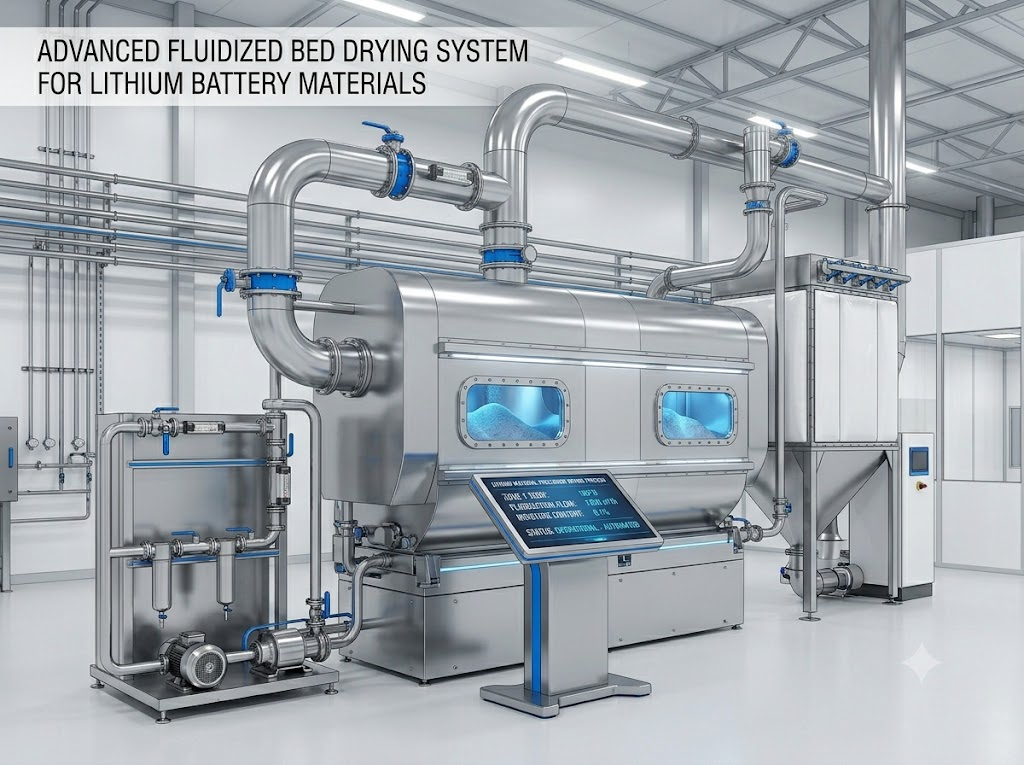
A clean, professional B2B industrial engineering 3D render of an advanced industrial fluidized bed dryer system inside a state-of-the-art lithium battery material manufacturing facility, 4:3 aspect ratio. The image showcases a massive, meticulously engineered stainless steel drying unit with high-tech matte and polished surfaces, clean pipeline systems, and a glowing blue-backlit digital control terminal showing automated powder processing data. The surrounding environment is pristine, showcasing bright, professional factory lighting and a high-end corporate blue, silver, and white color palette. Focus on extreme clean room standards, industrial automation, and zero-contamination engineering. No messy details, realistic text, or cluttered floor space. –ar 4:3