Spray Dryer for Ceramic Powder: Alumina and Zirconia Granulation Guide
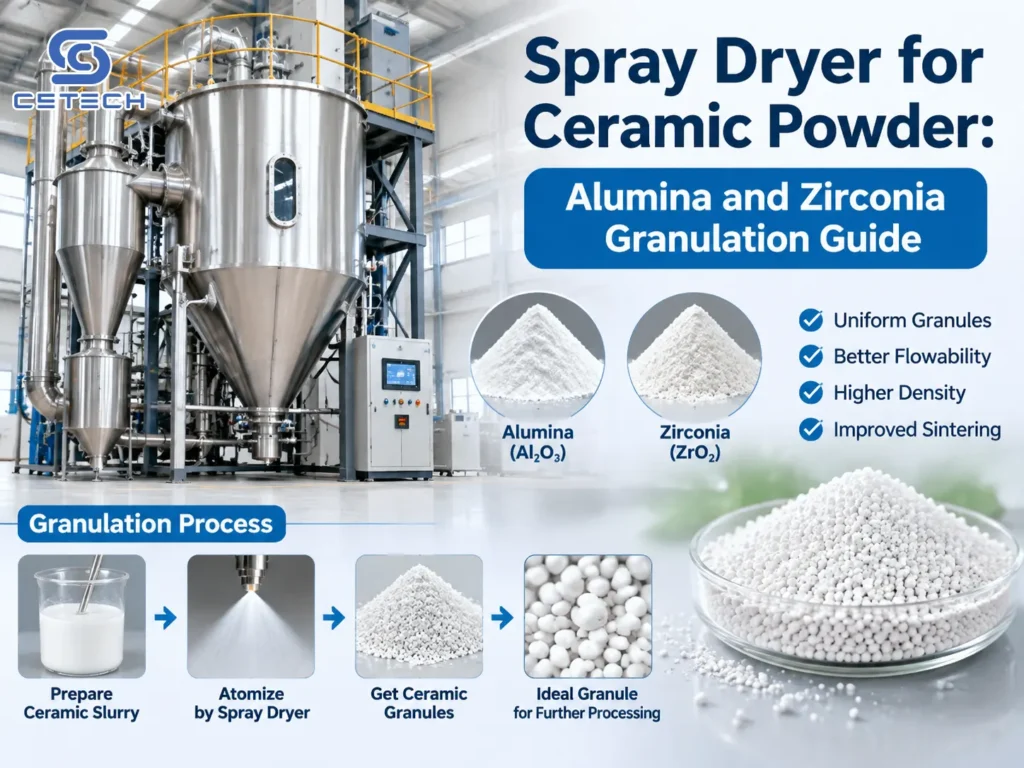
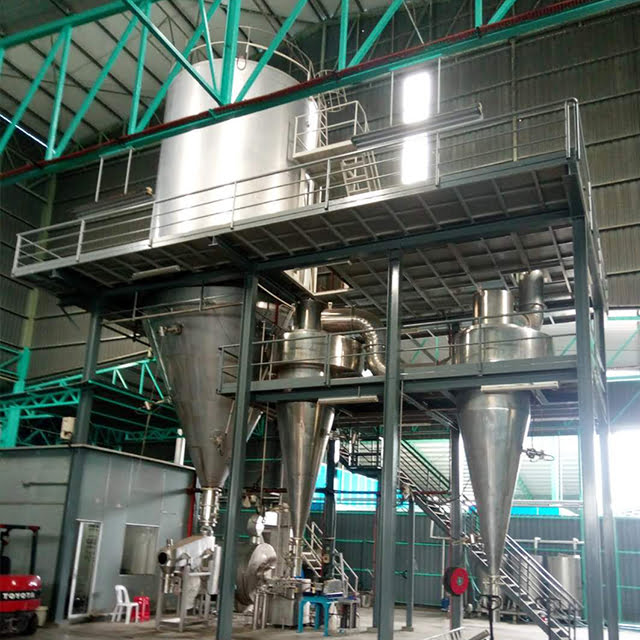
Advanced ceramics — alumina insulators, zirconia dental blocks, ceramic membranes and catalyst substrates — start life as a spray-dried powder. The particle size, spherical shape and flowability of that granulated powder directly determine how uniformly it presses, sinters and finishes. A spray dryer for ceramic powder is therefore not a packaging step; it is a granulation reactor that decides the performance of the final ceramic part.
This guide explains why ceramic engineers use spray drying, what alumina and zirconia slurries require from a dryer, how particle morphology is controlled, and what to ask a supplier before investing in an industrial ceramic spray dryer.
Why Ceramics Use Spray Drying at All
Raw ceramic powders are ultrafine — often below 1 µm — and flow poorly. Dry pressing, isostatic pressing and tape casting all require a granulated feed that:
– Flows evenly into the die cavity
– Has consistent bulk density shot after shot
– Releases from the press cleanly
– Burns out its organic binder without defects
Spray drying converts a water-based ceramic slurry (55–70 % solids, with binders such as PVA) into spherical, free-flowing granules typically 50–200 µm. The spherical granule is the smallest engineered unit of the ceramic part; its uniformity controls pressing density variation, which controls sintering shrinkage, which controls dimensional tolerance.
Alumina vs Zirconia: Slurry Differences
| Property | Alumina (Al₂O₃) | Zirconia (ZrO₂) |
| Typical slurry solids | 60–70 % | 55–65 % |
| Binder system | PVA, often with lubricants | PVA / PEG, controlled for dental grade |
| Abrasiveness | High | Very high |
| Target granule size | 60–150 µm | 50–120 µm |
| Key quality issue | Press wear, dust | Yttria retention, thermal stability |
Alumina slurry is dense and abrasive; zirconia slurry is even denser, so pumps, nozzles and chamber wear parts must be specified accordingly. Dental-grade zirconia adds the requirement that drying temperature never degrades the yttria stabilizer dispersion.
The Ceramic Spray Drying Process
1. Slurry preparation. Powder, water, dispersant and binder are milled together in a ball mill or attritor until viscosity is stable (typically 300–1500 cP at shear).
2. Atomization. The slurry is pumped to a pressure nozzle or rotary atomizer at 2–5 MPa, breaking it into droplets.
3. Drying. Inlet air at 180–250 °C meets the droplets; surface water evaporates, forming a rigid spherical granule.
4. Collection. Granules exit at the cone; fines go to cyclone and filter.
5. Screening and rework. Oversize and undersize fractions are separated; fines are re-slurried rather than discarded.
The desired granule is spherical and slightly hollow, not solid. Hollow or dimpled granules deform more uniformly during pressing and reduce spring-back.
Controlling Granule Morphology
The shape and structure of each granule are set by:
– Slurry viscosity and solids — thicker slurry produces larger, denser granules.
– Atomizer pressure / wheel speed — higher pressure or faster wheel speed produces smaller granules.
– Inlet temperature — too high and the granule surface skin forms instantly, trapping water inside and causing “popcorn” cracks on pressing.
– Chamber conical angle — steep cones reduce wall build-up of sticky binder-rich granules.
For alumina insulators pressed in large volumes, customers typically specify a granule size distribution (D50, D90), flow rate (g/s through a standardized funnel) and pressed-density variation. The dryer supplier should be able to tune all three on a pilot run with the customer’s own slurry.
Wear and Abrasion: The Hidden Cost
Ceramic slurries are among the most abrasive feeds a spray dryer handles. Expect:
– Chromium-carbide or tungsten-carbide nozzles in place of standard steel
– Hard-chrome or polyurethane pump rotors
– Chamber wear liners at the hot-air inlet zone
– Regular nozzle rebuilds, not nozzle replacements
When comparing quotes, the difference between a generic spray dryer and a ceramic-rated dryer is exactly these wear parts and the service schedule around them.
Energy Recovery and Dust Control
Ceramic plants run continuously. Two design choices matter economically:
– Air recirculation with after-burning reduces fuel use but must be managed for binder fumes.
– Bag filtration with conductive bags handles fine ceramic dust; the fines recovered are a significant percentage of output.
Supplier Audit Checklist for a Ceramic Spray Dryer
1. Has the supplier delivered spray dryers running alumina or zirconia slurries, not only food or chemicals?
2. Can they pilot your own slurry sample and return measured granule size distribution, flow rate and pressed density?
3. What is the standard nozzle material, and what is the wear-part replacement cycle?
4. Is the chamber lined against abrasion, and where are the expected wear zones?
5. How are fines recovered and reintroduced?
6. What is the guaranteed evaporation rate at your slurry solids and inlet/outlet temperatures?
7. Do they supply slurry preparation (mill, de-airing pump) alongside the dryer?
8. What documentation is provided for process repeatability (batch records, parameter logging)?
FAQ
Q: What granule size do I need for dry pressing alumina substrates?
A: Most electronic alumina substrates press from a D50 around 80–120 µm, with fines below 20 µm minimized to reduce dust and die wear.
Q: Why do my pressed ceramic parts crack after sintering?
A: Cracks often trace back to over-dried or overheated granules with a hard surface skin that does not deform uniformly during pressing. Review inlet temperature and binder system first.
Q: Can one dryer switch between alumina and zirconia?
A: Yes, with thorough cleaning between campaigns and hardened wear parts. Cross-contamination risk is why many plants dedicate lines to one chemistry.
Q: Is a rotary atomizer or pressure nozzle better for ceramic slurry?
A: Rotary wheels handle high throughputs and abrasive feeds well; pressure nozzles give narrower size distributions for precision ceramics. Choose based on your target granule size tolerance.
Contact Us
Send us your slurry solids %, target granule size, and required pressed output kg/h, and we will return an evaporation-rated proposal with wear-part specifications and a pilot-run option. Our engineering team supports alumina, zirconia, silicon carbide and other advanced ceramic granulation projects. Reach us through the contact page or WhatsApp.