5 Essential Powder Mixing Uniformity Tests for Industrial Buyers
5 Essential Powder Mixing Uniformity Tests for Industrial Buyers
If your laboratory sample passes but customers still report inconsistent product, the problem may be sampling, segregation, or transfer after mixing. In our 20 years of powder-equipment manufacturing, we treat powder mixing uniformity as a complete process result rather than a mixer-speed claim. This guide gives procurement and QA teams a practical test plan.
What should be defined before testing powder mixing uniformity?
Define the critical ingredient, target concentration, acceptable variation, batch size, sampling locations, and the method used to assay each sample. Particle size, bulk density, moisture, and electrostatic behavior can change how a powder moves inside the mixer and after discharge.
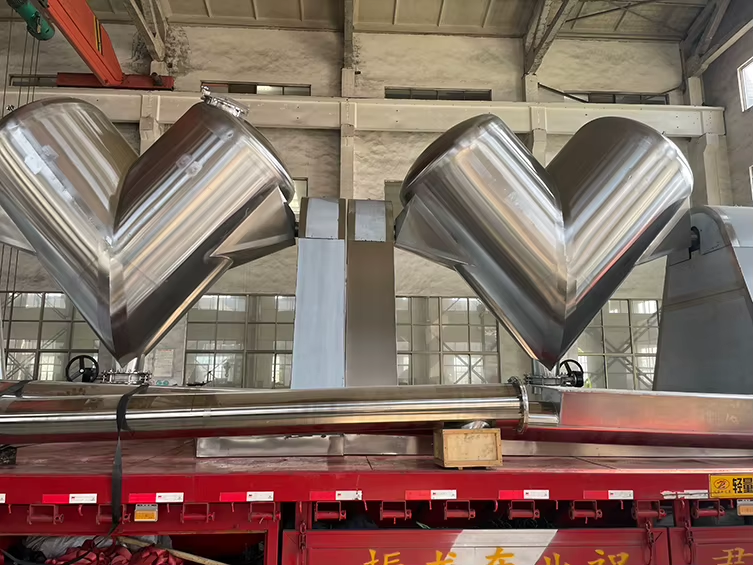
When we work with food, pharmaceutical, chemical, or additive manufacturers, we also ask where the product can segregate. A V Mixer, Square Cone Mixer, or Double Conical Mixer should be tested with the real material or a validated representative, not an unrelated free-flowing powder.
Which sampling method gives a trustworthy uniformity result?
A single sample from the mixer outlet cannot represent the full batch. Use a defined grid or time sequence that covers the beginning, middle, and end of discharge, then compare individual results with the acceptance range rather than relying only on an average.
The sample quantity must be large enough for the assay but small enough to show local variation. Ask the supplier to document the sampling tool, sample mass, laboratory method, and the number of replicates before signing a purchase order.

How do particle properties affect powder mixing uniformity?
Large differences in particle size or density can produce percolation and segregation even when the mixer initially reaches a uniform state. Moisture can change flowability, while cohesive fines may attach to larger carrier particles or remain in dead zones.
Our material precision test identifies these risks before equipment sizing. The resulting technical scheme can address fill level, mixing cycle, discharge geometry, dust control, and the need for gentle handling after the blend is complete.
How can a buyer distinguish mixing failure from post-discharge segregation?
Compare samples taken inside the mixer or immediately at discharge with samples collected after conveying, filling, or storage. If uniformity is acceptable at the outlet but drifts later, the corrective action belongs in the transfer and packaging layout rather than in longer mixing time.
Record bulk density, vibration exposure, drop height, conveying velocity, and bin geometry during the investigation. JSCSTECH uses a full life-cycle view so the selected equipment solves the quality problem without adding avoidable labor or energy cost.
Powder Mixing Uniformity: Practical Test Matrix
| Test area | What to measure | What it tells the buyer |
|---|---|---|
| Material | Particle size, density, moisture, flowability | Segregation and cohesive-flow risk |
| Mixer | Fill level, cycle time, sample grid | Uniformity during mixing |
| Discharge | Start/middle/end samples | Outlet consistency |
| Transfer | Conveying, drop height, storage | Post-mix segregation risk |
Supplier Audit Checklist: 5 Documents to Request Before Signing a Purchase Order
- Material characterization report for the actual powder.
- Uniformity test protocol with sampling locations and acceptance limits.
- Cycle-time and fill-level calculation for the selected mixer.
- Cleaning, inspection, and changeover procedure.
- Pre-shipment inspection report sample and commissioning support plan.
Frequently Asked Questions
Q: How do you test powder mixing uniformity? Take samples from defined locations and compare ingredient concentration with the agreed acceptance range. JSCSTECH reviews powder properties and sampling design before selecting a mixer.
Q: Why can a mixer pass one test and fail production? Segregation may occur after discharge during conveying, filling, or storage. Verify both mixer uniformity and post-mix handling.
Q: What data should a buyer request from a mixer supplier? Request material-test results, sampling protocol, uniformity data, cycle-time basis, cleaning method, and pre-shipment inspection plan.
Review our custom powder mixing equipment and the batch versus continuous mixing guide before finalizing your QA plan. Then send your target variation, sampling method, and production schedule so our team can recommend a practical validation sequence.
For a material-based recommendation, contact Leta through WhatsApp. Share your recipe, batch size, and uniformity target so our engineers can prepare a technical scheme.
For background on powder characterization research, review the Powder Technology journal and compare its terminology with your internal QA method. The external reference should support your test design, while the supplier must still validate your actual recipe and equipment configuration.