Spray Dryer for Whey Protein Powder: 7 Factors That Decide Powder Quality
Spray Dryer for Whey Protein Powder: 7 Factors That Decide Powder Quality
If you’ve ever shipped a batch of whey protein concentrate only to see it arrive as a caked, off-flavor powder, you know the cost of an under-specified **spray dryer for whey protein powder**. The dryer is not an accessory to your line; it decides solubility, denaturation, particle size and rework rate. Here is how we engineer our systems to protect all four.
Why Whey Protein Is Harder to Dry Than Most Food Powders
Whey protein concentrate and isolate are heat-sensitive, hygroscopic and expensive per kilo. When the feed leaves the atomizer, each droplet carries protein that can denature above roughly 70°C in the wet state, and powder that can re-wet and stick if outlet conditions are wrong.
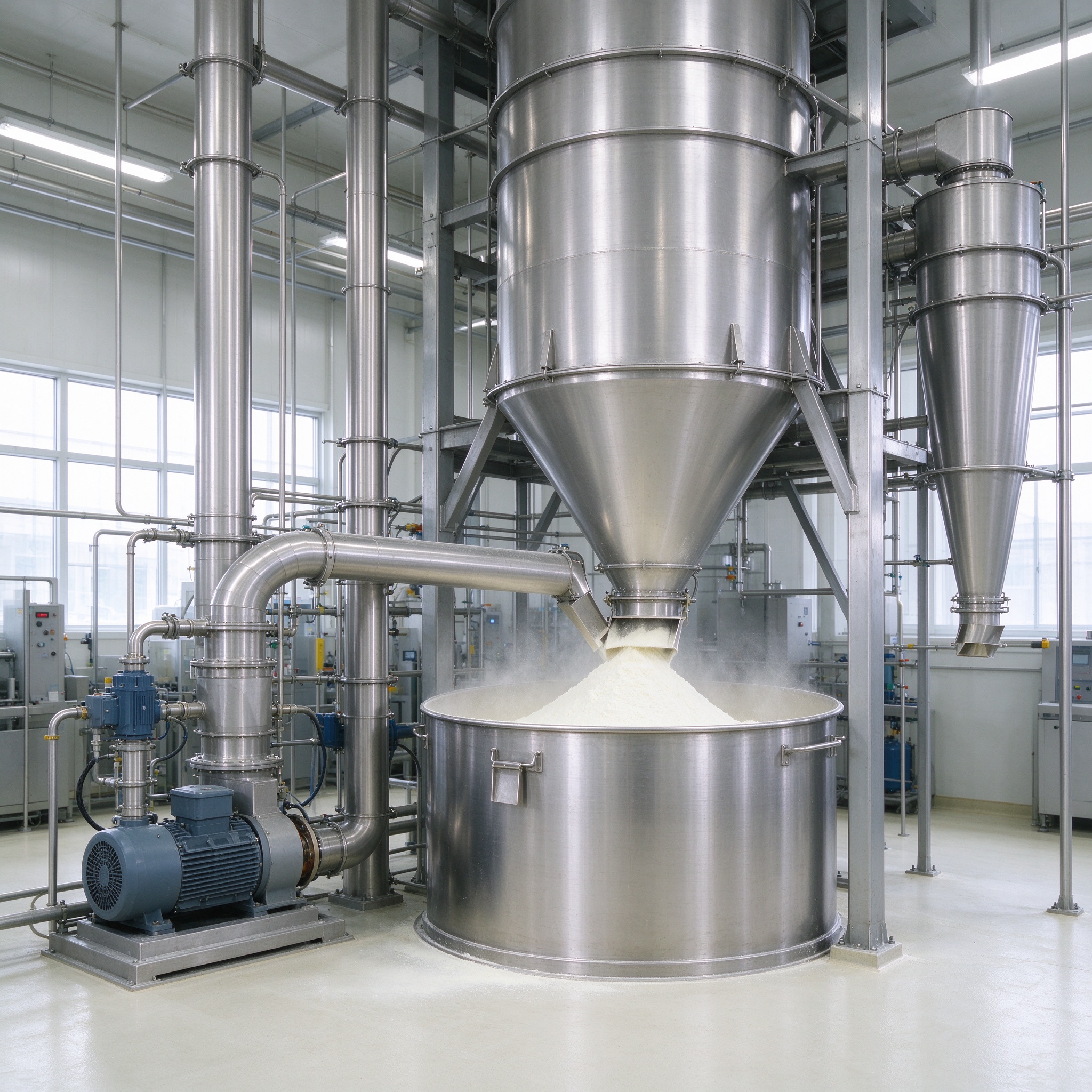
The failure modes are specific. Insufficient inlet temperature leaves wet, heavy particles. Excessive outlet temperature scorches the protein and drops solubility index. Poor cyclone or baghouse design pushes fines out the exhaust, which in whey drying is not dust; it is revenue.
That is why a generic dairy dryer is rarely a safe answer. The engineering has to start from the protein itself: solids content of the feed, sensibilidad al calor, target bulk density and the solubility specification your buyer will test. Nuestro guide to spray dryers for food walks through how dairy and protein powders behave differently in the drying tower.
Inlet and Outlet Temperature: The Two Numbers That Control Protein Damage
Feed concentration for whey typically sits between 40% y 50% total solids before spray drying, and the inlet temperature usually runs from 160°C to 180°C, with outlet temperature held around 75°C to 85°C for concentrate. Those are typical process figures, not universal; the safe window depends on your specific protein source and target spec.
What matters is control, not just set points. A stable outlet temperature means stable moisture. When we quote a whey line, we check whether the control loop can hold outlet temperature within a narrow band across feed fluctuations, because that band is what protects solubility.
Ask any supplier for their test data on your own feed. Free material testing is standard practice in our shop, and it should be in every serious quotation you receive.
Atomizer Selection: Centrifugal vs Pressure Nozzle
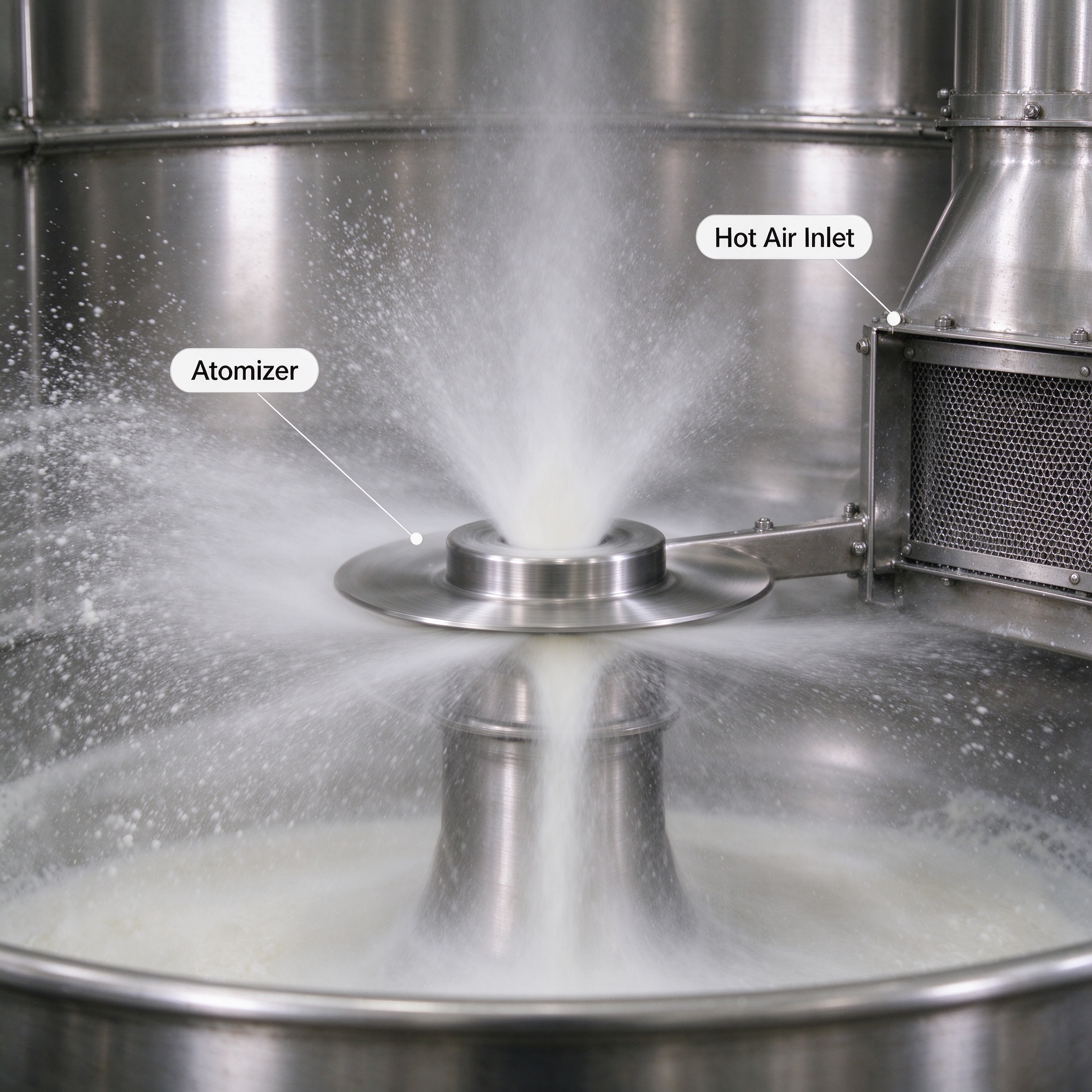
The atomizer decides particle size distribution, which decides bulk density, reconstitution and dustiness. Get this choice wrong, and every downstream spec drifts with it.
For whey protein, centrífugo (giratorio) atomizers are the common choice at industrial scale because they handle variable feed rates and produce a consistent powder. Pressure nozzle systems can produce coarser particles and higher bulk density, useful when your customer wants a denser powder for specific applications, but they are more sensitive to feed viscosity changes.
In our experience, the selection comes down to the product spec sheet, not a preference. If solubility index and dispersibility are the buying criteria, centrifugal atomization with controlled peripheral speed gives the most repeatable result. Nuestro comparison of centrifugal vs pressure spray dryers details how atomizer choice changes food powder characteristics.
The Drying Chamber and Powder Collection System
A whey drying chamber must be sized for complete drying within the residence time, and the collection system must capture fines without letting protein accumulate in dead zones. Both decisions feed into the overall yield and consistency you can promise your buyers.
Cyclone efficiency matters more than most buyers assume. A cyclone that runs below design efficiency sends fine protein powder out the stack, which shows up immediately in yield accounting. Baghouse or additional fines recovery can push collection toward the high end, but adds pressure drop and cleaning complexity.
When we build for food-grade whey, the contact surfaces are SUS304 with welded construction, polished to a finish that prevents product hold-up, and the system is designed so operators can verify clean-in-place coverage without opening every duct. That cleanability is what your audit team will check first.
Handling Hygroscopic Powder: Sticking and Re-Wetting
Whey powder is hygroscopic; it will absorb moisture from warm, humid air and form lumps in the bag or in the conveying line. This is why outlet temperature control and downstream cooling matter as much as the drying itself.
Options that matter on a real production line include secondary fluid bed drying or cooling after the main chamber, and dry air conveying into the packing area. These are not upgrades to debate later; they protect the moisture spec your customer tests on arrival.
Cleaning Between Batches and Changeover
Food-grade whey lines run multiple grades, sometimes multiple protein sources, on the same dryer. Changeover time is downtime, and incomplete cleaning is a cross-contamination risk.
CIP design should cover the chamber, cyclone, ducts and baghouse with spray coverage that reaches every surface. In our installations we provide CIP connections sized for the actual pipework and a documented sequence, so your QA team can validate cleaning rather than assume it.
Energy Use and Operating Cost
Spray drying is energy-intensive, and whey powder is produced in volume, so kWh per tonne of powder is a direct line on your P&l. Heat recovery from the exhaust, insulated chambers and optimized air flow all reduce that number.
We publish the energy comparison from our test runs on your material before you commit. In our practice, an optimized thermal cycle on a whey line typically pays for the efficiency upgrade within the first two years of continuous operation; your figures depend on feed solids, capacity and local energy prices.
Capacity Sizing: Matching the Dryer to Your Production Plan
Capacity is quoted in water evaporation per hour, not in powder output, and that is where buyers misread quotations. A dryer that evaporates 500 kg of water per hour will produce different powder tonnage depending on your feed solids, because powder output equals the dry solids in the feed minus losses.
En 45% sólidos de alimentación, roughly 55% of every kilo of feed is water to remove. Raise feed concentration to 50%, and the same evaporative capacity produces more powder per hour while consuming less heat per kilo. That is why we always ask for your feed concentration and target moisture before sizing, and why feed pre-concentration with a falling film evaporator is often the most economical upgrade before the dryer itself.
When we size a whey line, we work backwards from your annual tonnage: operating days, shift hours, planned cleaning windows and the moisture spec of the packed product. The result is a dryer sized for your real production plan, not for a best-case brochure figure.
Food Safety Compliance and Documentation
Food-grade whey powder buyers increasingly ask for evidence, not adjectives. That includes contact material certificates, documented cleaning procedures and, for export markets, compliance with the food contact and hygiene requirements that apply in the destination country.
We build our food-grade spray dryers with SUS304 contact surfaces as standard, welded rather than bolted where product can hold up, and we supply the material certificates your QA team needs for their supplier file. For stricter requirements, 316L contact parts and documented surface finish are available options, quoted transparently rather than discovered later.
Ask the supplier whether their standard machine matches the hygiene level your customer requires. If the answer is vague, request the material certificates and surface finish spec in writing before you sign.
Why Working with a Manufacturer That Tests Your Feed Changes the Outcome
The difference between a whey dryer that works on paper and one that works on your floor is the test data. We run your material through our pilot and laboratory dryers, confirm moisture, solubility and yield, then scale the parameters to production capacity.
That process removes the guesswork from inlet temperature, atomizer speed, chamber size and collection configuration. It also gives your team a documented basis for the IQ/OQ/PQ that food customers increasingly request.
Lista de verificación de auditoría de proveedores: 5 Documentos a solicitar antes de firmar una orden de compra
Before you commit to any spray dryer for whey protein powder, request these five documents. Each one verifies a specific engineering claim, not a marketing promise:
- 1. Material test report on your feed, showing inlet/outlet temperature, moisture and solubility results.
- 2. Dimensioned GA drawing with material grades (SUS304 vs 316L) and weld specification.
- 3. Cyclone and collection efficiency calculation with expected fines loss at your particle size.
- 4. CIP coverage drawing and cleaning validation protocol.
- 5. Reference list of whey or dairy lines operating in similar capacity, with contact references.
A supplier who cannot produce these is asking you to buy on promises, not on engineering. Walk away before you own the risk.
Preguntas más frecuentes: Spray Dryer for Whey Protein Powder
What is the typical inlet temperature for drying whey protein?
For whey protein concentrate, typical inlet temperatures run from 160°C to 180°C with outlet temperature around 75°C to 85°C, but the safe window depends on your feed solids and target moisture. Confirm the exact range with a material test on your own concentrate, because protein sources differ in heat sensitivity.
Can a standard milk powder dryer handle whey protein?
It can run, but whey protein is more heat-sensitive and more hygroscopic than whole milk powder, so results on solubility and stickiness may be poor. A dryer designed for whey includes tighter outlet temperature control, efficient fines collection and downstream cooling; verify these features before reuse.
Centrifugal or pressure nozzle for whey powder?
Centrifugal atomizers are the usual industrial choice for whey because they tolerate feed variation and give repeatable particle size. Pressure nozzles can raise bulk density when a coarser, denser powder is specified, but they need stable feed viscosity. Choose by your product spec, not by habit.
How do I prevent whey powder from caking after drying?
Control outlet temperature, cool the powder before packing and convey it in dry air. Secondary fluid bed cooling and dry conveying into the packing area protect the moisture specification during storage and transport.
Why does cyclone efficiency matter so much for whey?
Whey powder is valuable, and fines lost through an under-performing cyclone are direct revenue loss. Confirm the cyclone design efficiency at your particle size distribution and ask for the expected fines loss in writing.
Contáctenos
Need a spray dryer for whey protein powder that is sized on your feed, not on a brochure? Send us your material data and we will run the test and quote the line, with the process parameters documented.
Consulte el BÜCHI spray drying process guide for an independent overview of food and pharmaceutical spray drying fundamentals.