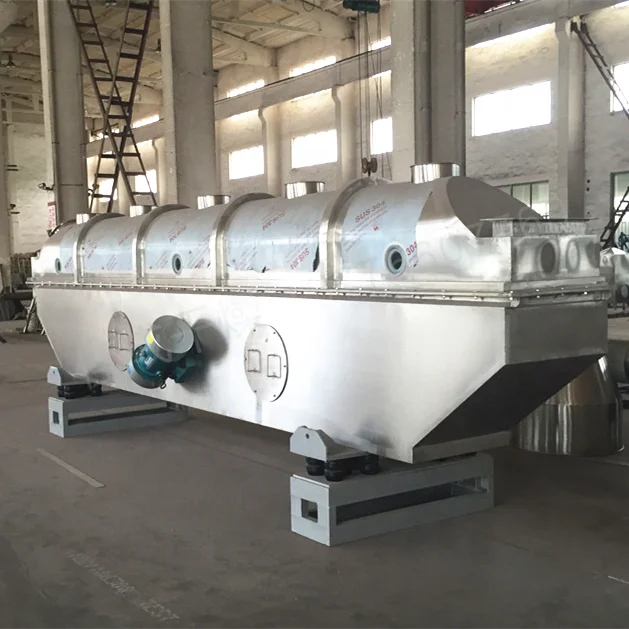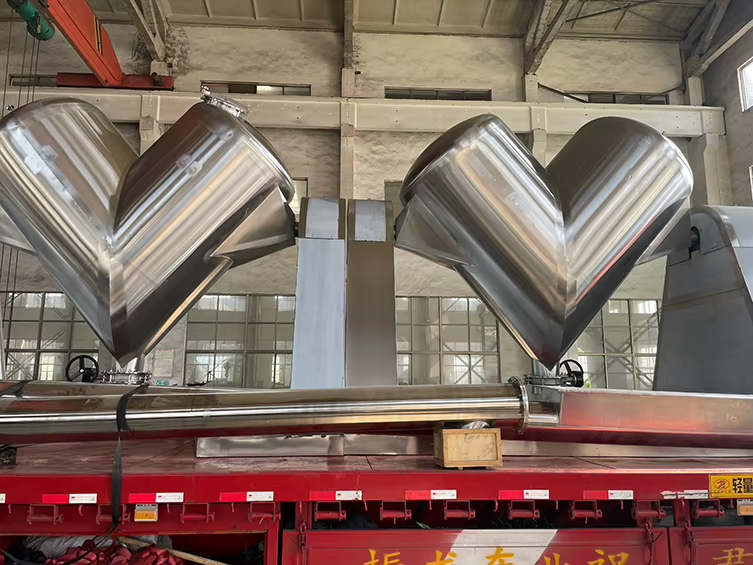
Verstehen des schematischen Diagramms eines Wirbelschichttrockners
Mit einem Wirbelschichttrockner entziehen Sie Pulvern und Granulaten Wasser. Heiße Luft strömt durch die Pulver und Granulate. Dies hilft Ihnen in vielen Branchen, sie gleichmäßig zu trocknen. Jiangsu Changshi Technology stellt fortschrittliche Trocknungsmaschinen her. Der Schwerpunkt liegt auf Wirbelschichttrocknern. Wenn Sie das schematische Diagramm des Wirbelschichttrockners kennen, können Sie die Maschine sicher verwenden. Es hilft Ihnen auch, Probleme schnell zu beheben. Die folgende Tabelle zeigt, wie Sie verwenden einen Wirbelschichttrockner für unterschiedliche Aufgaben in jeder Branche.
Industrie | Hauptfunktionen |
|---|---|
Pharmazeutisch | Trocknen pharmazeutischer Wirkstoffe, Granulationstrocknung, Tablettentrocknung |
Chemisch | Trocknen chemischer Pulver, Polymertrocknung, Chemische Reaktionstrocknung |
Lebensmittelverarbeitung | Trocknen von Getreide und Getreide, Kaffeebohnen trocknen, Trocknen von Obst und Gemüse |
Mineralisches Aggregat | Trocknen von Mineralien und Erzen, Desagglomeration |
Biomasse | Trocknen von Biomasse für eine bessere Verbrennung |
Recycling | Trocknen und Behandeln von Abfällen zur Herstellung neuer Produkte oder Kraftstoffe |
Wichtige Erkenntnisse
Fluid bed dryers use hot air to dry powders and granules. This helps them dry evenly. They are important in places like medicine and food factories.
Knowing the fluid bed dryer schematic diagram helps you find parts fast. It also helps you fix problems quickly. This keeps the dryer safe and working well.
The main parts are the air supply, Heizung, and dust separation. These parts work together to keep the product good while drying.
You can change the air temperature and flow. This helps you make drying faster or slower. It lets you control how things dry and how good they turn out.
Fluid bed dryers can be used for many things. Sie save energy and work with different materials. They are good for things that need gentle heat.
What Is a Fluid Bed Dryer?
Definition and Principle
A fluid bed dryer is a machine that dries things like powder and granules. You put the wet material in a chamber with small holes at the bottom. When you start the machine, hot air blows up through the holes. The air lifts the particles and makes them float around. The particles move like a liquid. This is called fluidization.
Here is how fluidization happens in a fluid bed dryer:
The air makes the solid particles float and move like a fluid.
The hot air gives heat to the particles, so water turns into vapor.
You can change the Trocknungszeit by setting the air and heat.
The moving air stops the particles from sticking together, so they dry evenly.
The air takes the water vapor away, and it leaves as wet exhaust.
The air touches every particle, so drying is fast and even. This way works better than many other drying ways. Mit dem Wirbelschichttrockner können Sie die Trocknung steuern, damit Sie die gewünschten Ergebnisse erzielen.
Schlüsselfunktionen
Sie verwenden einen Wirbelschichttrockner, um den Wassergehalt in Pulvern und Granulaten zu senken. Dies trägt dazu bei, dass Ihre Produkte sicher und von guter Qualität bleiben. Die Maschine wird in vielen Bereichen eingesetzt, wie Medizin und Essen. Jiangsu Changshi Technology stellt für diese Aufgaben spezielle Wirbelschichttrockner her.
Anwendung | Beschreibung |
|---|---|
Trocknung pharmazeutischer Wirkstoffe (APIs) | Sie trocknen sie gleichmäßig, So bleiben sie stark und von guter Qualität. |
Granulationstrocknung | Sie verwenden es nach der Herstellung von Nassgranulat, um die richtige Größe und Trockenheit zu erreichen. |
Tablettentrocknung | Sie entnehmen den Tabletten Wasser, ohne sie zu zerbrechen. |
Trocknen von Getreide und Getreide | Sie sorgen dafür, dass sie länger haltbar sind und verhindern, dass sie verderben. |
Kaffeebohnen trocknen | Durch sanftes und gleichmäßiges Trocknen bleiben Geschmack und Geruch erhalten. |
Trocknen von Obst und Gemüse | Sie verlängern die Haltbarkeit, indem Sie vor dem Verpacken das Wasser herausnehmen. |
Jiangsu Changshi Technology kann Trockner herstellen, die Ihren Anforderungen entsprechen. Sie können sich auf eine gute und gleichmäßige Trocknung verlassen.
Schematische Darstellung eines Wirbelschichttrockners
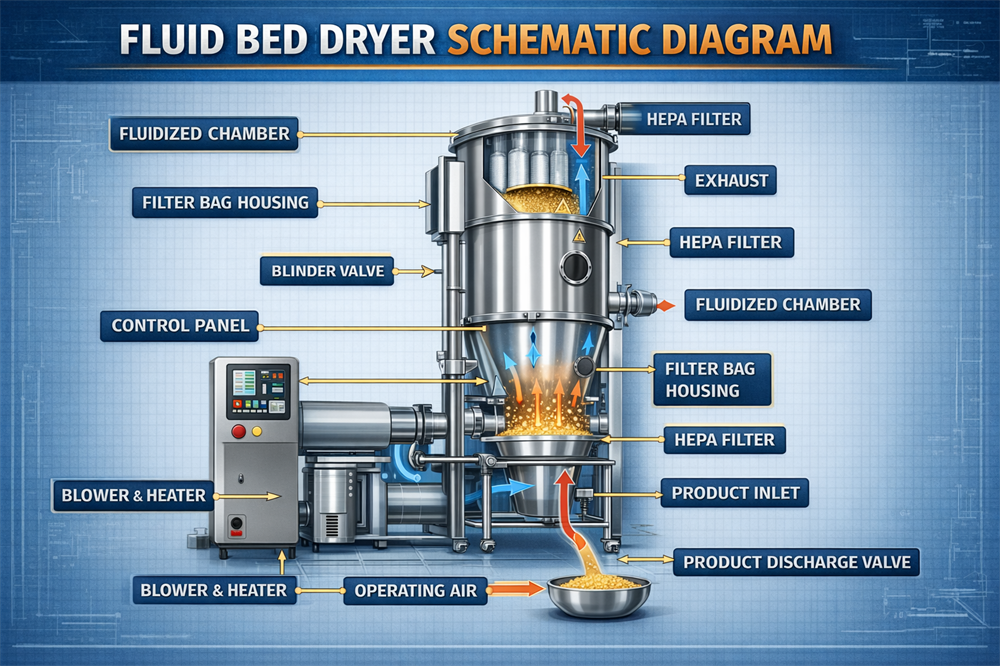
Wenn man sich das anschaut fluid bed dryer schematisches Diagramm, Sie können sehen, wie die Maschine funktioniert. Mithilfe des Diagramms erfahren Sie, wie sich Luft bewegt und wie sich Materialien im Inneren bewegen. Es zeigt auch, wie jedes Teil mit einem anderen Teil verbunden ist. Wenn Sie das Diagramm studieren, Sie können Probleme schnell finden. Auch bei der Nutzung oder Reparatur der Maschine können Sie gute Entscheidungen treffen. Das Diagramm zeigt, wohin Luft und Material gelangen, So wissen Sie, wo Sie suchen müssen, wenn etwas nicht stimmt.
Hauptkomponenten
Das schematische Diagramm eines Wirbelschichttrockners besteht aus vielen Teilen. Jedes Teil hat eine wichtige Funktion für die Funktion des Trockners. Hier sind die Hauptteile, die Sie sehen werden:
Luftzufuhr: Bringt neue Luft herein.
Heizung: Erwärmt die Luft, bevor sie eindringt.
Luftverteilerplatte: Verteilt die Luft unter dem Material.
Futterversorgung: Füllt nasses Pulver oder Granulat in die Kammer.
Staubabscheidung: Verhindert, dass Staub austritt.
Sammel- und Kontrollpanel: Ermöglicht Ihnen, die Funktionsweise des Trockners zu beobachten und zu ändern.
Sprühverteiler (optional): Für spezielle Trocknungsaufgaben Flüssigkeit hinzufügen.
Luftentfeuchter (optional): Entfernen Sie zusätzliches Wasser aus der Luft.
Äußere und innere Unruhe: Verwenden Sie Motoren oder Rührwerke, um die Dinge in Bewegung zu halten.
Abgasauslass: Lässt feuchte Luft aus der Kammer entweichen.
Wirbelschichtprozessor: Hier findet die Trocknung statt.
Kreiselmotoren: Schütteln Sie die Kammer, um eine bessere Durchmischung zu erreichen.
Distanzrahmen: Hält die Teile an Ort und Stelle.
Expansionskammer: Bietet mehr Raum für die Bewegung von Luft und Material.
Materialauslaufstutzen: Schickt trockenes Material aus dem Trockner.
Gebläse oder Zuluftventilator: Schiebt Luft durch den Trockner.
Feuchtigkeitscreme zum Heizen/Kühlen: Verändert die Wärme und Feuchtigkeit der Luft.
Lufteinlass: Wo Luft reinkommt.
Zyklonabscheider: Entfernt feine Partikel aus dem Abgas.
Vibrations- oder Schneckenförderer: Fördert trockenes Material.
Steuerungssystem: Hier können Sie die Funktionsweise des Trockners einstellen und ändern.
Tipp: Wenn Sie sich das schematische Diagramm des Wirbelschichttrockners ansehen, Achten Sie besonders auf das Luftverteilungssystem. Die Luftverteilerplatte verteilt die Luft so, dass jedes Partikel trocken wird. Einige Platten sorgen dafür, dass die Luft verwirbelt wird, Das spart Energie und trocknet schneller.
So lesen Sie das Diagramm
So lesen Sie das Diagramm eines Wirbelschichttrockners, Folgen Sie dem Weg von Luft und Material. Beginnen Sie am Lufteinlass. Luft strömt durch die Heizung und dann in die Kammer unter der Verteilerplatte. Die Platte verteilt die Luft, sodass das Material schwimmt und trocknet. Feuchte Luft entweicht durch den Abluftauslass. You can see where dust separation and cyclone separators keep the air clean. The control panel lets you change the heat and air flow.
You will also see that batch and continuous fluid bed dryer diagrams look different. Batch models dry one load at a time. Continuous models keep material moving and drying all the time. The table below shows how these two types are different:
Besonderheit | Batch-Wirbelschichttrockner | Kontinuierlicher Wirbelschichttrockner |
|---|---|---|
Operation | Dries material in batches | Dries material all the time |
Design | Uses a disc with holes for air | Uses heated air through a plate |
Materielle Bewegung | Loads, trocknet, and empties in batches | Moves from one chamber to the next |
Discharge Mechanism | Uses a stream or hopper to empty | Lets material out all the time |
Heat Transfer Systems | Changes by design | Can use different heat units |
Wenn Sie sich das schematische Diagramm des Wirbelschichttrockners ansehen, you see how all the parts work together. You can follow the arrows and lines to learn how drying happens. You use the diagram to check the main parts and make sure the dryer works right. If you want to know more, you can ask Jiangsu Changshi Technology for special diagrams that fit what you need.
Fluid Bed Dryer Operation
Drying Process Steps
You can understand how a fluid bed dryer works by following each step in the drying process. The machine uses hot air to dry materials like powder. Here is a simple way to see the main steps:
Loading: You place the material to be dried into the chamber. This can be powder or granules.
Air Flow: Hot air enters through a perforated plate at the bottom. The air lifts the particles and creates a fluidized bed. You see the answer to how does a fluid bed dryer work in this step.
Trocknen: Die heiße Luft berührt jedes Partikel. Feuchtigkeit verdunstet und verlässt das Material. Dieser Schritt ist wichtig, um Pulver schnell und gleichmäßig zu trocknen.
Auspuff: Feuchte Luft verlässt die Kammer durch Filter oder einen Zyklonabscheider. Das System hält die Luft sauber und entfernt Wasserdampf.
Entladen: Sie nehmen das getrocknete Produkt aus dem Trockner. Das Material ist nun bereit für den nächsten Schritt in Ihrem Prozess.
Tipp: Wenn Sie die besten Ergebnisse erzielen möchten, Stellen Sie sicher, dass Sie die richtige Materialmenge laden und die richtige Lufttemperatur einstellen.
Referenzpunkte im Diagramm
Wenn Sie sich das schematische Diagramm ansehen, Sie finden mehrere Kontrollpunkte, die Ihnen helfen, den Wirbelschichttrockner sicher und effizient zu betreiben. Diese Punkte zeigen Ihnen, wie ein Wirbelschichttrockner funktioniert und wo Sie den Prozess überprüfen oder anpassen können.
Einlasslufttemperatur: You set and monitor the temperature of the air entering the dryer.
Out-Air Temperature: You check the temperature of the air leaving the chamber.
Product Temperature: You watch the temperature of the material inside the dryer.
Fan Motor Speed: You control how fast the fan moves air through the system.
Loss On Drying (LOD): You measure how much moisture leaves the material.
These reference points help you keep the drying process stable. You can use the diagram to find each point and make changes if needed. The fluid bed dryer gives you control over every step, so you get high-quality dried products every time.
Advantages and Applications
Benefits of Fluid Bed Dryers
Wirbelschichttrockner give you many benefits in production. The machine dries every particle at the same speed. This helps your product quality stay high. Der Trockner hält die Temperatur konstant und verhindert eine Überhitzung. Der Vorgang ist schnell, So sparen Sie Zeit und Energie. Sie können es für viele Pulver und Granulate verwenden. Es funktioniert auch bei hitzeempfindlichen Materialien gut.
Hier ist eine Tabelle, die das zeigt Hauptvorteile von Wirbelschichttrocknern im Vergleich zu älteren Trocknungsmaschinen:
Vorteil | Beschreibung |
|---|---|
Effiziente Trocknung | Die Wärme verteilt sich gleichmäßig und entfernt Feuchtigkeit von allen Partikeln. |
Schneller Prozess | Es trocknet Dinge schneller als ältere Maschinen. |
Vielseitigkeit | Sie können viele Materialien trocknen, auch diejenigen, die sanfte Wärme benötigen. |
Energieeffizient | Es verbraucht weniger Energie, weil die Wärme gut transportiert wird. |
Skalierbarkeit | Sie können kleine oder große Trockner für Labore oder Fabriken erwerben. |
The air touches every particle, Daher funktionieren Wärme- und Stoffübertragung gut. So trocknen Sie Ihre Sachen schnell und behalten ihre gute Qualität. In der Medizin, Sie kontrollieren die Trocknungsschritte genau, um strenge Regeln einzuhalten. Im Essen, Sie bewahren Geschmack und Sicherheit und sorgen gleichzeitig dafür, dass die Produkte länger halten.
Tipp: Jiangsu Changshi Technology kann spezielle Trockner für Sie herstellen. Ihr Team hilft Ihnen bei der Auswahl des richtigen Trockners und prüft bei jedem Schritt die Qualität.
Typische Anwendungen in der Industrie
Wirbelschichttrockner werden in vielen Branchen eingesetzt. Mehr als die Hälfte der Medizinunternehmen Verwenden Sie diese Trockner zum Trocknen und Granulieren. Lebensmittelfabriken nutzen sie zum Trocknen von Früchten, Gemüse, Körner, und Kräuter. Chemiefabriken nutzen sie zum Trocknen von Verbindungen und Farben. Man sieht sie auch bei der Waschmittelherstellung, Bergbau, und Landwirtschaft zum Trocknen von Samen und Kaffeebohnen.
Hier sind einige gängige Einsatzmöglichkeiten von Wirbelschichttrocknern:
Arzneimittel: Trockene Pulver, Granulat, und Tabletten mit sorgfältiger Kontrolle.
Lebensmittelverarbeitung: Trockenfrüchte, Gemüse, Körner, und Kräuter und bewahren Sie sie gut auf.
Chemikalien: Trockene chemische Verbindungen und Farben.
Reinigungsmittel: Trockenwaschpulver und Reinigungsmittel.
Mineralien: Trockene Mineralerze und Zuschlagstoffe.
Landwirtschaft: Trockene Samen, Körner, und Kaffeebohnen.
Jiangsu Changshi Technology makes advanced dryers for many jobs. Their custom designs and quality checks help you get great results for your products.
When you know how to read the fluid bed dryer schematic diagram, you get many benefits.
You can see how air and water move during drying.
You learn how air temperature and Adiabatic Saturation Ratio help remove water.
You make the process better by picking the right dryer and getting your material ready.
If you pick new machines from Jiangsu Changshi Technology, you can work faster and save time. For the best results, ask experts for help with custom drying.
Faktor | Erläuterung |
|---|---|
Material properties | You pick the best dryer by knowing Partikelgröße and water amount. |
Kapazität | You choose drying speed to fit your production. |
Energieeffizienz | You save money by using heat and air in a smart way. |
Integration | Sie stellen sicher, dass Ihr Trockner mit Ihren anderen Maschinen funktioniert. |
Spezifische Herausforderungen | Sie erhalten spezielle Beratung für Ihre eigenen Prozessprobleme. |
FAQ
Welche Materialien können Sie in einem Wirbelschichttrockner trocknen??
Du kannst trockene Pulver, Granulat, Körner, Samen, und sogar einige kleine Kristalle. Diese Maschine eignet sich gut für Lebensmittel, Medizin, Chemikalien, und Mineralien.
Wie reinigt man einen Wirbelschichttrockner??
Sie sollten die Maschine ausschalten und abkühlen lassen. Materialreste entfernen. Verwenden Sie eine weiche Bürste oder einen Staubsauger. Oberflächen mit einem feuchten Tuch abwischen. Befolgen Sie immer die Sicherheitsregeln.
Warum spielt die Lufttemperatur beim Trocknen eine Rolle??
Die Lufttemperatur steuert, wie schnell Wasser Ihr Material verlässt. Wenn Sie es zu hoch einstellen, Sie könnten Ihr Produkt beschädigen. Wenn es zu niedrig ist, Das Trocknen dauert länger.
Kann man die Trocknungszeit anpassen??
Ja, Sie können die Trocknungszeit ändern. Dies erreichen Sie durch die Einstellung der Luftgeschwindigkeit, Temperatur, und wie viel Material Sie laden. The control panel helps you make these changes.
What safety steps should you follow?
Always check that all parts work before you start. Wear safety gear. Never open the chamber while the machine runs. Follow the instructions from your manufacturer.